

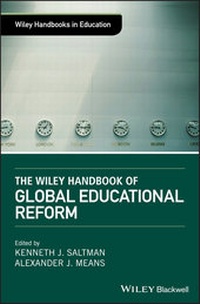
The Wiley Handbook of Global Educational Reform
Description

The Handbook probes the history, ideology, organization, and institutional foundations of global educational reform movements; actors, institutions, and agendas; and local, national, and global education reform trends. It further examines the "new managerialism" in global educational reform, including the standardization of national systems of educational governance, curriculum, teaching, and learning through the rise of new systems of privatization, accountability, audit, big-data, learning analytics, biometrics, and new technology-driven adaptive learning models. Finally, it takes on the subjective and intersubjective experiential dimensions of the new educational reforms and alternative paths for educational reform tied to the ethical imperative to reimagine education for human flourishing, justice, and equality.
* An authoritative, definitive volume and the first global take on a subject that is grabbing headlines as well as preoccupying policy makers, scholars, and teachers around the world
* Edited by distinguished leaders in the field
* Features contributions from an illustrious list of experts and scholars
The Wiley Handbook of Global Educational Reform will be of great interest to scholars and graduate students of education throughout the world as well as the policy makers who can institute change.
More details
Other editions
Additional editions
Persons
KENNETH J. SALTMAN, PhD, is Professor of Educational Leadership and Policy Studies at the University of Massachusetts Dartmouth. His research examines education, politics, and culture.
ALEXANDER J. MEANS, PhD, is Assistant Professor in the Department of Educational Foundations, University of Hawai'i at Manoa. His research examines educational policy and governance in relation to political economy, urbanization, social inequality, and democracy.
Content
- Intro
- Table of Contents
- Introduction: Toward a Transformational Agenda for Global Education Reform
- Global Education Reform: Trends, Ideology, and Crisis
- A Transformational Agenda for Global Education Reform
- References
- 1 Capitalism and Global Education Reform
- Introduction
- Schools Are Failures and Teachers Are to Blame
- Dominant Discourses
- Who Are the Purveyors?
- What Is Being Sold: Privatization
- What's Wrong with Capitalism?
- What to Do?
- Acknowledgments
- References
- 2 The Business Sector in Global Education Reform: The Case of the Global Business Coalition for Education
- Introduction
- Business Participation in Global Education Reform
- Conceptualizing the Role of Business in Education in Contexts of Humanitarian Crisis
- The Global Business Coalition for Education (GBC-E)
- GBC-E Participation in the Syrian Refugee Crisis
- Conclusion
- References
- 3 Venture Philanthropy and Education Policy-Making: Charity, Profit, and the So-Called "Democratic State"
- Introduction
- From the Rear Guard to the Frontline: A New Role for Philanthropy
- New/Effective/Impact/Strategic/Engaged/Venture Philanthropy
- Change in the Nature of Investments: Both For-Profit and Not-For-Profit
- Back to the Future.
- References
- Annexes
- 4 Nodes, Pipelines, and Policy Mobility: The Assembling of an Education Shadow State in India
- Introduction
- Network Ethnography
- Pipelines, Conduits, and Nodes
- Thought Leadership
- Technology in the Classroom
- Discussion
- References
- 5 Reframing Teachers' Work for Global Competitiveness*: New Global Hierarchies in the Governing of Education
- Introduction
- Methods and Data
- Bringing Teachers into View as Policy Problem and Solution
- The TALIS Program: A Brief Introduction
- The TALIS ensemble
- Tensions and Contradictions in the TALIS Program
- The TALIS Model of Development and its Wider Politics
- References
- 6 School Principals in Neoliberal Times: A Case of Luxury Leadership?
- Introduction
- Luxury Leadership: An Elite Project
- Luxury Leadership: An Elite Practice
- Luxury Leadership: Dynamic and Contextually Located
- Conclusion
- Acknowledgments
- References
- 7 The Expansion of Private Schooling in Latin America: Multiple Manifestations and Trajectories of a Global Education Reform Movement
- Introduction
- Conceptual Framework and Methodology
- Main Results: Different Trajectories toward Education Privatization in Latin America
- Conclusion
- References
- Appendix A Evolution of Enrollment in Private Institutions by Country: Primary and Secondary Education
- Appendix B Primary Studies Included in the Revision
- 8 Global Education Policies and Taken-For-Granted Rationalities: Do the Poor Respond to Policy Incentives in the Same Way?1
- Introduction: The Globalization of Demand-Side Education Policies for Poverty Reduction
- Instrumental Rationality and Theory of Change in Demand-Side Interventions
- What Is the Rationality of the Poor? Three Alternatives to Instrumental Rationality
- Policy Implications
- References
- 9 The Politics of Educational Change in the Middle East and North Africa: Nation-Building, Postcolonial Reconstruction, Destabilized States, Societal Disintegration, and the Dispossessed
- Introduction
- General Educational Trends in the Middle East and North Africa
- Sub-Regional Conditions
- Conclusion
- References
- 10 Profiting from the Poor: The Emergence of Multinational Edu-Businesses in Hyderabad, India1
- Introduction
- Examining the North-South Impact of the Global Education Industry
- The Emergence of the Global Education Industry in India
- Conclusion: For-Profit Education Undermines the Right to Education
- References
- 11 The Bait-and-Switch and Echo Chamber of School Privatization in South Africa
- Introduction
- An Overview of the Size and Shape of School Privatization
- The Echo Chamber
- The Adverse Consequences of Privatization
- Resistance
- References
- 12 The Violence of Compassion: Education Reform, Race, and Neoliberalism's Elite Rationale
- Introduction
- F.A. Hayek and the Defense of Privilege
- Neoliberalism's Racial Fantasies and the Whiteness of Empathy
- Epistemology of Elitism: Social Engineering and the New Educational Philanthropy
- Race, Neoliberal Care, and Global Education Reform
- Conclusion
- References
- 13 Uncommon Knowledge: International Schools as Elite Educational Enclosures
- Introduction
- Global Education Reform: Quality, Competition, and Choice
- International Schools
- Transnationally Recognized Educational Credentials
- Competing Concerns? Commodities and Dispositions
- Tiered Elitism and Mobility in Global Education
- Malaysia in the Global Education Reform Context: Quality, Choice, and Competition
- Educational Enclosures: Discourses of Exclusivity and Privilege
- Conclusion
- References
- 14 Startup Schools, Fast Policies, and Full-Stack Education Companies: Digitizing Education Reform in Silicon Valley
- Introduction
- Situating Silicon Valley
- Fast Startup Networks
- Venture PhilTech
- Algorithmic Progressivism
- Learning Laboratories
- Conclusion
- References
- 15 Who Drives the Drivers?: Technology as the Ideology of Global Educational Reform
- Introduction
- Neoliberal Patterns of Governance
- Governmentality as a Powerful Driver of Neoliberalism
- Identifying Who Is "Acting" in Textual Patterns of Governance in HE Policy
- Who Drives the Drivers? A Post-Hegemonic Cultural Studies Perspective
- Post-Hegemonic Power and Educational Reform
- Conclusion
- References
- 16 Resurgent Behaviorism and the Rise of Neoliberal Schooling
- Introduction
- Neoliberal Education Policy as Applied Behaviorism
- Behaviorism Is Not Dead
- The Philosophical and Political Foundations of Behaviorist Thought
- Parallels Between Neoliberal and Behaviorist Thought
- The Environmental Determinist Logic of the Neoliberal Market
- Neoliberalism, Behaviorism and Control for the End of History
- Neoliberalism and the Skillsification of Education
- The Behaviorist Conception of Skill
- Conclusion
- References
- 17 Educating Mathematizable, Self-Serving, God-Fearing, Self-Made Entrepreneurs
- Introduction
- Official Education Policies and the Conservative, Neocolonial, Neoliberal Intentions Behind Them
- Meaning and Purpose of the Arts, Humanities, and Social Sciences
- Differentiating Public, Private and Charter Schools
- References
- 18 Putting Homo Economicus to the Test: How Neoliberalism Measures the Value of Educational Life
- Neoliberalism, Educational Reform, and the Human Capital Imperative
- Subjects of Interest, Subjects of Value: Homo Economicus and the Global War over Measure
- The Techno-Scientific Production of Educational Life
- Rethinking Educational Questions of Value at the Limits of Neoliberal Measurement
- References
- 19 EcoJust STEM Education Mobilized Through Counter-Hegemonic Globalization
- Introduction
- Alternatives to Neoliberal Stem Education
- Addressing Ecojustice in University-based Science Teacher Education
- Case Studies
- Conclusion
- References
- 20 When the Idea of a Second Grade Education for the Marginalized Becomes the Dominant Discourse: Context, Policy, and Practice of Neoliberal Capitalism
- Introduction
- The Dangers of Affordable Private Schools (APS)
- The Difficult Times: Inequality and the Impossibility of Quality Education for All
- The Logic of Reproduction in Education
- Commodifying Education in a Situation of Inequality
- The Altered Educational Institutions Under Neoliberalism
- Amidst Poverty, How Would One Buy Education?
- Social Justice, Democracy and Neoliberalism
- Conclusion
- References
- 21 Financial Literacy and Entrepreneurship Education: An Ethics for Capital or the Other?
- Introduction
- FLE and EE: Remaking the World and Others
- The FLE and EE Public Pedagogy, Levinas, and Ethics
- An FLE for Capital
- An EE for Capital
- An Ethics Against the Other
- A Financial Literacy and Entrepreneurship for the Other
- References
- 22 The Socially Just School: Transforming Young Lives
- Introduction
- There Were Alternatives, It's Just That We Were Muzzled!
- The Neoliberal School
- Why Neoliberalism Is Destined Not to Work in Schools
- What Do We Mean by the Term Socially Just Education?
- What Is the Socially Just School? Where Is It Coming from? Who Does It Exist for?
- Conclusion
- References
- 23 Beyond Neoliberalism: Educating for a Just Sustainable Future
- Introduction
- The False Premises and Pernicious Outcomes of Neoliberalism: Market Fundamentalism, and the Inability to Think Beyond Individual Preferences and the Short Term
- How Neoliberalism Has Failed the Environment
- Understanding and Responding to Our Current Crises
- Rethinking Education
- Conclusion
- References
- 24 When Schools Become Dead Zones of the Imagination: A Critical Pedagogy Manifesto
- Introduction
- References
- Index
- End User License Agreement
Notes on Contributors
Chris Arthur is a teacher in the Toronto District School Board, Canada. His research interests include philosophy and sociology of education, political economy, ethics, and critical policy analysis. Dr. Arthur's work appears in a number of education journals and his book, Financial Literacy Education: Neoliberalism, the Consumer and the Citizen (2012), is published by Sense Publishers.
Stephen J. Ball is Distinguished Service Professor of Sociology of Education at the University College London, Institute of Education, UK. He was elected Fellow of the British Academy in 2006; and is also Fellow of the Academy of Social Sciences and Society of Educational Studies, and a Laureate of Kappa Delta Phi; he has honorary doctorates from the Universities of Turku (Finland), and Leicester. He is co-founder and Managing Editor of the Journal of Education Policy. His main areas of interest are in sociologically informed education policy analysis and the relationships between education, education policy, and social class. He has written 20 books and had published over 140 journal articles. Recent books: Edu.Net (Routledge, 2017) and Foucault as Educator (Springer, 2017).
Larry Bencze is an Associate Professor in Science Education at the Ontario Institute for Studies in Education, University of Toronto, Canada, where he teaches in the graduate studies program. In addition to his PhD from the Universityof Toronto, 1995 and BEd from Queen's University in 1977 in education, he holds a BSc from Queen's University in 1974 and an MSc Queen's University in 1977 in biology. Prior to his work as a professor, he worked as a teacher of science in elementary and secondary schools and as a science education consultant in Ontario, Canada. His teaching and research emphasize the history, philosophy, and sociology of science and technology, along with student-led research-informed and negotiated socio-political actions to address personal, social, and environmental harms associated with fields of science and technology. He has recently edited (or co-edited) two books about activism and is co-editor of the open-source, non-refereed, journal on activism at: goo.gl/cvO2TA.
Xavier Bonal is Professor of Sociology at the Universitat Autònoma de Barcelona, Spain, and Special Professor of Education and International Development at the University of Amsterdam, the Netherlands. He is the director of the research group, Globalisation, Education and Social Policies (GEPS) at the Universitat Autònoma de Barcelona, and Coordinator of the GLOBED Project, an Erasmus Mundus Master on Education Policies for Global Development. He has been member of the EU Network of Experts in Social Sciences and Education (NESSE) and is member of the Editorial Board of several international journals of education policies and educational development. Professor Bonal has published widely in national and international journals and is the author of several books on the sociology of education, education policy and globalization, education and development. He has worked as a consultant for international organizations, such as UNESCO, UNICEF, the European Commission, and the Council of Europe. Between 2006 and 2010, he was Deputy Ombudsman for Children's Rights at the Office of the Catalan Ombudsman.
Lyn Carter is a science educator at the Australian Catholic University in Melbourne, Australia, where she also teaches in the higher degrees programs.The overall aim of her research seeks new articulations of science education valuing cultural diversity, ecological sustainability, and social justice in a globalized world. More specifically, she specializes in science educational policy and curriculum studies, with a particular emphasis on the effects and consequences of globalization and neoliberalism as it reshapes science education for the twenty-first century. All of these areas are reflected in the titles of her manuscripts published extensively in prominent international science education journals including JRST, RISE, Science Education and CSSE as well as many book chapters.
Steven J. Courtney is a Lecturer in Management and Leadership in the Manchester Institute of Education, University of Manchester, UK. His work critically explores school leaders' identities and agency in the context of regimes of power, and how these interplay with education policy. Dr Courtney was awarded the AERA Division A 2016 Outstanding Dissertation Award, the BELMAS Thesis Award 2016, and the BERA Doctoral Thesis Award 2016 for his doctoral research, which focused on the relationship between the structural reform of education and school leaders' identity construction and practice.
Noah De Lissovoy is Associate Professor of Cultural Studies in Education at the University of Texas at Austin, USA. His research centers on emancipatory approaches to education policy, curriculum, and cultural studies, with a special focus on the intersecting effects of race, class, and capital. He is the author of Power, Crisis, and Education for Liberation (Palgrave), Education and Emancipation in the Neoliberal Era (Palgrave), and co-author (with Alexander Means and Kenneth Saltman) of Toward a New Common School Movement (Paradigm). His work has appeared in many journals, including Harvard Educational Review, Curriculum Inquiry, Critical Sociology, Discourse, and Educational Philosophy and Theory.
Clara Fontdevila holds a degree in Sociology from the Universitat Autònoma de Barcelona and is currently a PhD candidate in the Department of Sociology of the same university, with a thesis research project on the settlement of the post-2015 global education agenda through network analysis. She has collaborated with Education International on different investigations, including a research project on the role of the World Bank in the global promotion of teacher reforms, and a study on the political economy of education privatization. Previously, she also participated in the 2012 evaluation report of the Global and Regional Civil Society Education Funds (CSEF), supported by the Global Partnership of Education. Her areas of interest are private-sector engagement in education policy, education and international development, and the global governance of education.
Mark J. Garrison holds both a BA and an MA in Sociology and a PhD in the Social Foundations of Education, with a concentration in the Sociology of Education. Since 1995, he has worked in various higher education institutions, serving in a variety of research, administrative, and faculty roles. He is currently Professor of Education Policy & Research in the Educational Leadership Doctoral Program at D'Youville College, Buffalo, New York. Mark is a recognized education policy analyst and public intellectual focusing on the political, sociological, and philosophical significance of education policy. His scholarship has won him national acclaim, including the 2011 American Education Studies Association Critic's Choice Award and the 2010 CHOICE Outstanding Academic Title for his book, A Measure of Failure: The Political Origins of Standardized Testing (SUNY Press, 2009).
Henry A. Giroux currently holds the McMaster University Chair for Scholarship in the Public Interest in the English and Cultural Studies Department and a Distinguished Visiting Professorship at Ryerson University,Toronto, Canada. His most recent books are America's Education Deficit and the War on Youth (Monthly Review Press, 2013) and Neoliberalism's War on Higher Education (Haymarket Press, 2014).
Helen M. Gunter is Professor of Educational Policy and Sarah Fielden Professor of Education in the Manchester Institute of Education, University of Manchester, UK, and is a Fellow of the Academy of Social Sciences. She co-edits the Journal of Educational Administration and History. Her work focuses on the politics of education policy and knowledge production in the field of school leadership. Her most recent books are: An Intellectual History of School Leadership Practice and Research (Bloomsbury, 2016) and with Colin Mills, Consultants and Consultancy: The Case of Education (Springer, 2017).
David Hall is Professor of Education at the Manchester Institute of Education, University of Manchester, UK. His research has focused upon education professionals and their experiences of and responses to large-scale reforms intended to transform their practices. This research has been funded by organizations including the UK Economic and Social Research Council, the Department for Education and the EU, and his work has been published in a range of international journals and books. David is the Founding Head of the Manchester Institute of Education.
Sarah Hayes has taught across Sociology, Education and Computing at Aston University and University of Worcester, UK. Sarah is interested in ways that the role of humans and their academic labor are frequently diminished within educational policy language. Through her teaching and research, Sarah is exploring forms of resistance, via creative approaches toward restoring the presence of human bodies and emotion. Sarah recently became a Principal Fellow of the Higher Education Academy, co-edited a Special Issue of Knowledge Cultures, was commissioned by the UK Quality Assurance Agency to write a literature review on MOOCs and Quality,...
