

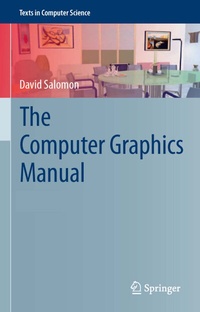
The Computer Graphics Manual
Description

Features: includes numerous figures, examples and solved exercises; discusses the key 2D and 3D transformations, and the main types of projections; presents an extensive selection of methods, algorithms, and techniques; examines advanced techniques in CG, including the nature and properties of light and color, graphics standards and file formats, and fractals; explores the principles of image compression; describes the important input/output graphics devices.
Reviews / Votes
From the reviews:
"The book presents a broad overview of computer graphics, its history and its pioneers, and the hardware tools it employs. . The book is presented in a very accessible fashion, with many grayscale and color illustrations, Mathematica or Matlab codes and examples with solutions. . The book is definitely a must read for all who are interested in computer graphics in any way." (Agnieszka Lisowska, Zentralblatt MATH, Vol. 1235, 2012)More details
Other editions
Additional editions
Person
David Salomon is a professor emeritus of Computer Science at California State University, Northridge. He has authored numerous articles and Springer books, including Elements of Computer Security , Handbook of Data Compression , A Concise Introduction to Data Compression , Variable-length Codes for Data Compression , Transformations and Projections in Computer Graphics , Curves and Surfaces for Computer Graphics , Coding for Data and Computer Communications , Data Privacy and Security , and A Guide to Data Compression Methods .
Content
Part I: Basic Techniques.- Historical Notes.- Raster Graphics.- Scan Conversion.- Part II: Transformations and Projections.- Transformations.- Parallel Projections.- Perspective Projection.- Nonlinear Projections.- Part III: Curves and Surfaces.- Basic Theory.- Linear Interpolation.- Polynomial Interpolation.- Hermite Interpolation.- Spline Interpolation.- Bezier Approximation.- B-Spline Approximation.- Subdivision Methods.- Sweep Surfaces.- Part IV: Advanced Techniques.- Rendering.- Visible Surface Determination.- Computer Animation.- Graphics Standards.- Color.- Fractals.- Part V: Image Compression.- Compression Techniques.- Transforms and JPEG.- The Wavelet Transform.- Part VI: Graphics Devices.- Graphics Devices.- Part VII: Appendixes.
