

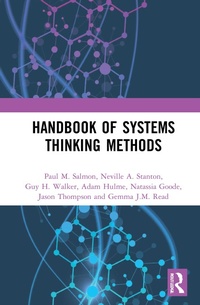
Handbook of Systems Thinking Methods
1st Edition
Published on 19. August 2022
330 pages
978-1-000-60276-0 (ISBN)
Description

The systems thinking philosophy has become popular in human factors and ergonomics and safety science. These methods are being used to understand and resolve complex societal problems in areas such as transport safety, workplace safety, medication error, disaster management, child abuse, financial crises, terrorism, climate change and public health and wellbeing. This handbook presents practical step-by-step guidance for practitioners and researchers wishing to use these methods to tackle complex problems. Each method includes an example case study which demonstrates how the method can be applied and how the results can be interpreted and translated into practical recommendations.
The book presents practical guidance on state-of-the-art systems thinking methods and offers case study applications describing systems thinking methods in novel areas. It explains how to translate the outputs of systems thinking methods in practice and introduces systems thinking with an overview of Human Factors and Ergonomics applications.
This book will serve as a great reference for students and engineers in the field of systems engineering, complex systems and the design and development of systems, including ergonomics/human factors and systems engineers, designers, architects, industrial engineers, project management engineers, reliability engineers, risk engineers, software engineers and computer engineers.
The book presents practical guidance on state-of-the-art systems thinking methods and offers case study applications describing systems thinking methods in novel areas. It explains how to translate the outputs of systems thinking methods in practice and introduces systems thinking with an overview of Human Factors and Ergonomics applications.
This book will serve as a great reference for students and engineers in the field of systems engineering, complex systems and the design and development of systems, including ergonomics/human factors and systems engineers, designers, architects, industrial engineers, project management engineers, reliability engineers, risk engineers, software engineers and computer engineers.
More details
Edition
1. Auflage
Language
English
Place of publication
London
United Kingdom
Publishing group
Taylor & Francis Ltd
Target group
Professional and scholarly
College/higher education
Illustrations
34 Tables, black and white; 95 Line drawings, black and white; 3 Halftones, black and white; 98 Illustrations, black and white
ISBN-13
978-1-000-60276-0 (9781000602760)
Copyright in bibliographic data and cover images is held by Nielsen Book Services Limited or by the publishers or by their respective licensors: all rights reserved.
Schweitzer Classification
Other editions
Additional editions
Paul M. Salmon | Neville A. Stanton | Guy H. Walker
Handbook of Systems Thinking Methods
Book
04/2025
1st Edition
CRC Press
€73.00
Shipment within 10-20 days
Paul M. Salmon | Neville A. Stanton | Guy H. Walker
Handbook of Systems Thinking Methods
Book
08/2022
1st Edition
CRC Press
€196.90
Shipment within 15-20 days
Persons
Paul M. Salmon is a Professor in Human Factors and is the Director of the Centre for Human Factors and Sociotechnical Systems at the University of the Sunshine Coast.
Neville A. Stanton is a Chartered Psychologist, Chartered Ergonomist and Chartered Engineer. He holds the Chair in Human Factors Engineering in the Faculty of Engineering and the Environment at the University of Southampton in the UK.
Guy H. Walker is a Professor within the Centre for Sustainable Road Freight at Heriot-Watt University in Edinburgh.
Adam Hulme is a Research Fellow at the Centre for Human Factors and Sociotechnical Systems at the University of the Sunshine Coast.
Natassia Goode is a Program Manager at WorkSafe Victoria, and Adjunct Fellow within the Centre for Human Factors and Sociotechnical Systems at the University of the Sunshine Coast.
Jason Thompson is an Associate Professor the University of Melbourne's School of Medicine and Melbourne School of Design.".
Gemma J. M. Read is a Senior Research Fellow at the Centre for Human Factors and Sociotechnical Systems at the University of the Sunshine Coast.
Neville A. Stanton is a Chartered Psychologist, Chartered Ergonomist and Chartered Engineer. He holds the Chair in Human Factors Engineering in the Faculty of Engineering and the Environment at the University of Southampton in the UK.
Guy H. Walker is a Professor within the Centre for Sustainable Road Freight at Heriot-Watt University in Edinburgh.
Adam Hulme is a Research Fellow at the Centre for Human Factors and Sociotechnical Systems at the University of the Sunshine Coast.
Natassia Goode is a Program Manager at WorkSafe Victoria, and Adjunct Fellow within the Centre for Human Factors and Sociotechnical Systems at the University of the Sunshine Coast.
Jason Thompson is an Associate Professor the University of Melbourne's School of Medicine and Melbourne School of Design.".
Gemma J. M. Read is a Senior Research Fellow at the Centre for Human Factors and Sociotechnical Systems at the University of the Sunshine Coast.
Content
SECTION I Introduction to Systems Thinking
1. Introduction to Systems Thinking in Human Factors and Ergonomics and Safety Science.
SECTION II Risk Assessment Methods
2. The Networked Hazard Analysis and Risk Management System (Net-HARMS).
3. The Event Analysis of the Systemic Teamwork Broken Links (EAST-BL).
4 The Systems Theoretic Process Analysis (STPA) Method.
SECTION III Systems Analysis and Design Methods
5. Hierarchical Task Analysis (HTA).
6. Cognitive Work Analysis (CWA).
7. The Event Analysis of Systemic Teamwork (EAST).
8. Causal Loop Diagrams (CLDs).
SECTION IV Accident Analysis Methods
9. The Accident Mapping (AcciMap) Method.
10. The Accident Network (AcciNet).
11. The Systems Theoretic Accident Model and Process-Causal Analysis based on Systems Theory (STAMP-CAST) Method.
SECTION V Computational Modelling Methods
12. Agent Based Modelling (ABM).
13. System Dynamics.
SECTION VI Many Model Systems Thinking
14. A Many-Model Systems Thinking Approach.
1. Introduction to Systems Thinking in Human Factors and Ergonomics and Safety Science.
SECTION II Risk Assessment Methods
2. The Networked Hazard Analysis and Risk Management System (Net-HARMS).
3. The Event Analysis of the Systemic Teamwork Broken Links (EAST-BL).
4 The Systems Theoretic Process Analysis (STPA) Method.
SECTION III Systems Analysis and Design Methods
5. Hierarchical Task Analysis (HTA).
6. Cognitive Work Analysis (CWA).
7. The Event Analysis of Systemic Teamwork (EAST).
8. Causal Loop Diagrams (CLDs).
SECTION IV Accident Analysis Methods
9. The Accident Mapping (AcciMap) Method.
10. The Accident Network (AcciNet).
11. The Systems Theoretic Accident Model and Process-Causal Analysis based on Systems Theory (STAMP-CAST) Method.
SECTION V Computational Modelling Methods
12. Agent Based Modelling (ABM).
13. System Dynamics.
SECTION VI Many Model Systems Thinking
14. A Many-Model Systems Thinking Approach.
