

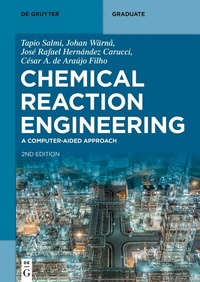
Chemical Reaction Engineering
Description

Follow step-by-step explanations to understand mathematical models - algebraic and differential equations - of chemical reactors and how numerical models workin computer implementation. Learn the basics behind current user-friendly tools in numerical simulation and optimization of reactor systems (Python, Matlab, Julia and gPROMS). Discover how to select the right algorithm for specific reactor models from homogenous to multiphase systems and structured reactors in detailed discussions at the end of each chapter. In this second edition, 20 solved example simulations performed in MATLAB and Python are included for demonstration purposes. Download solutions to exercises in the book: http://web.abo.fi/fak/tkf/tek/cre/.
.
More details
Other editions
Additional editions
Previous edition
Persons
Dr Tapio Salmi
is currently professor in chemical reaction engineering at Åbo Akademi, Turku/Åbo Finland and research professor at Academy of Finland. He is author and co-author of four textbooks and around 600 journal articles.
Dr Johan Wärnå
is professor in in chemical reaction engineering at Åbo Akademi, Turku/Åbo Finland. He has been visiting professor at Umeå University and TU Dresden. He is author and co-author of around 150 peer-review journal articles.
Dr José Rafael Hernández Carucci
Has a Master's degree in Chemical Engineering from Universidad Simón Bolívar, Venezuela and a doctoral degree in Chemical Reaction Engineering from Åbo Akademi, Finland. He is currently working at Neste in Finland.
Dr César Augusto de Araújo Filho
has a Master's degree from Universidade Federal do Ceará, Fortaleza, Brazil and doctoral degree in chemical reaction engineering from Åbo Akademi. He is currently employed by Metso-Outotec.
Content
- Intro
- Preface to the second edition
- Preface to the first edition
- Contents
- Nomenclature
- 1 Introduction
- 2 Kinetics in reaction engineering
- 3 Modelling of homogeneous systems
- 4 Modelling of fixed beds and fluidized beds
- 5 Modelling of three-phase systems
- 6 Modelling of gas-liquid systems
- 7 Structured reactors
- 8 Modelling of unsteady-state reactor systems
- 9 Equipment and models for laboratory experiments
- 10 Parameter estimation in reaction engineering
- References
- Exercises
- Appendices
- Appendix A. Numerical strategies in the solution of nonlinear algebraic equations and ordinary differential equations Two kinds of numerical tasks appear very often in solving tasks
- Appendix B. Computer simulation of CSTR, PFR and batch reactor models
- Appendix C. Numerical simulation of non-isothermal tubular reactors
- Index
