


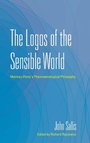
The Logos of the Sensible World
Merleau-Ponty's Phenomenological Philosophy
Published on 22. December 2021
187 pages
978-0-253-04046-6 (ISBN)
Description

A presentation of the two-semester lecture course on Merleau-Ponty given at Duquesne University from 1970 to 1971 by the esteemed American philosopher.
Devoted primarily to a close reading of the French philosopher's magnum opus, Phenomenology of Perception, this course begins with a detailed analysis of The Structure of Behavior. The central topics considered in the lectures include the functions of the phenomenological body; beyond realism and idealism; the structures of the lived world; spatiality, temporality, language, sexuality; and perception and knowledge. Sallis illuminates Merleau-Ponty's first two works and offers a thread to follow through developments in his later essays. Merleau-Ponty's notion of the primacy of perception and his claim that "the end of a philosophy is the account of its beginning" are woven throughout the lectures. For Sallis's part, these lectures are foundational for his extended engagement with Merleau-Ponty's The Visible and the Invisible, which was published in Sallis's Phenomenology and the Return to Beginnings.
"Sallis has managed to write a review that is accessible and makes only modest demands on the reader. This is an ideal resource for nonspecialists and for those who want a straightforward, relatively brief treatment of Merleau-Ponty's important book... Highly recommended." - Choice
Devoted primarily to a close reading of the French philosopher's magnum opus, Phenomenology of Perception, this course begins with a detailed analysis of The Structure of Behavior. The central topics considered in the lectures include the functions of the phenomenological body; beyond realism and idealism; the structures of the lived world; spatiality, temporality, language, sexuality; and perception and knowledge. Sallis illuminates Merleau-Ponty's first two works and offers a thread to follow through developments in his later essays. Merleau-Ponty's notion of the primacy of perception and his claim that "the end of a philosophy is the account of its beginning" are woven throughout the lectures. For Sallis's part, these lectures are foundational for his extended engagement with Merleau-Ponty's The Visible and the Invisible, which was published in Sallis's Phenomenology and the Return to Beginnings.
"Sallis has managed to write a review that is accessible and makes only modest demands on the reader. This is an ideal resource for nonspecialists and for those who want a straightforward, relatively brief treatment of Merleau-Ponty's important book... Highly recommended." - Choice
More details
Other editions
Additional editions
Book
03/2019
Indiana University Press
€70.50
Shipment within 10-20 days
Persons
John Sallis is Frederick J. Adelmann Professor of Philosophy at Boston College. He is author of more than 20 books, including Light Traces, The Return of Nature, and The Figure of Nature.
Richard Rojcewicz is Scholar-in-Residence in the Philosophy Department at Duquesne University, the translator of several works by Martin Heidegger, and author of The Gods and Technology: A Reading of Heidegger.
