

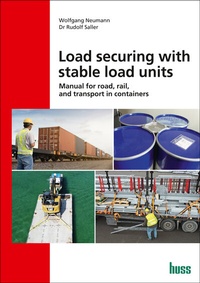
Load securing with stabel load units
Manual for road, rail and transport in containers
2nd Edition
Published on 21. August 2024
143 pages
978-3-949994-78-4 (ISBN)
Description

The fine art of safely transporting goods of all kinds and hazardous goods
Transporting valuable goods and especially hazardous goods from A to B undamaged is no trivial task. They must not tip over, slip or become deformed en route and must arrive at their destination in an upright position.
Safe transport begins with the correct packaging and the formation of loading units and requires extensive expertise and many years of practical experience. The authors Wolfgang Neumann and Dr Rudolf Saller have had all of this at their disposal for almost three decades.
In this handbook, they present their knowledge in a detailed and comprehensible manner. A wide range of findings from research and science have also been incorporated into the practical book. Their motivation is to prevent accidents involving the transport of hazardous goods, which unfortunately always have serious consequences. Ultimately, it is about the safety of all road users!
What you will find in this book:- A comprehensive legal overview for the training of shippers, consignors, forwarders and drivers on the subject of load securing.
- Information on the relationship between product, packaging, loading unit and load securing.
- Procedures and calculations for securing general cargo in road and rail transport and in sea containers.
- Distinguishing features between soft and rigid packaging. Information on how these behave with the load units and how they can be made safe for transport.
- Examples for the manufacturing industry (chemicals, mechanical engineering, energy) with application examples for shippers and consignors as well as illustrative material for drivers and dispatchers.
- Special features of load securing for dangerous goods shipments.
- Comprehensive explanations of who is responsible for what and how responsibility is assessed in court.
- The most important information to be observed from national and international guidelines and standardisation, including the CTU code for combined transport and maritime transport
For these reasons, the book is a must-read and a daily companion for freight carriers and forwarders in the industry as well as for shippers and consignors, supported by real-life practical examples.
Above all, load securing thrives on practice. That's why the practical chapters are accompanied by short videos on the topics of load unit formation and load securing, which the reader can watch using a QR code on their smartphone.
From the contents:
- Law in the area of packaging and load securing
- Occupational safety in the loading and unloading process
- Selection of experts
- Norms, guidelines and test standards
- Process cost calculation
- Packaging - why and how?
- Testing of packaging (including hazardous and non-hazardous goods / inclination test / sled test / dynamic driving test and much more)
- Materials for forming load units
- Physics and application examples
- Vehicle body stability
- Load securing in containers in accordance with IMO/ SOLAS and CTU Code:2014
- Load distribution
- Load securing aids
- Training
- Various checklists and index
?
Transporting valuable goods and especially hazardous goods from A to B undamaged is no trivial task. They must not tip over, slip or become deformed en route and must arrive at their destination in an upright position.
Safe transport begins with the correct packaging and the formation of loading units and requires extensive expertise and many years of practical experience. The authors Wolfgang Neumann and Dr Rudolf Saller have had all of this at their disposal for almost three decades.
In this handbook, they present their knowledge in a detailed and comprehensible manner. A wide range of findings from research and science have also been incorporated into the practical book. Their motivation is to prevent accidents involving the transport of hazardous goods, which unfortunately always have serious consequences. Ultimately, it is about the safety of all road users!
What you will find in this book:- A comprehensive legal overview for the training of shippers, consignors, forwarders and drivers on the subject of load securing.
- Information on the relationship between product, packaging, loading unit and load securing.
- Procedures and calculations for securing general cargo in road and rail transport and in sea containers.
- Distinguishing features between soft and rigid packaging. Information on how these behave with the load units and how they can be made safe for transport.
- Examples for the manufacturing industry (chemicals, mechanical engineering, energy) with application examples for shippers and consignors as well as illustrative material for drivers and dispatchers.
- Special features of load securing for dangerous goods shipments.
- Comprehensive explanations of who is responsible for what and how responsibility is assessed in court.
- The most important information to be observed from national and international guidelines and standardisation, including the CTU code for combined transport and maritime transport
For these reasons, the book is a must-read and a daily companion for freight carriers and forwarders in the industry as well as for shippers and consignors, supported by real-life practical examples.
Above all, load securing thrives on practice. That's why the practical chapters are accompanied by short videos on the topics of load unit formation and load securing, which the reader can watch using a QR code on their smartphone.
From the contents:
- Law in the area of packaging and load securing
- Occupational safety in the loading and unloading process
- Selection of experts
- Norms, guidelines and test standards
- Process cost calculation
- Packaging - why and how?
- Testing of packaging (including hazardous and non-hazardous goods / inclination test / sled test / dynamic driving test and much more)
- Materials for forming load units
- Physics and application examples
- Vehicle body stability
- Load securing in containers in accordance with IMO/ SOLAS and CTU Code:2014
- Load distribution
- Load securing aids
- Training
- Various checklists and index
?
More details
Persons
Content
- Intro
- Content
- 1 Packaging law and Load securing
- 2 Occupational safety in the loading and unloading process
- 3 Selection of experts
- 4 Norms, guidelines and test standards
- 5 Activity-based costing
- 6 Formation of stable Ioad units
- 7 Inspection of packaging, loading units and the overall system
- 8 Materials for load unit formation
- 9 Physics and application examples
- 10 Vehicle body stability
- 11 Cargo securing in the container in accordance with IMO/SOLAS and the CTU Code:2014
- 12 Load distribution
- 13 Load securing aids
- 14 Training
- 15 Appendix
- Checklist driver - departure check
- Checklist holder - suitability check
- Checklist for consignors and shippers
- Checkliste disposition and dispatch warehouse
- Index
