

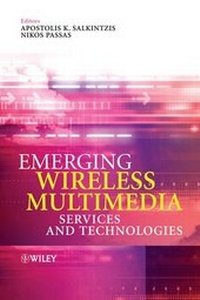
Emerging Wireless Multimedia
Description

More details
Other editions
Additional editions
Persons
Content
1. Introduction (Apostolis K. Salkintzis and Nikos Passas).
1.1 Evolving Towards Wireless Multimedia Networks.
1.2 Multimedia Over Wireless.
1.3 Multimedia Services in WLANs.
1.4 Multimedia Services in WPANs.
1.5 Multimedia Services in 3G Networks.
1.6 Multimedia Services for the Enterprise.
1.7 Hybrid Multimedia Networks and Seamless Mobility.
1.8 Book Contents.
References.
PART ONE: MULTIMEDIA ENABLING TECHNOLOGIES.
2. Multimedia Coding Techniques for Wireless Networks (Anastasios Delopoulos).
2.1 Introduction.
2.2 Basics of Compression.
2.3 Understanding Speech Characteristics.
2.4 Three Types of Speech Compressors.
2.5 Speech Coding Standards.
2.6 Understanding Video Characteristics.
2.7 Video Compression Standards.
References.
3. Multimedia Transport Protocols for Wireless Networks (Pantelis Balaouras and Ioannis Stavrakakis).
3.1 Introduction.
3.2 Networked Multimedia-based Services.
3.3 Classification of Real-time Services.
3.4 Adaptation at the Video Encoding Level.
3.5 Quality of Service Issues for Real-time Multimedia Services.
3.6 Protocols for Multimedia-based Communication Over the Wireless Internet.
3.7 Real-time Transport Protocol (RTP).
3.8 RTP Payload Types.
3.9 RTP in 3G.
References.
4. Multimedia Control Protocols for Wireless Networks (Pedro M. Ruiz, Eduardo Marti¿nez, Juan A. Sänchez and Antonio F. Gömez-Skarmeta).
4.1 Introduction.
4.2 A Premier on the Control Plane of Existing Multimedia Standards.
4.3 Protocol for Describing Multimedia Sessions: SDP.
4.4 Control Protocols for Media Streaming.
4.5 Session Setup: The Session Initiation Protocol (SIP).
4.6 Advanced SIP Features for Wireless Networks.
4.7 Multimedia Control Panel in UMTS: IMS.
4.8 Research Challenges and Opportunities.
Acknowledgement.
References.
5. Multimedia Wireless Local Area Networks (Sai Shankar).
5.1 Introduction.
5.2 Overview of Physical Layers of HiperLAN/2 and IEEE 802.11a.
5.3 Overview of HiperLAN/1.
5.4 Overview of HiperLAN/2.
5.5 IEEE 802.11 MAC.
5.6 Overview of IEEE 802.11 Standardization.
5.7 IEEE 802.11e HCF.
5.8 Simulation Performance of IEEE 802.11.
5.9 Support for VoIP in IEE 802.11e.
5.10 Video Transmission Over IEEE 802.11E.
5.11 Comparison of HiperLAN/2 and IEEE 802.11E.
5.12 Conclusions.
References.
6. Wireless Multimedia Personal Area Networks: An Overview (Minal Mishra, Aniruddha Rangnekar and Krishna M. Sivalingam).
6.1 Introduction.
6.2 Multimedia Information Representation.
6.3 Bluetooth1 (IEEE 802.15.1).
6.4 Coexistence with Wireless LANs (IEEE 802.15.2).
6.5 High-Rate WPANs (IEEE 802.15.3).
6.6 Low-rate WPANs (IEEE 802.15.4).
6.7 Summary.
References.
7. QoS Provision in Wireless Multimedia Networks (Nikos Passas and Apostolis K. Salkintzis).
7.1 Introduction.
7.2 QoS in WLANs.
7.3 RSVP over Wireless Networks.
7.4 QoS in Hybrid 3G/WLAN Networks.
7.5 UMTS/WLAN Interworking Architecture.
7.6 Interworking QoS Considerations.
7.7 Performance Evaluation.
7.8 Performance Results.
7.9 Conclusions.
Acknowledgements.
References.
8. Wireless Multimedia in 3G Networks (George Xylomenos and Vasilis Vogkas).
8.1 Introduction.
8.2 Cellular Networks.
8.3 UMTS Networks.
8.4 Multimedia Services.
8.5 IMS Architecture and Implementation.
8.6 MBMS Architecture and Implementation.
8.7 Quality of Service.
8.8 Summary.
8.9 Glossary of Acronyms.
References.
PART TWO: WIRELESS MULTIMEDIA APPLICATIONS AND SERVICES.
9. Wireless Application Protocol (WAP) (Alessandro Andreadis and Giovanni Giambene).
9.1 Introduction to WAP Protocol and Architecture.
9.2 WAP Protocol Stack.
9.3 WAP languages and Design Tools.
9.4 WAP Service Design Principles.
9.5 Performance of WAP over 2G and 2.5G Technologies.
9.6 Examples of Experimented and Implemented WAP Services.
References.
10. Multimedia Messaging Service (MMS) (Alessandro Andreadis and Giovanni Giambene).
10.1 Evolution From Short to Multimedia Message Services.
10.2 MMS Architecture and Standard.
10.3 MMS Format.
10.4 Transaction Flows.
10.5 MMS-based Value-added Services.
10.6 MMS Development Tools.
10.7 MMS Evolution.
References.
11. Instant Messaging and Presence Service (IMPS) (John Buford and Mahfuzur Rahman).
11.1 Introduction.
11.2 Client.
11.3 Design Considerations.
11.4 Protocols.
11.5 Security and Protocols.
11.6 Evolution, Direction and Challenges.
11.7 Summary.
References.
12. Instant Messaging Enabled Mobile Payments (Stamatis Karnouskos, Tadaaki Arimura, Shigetoshi Yokoyama and Baläzs Csik).
12.1 Introduction.
12.2 Instant Messaging Mobile Payment Scenario.
12.3 The Generic MP and IM Platforms of IMMP.
12.4 Design of an IM-enabled MP System.
12.5 Implementation.
12.6 Security and Privacy in IMMP.
12.7 Conclusions.
References.
13. Push-to-Talk: A First Step to a Unified Instant Communication Future (Johanna Wild, Michael Sasuta and Mark Shaughnessy).
13.1 Short History of PTT.
13.2 Service Description.
13.3 Architecture.
13.4 Standardization.
13.5 Service Access.
13.6 Performance.
13.7 Architecture Migration.
13.8 Possible Future, or PTT Evolving to PTX.
14. Location Based Services (Ioannis Priggouris, Stathes Hadjiefthymiades and Giannis Marias).
14.1 Introduction.
14.2 Requirements.
14.3 LBS System.
14.4 Available LBS Systems.
Acknowledgement.
References.
Index.
