

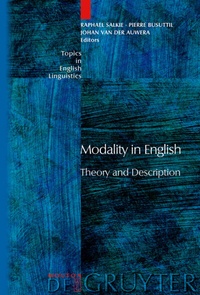
Modality in English
Description

This volume presents two kinds of studies on English modality.
On the one hand, there are strongly empirical, corpus-based studies of individual uses of English modal auxiliaries and modal constructions, such as may in interrogatives, might in concessive clauses, shall and may vs must in legal English, the use of surprised if and surprising if constructions, the use and history of adhortative constructions, or the modal-aspectual use of come to in I came to realize that X . The book also contains work that presents new views on some of the classical issues, like the relations between modality and time, modality and commitment, modals and (inter)subjectivity. A special place is given to work that approaches the English modals from the perspective of the 'Theory of Enunciative Operations' developed by the French linguist Antoine Culioli and his colleagues.
Thus the book provides new perspectives and answers on basic questions about modality, in general, and its expression in English, in particular.
More details
Other editions
Additional editions
Persons
Content
2 - Contents [Seite 5]
3 - Introduction [Seite 7]
4 - Towards a typology of modality in language [Seite 15]
5 - 'Not-yet-factual at time t': a neglected modal concept [Seite 37]
6 - Semantic ascent, deixis, intersubjectivity and modality [Seite 61]
7 - Degrees of modality [Seite 85]
8 - Another look at modals and subjectivity [Seite 111]
9 - For a topological representation of the modal system of English [Seite 129]
10 - Epistemic might in the interrogative [Seite 151]
11 - MAY in concessive contexts [Seite 165]
12 - When may means must: deontic modality in English statute construction [Seite 183]
13 - Legal English and the 'modal revolution' [Seite 205]
14 - Posteriority in expressions with must and have to: a case of interplay between syntax, semantics and pragmatics [Seite 217]
15 - Using the adjectives surprised/surprising to express epistemic modality [Seite 229]
16 - Commitment and subjectivity in the discourse of a judicial inquiry [Seite 243]
17 - Hearsay adverbs and modality [Seite 275]
18 - When Yes means No, and other hidden modalities [Seite 301]
19 - Modality and the history of English adhortatives [Seite 321]
20 - On the "great modal shift" sustained by come to VP [Seite 355]
21 - Backmatter [Seite 381]
