

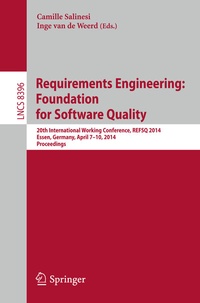
Requirements Engineering: Foundation for Software Quality
Description

This book constitutes the refereed proceedings of the 20th International Working Conference on Requirements Engineering: Foundation for Software Quality, REFSQ 2014, held in Essen, Germany, in April 2014.
The 23 papers presented were carefully reviewed and selected from 89 submissions. The REFSQ conference is organised as a three-day symposium with two days devoted to scientific papers presentation with a one-day industry track in-between. Both the industry and scientific presentations concern a variety of topics, which shows the liveliness of the requirements engineering domain. These topics are for instance: scalability in RE, communication issues, compliance with law and regulations, RE for self adaptive systems, requirements traceability, new sources of requirements, domain specific RE, Natural Language issues and of course games. 'Games for RE and RE for Games' was the special topic of REFSQ 2014. This is materialized by a plenary session at the conference, and by a keynote given by Catherine Rolland, a serious games expert and project manager at KTM Advance, a French company specialized in serious games.
More details
Other editions
Additional editions
Content
Is Requirements Engineering Useless in Game Development.- Towards Model-Driven Requirements Engineering for Serious Educational Games: Informal, Semi-formal, and Formal Models.- Measuring and Improving the Completeness of Natural Language Requirements.- (Semi-) automatic Categorization of Natural Language Requirements.- A Systematic Literature Review of Requirements Modeling and Analysis for Self-adaptive Systems.- Requirements-Driven Social Adaptation: Expert Survey.- A Requirements Monitoring Infrastructure for Very-Large-Scale Software Systems.- State of Practice of User-Developer Communication in Large-Scale IT Projects - Results of an Expert Interview Series.- Digital Addiction: A Requirements Engineering Perspective.- Feedback-Aware Requirements Documents for Smart Devices.- INCREMENT: A Mixed MDE-IR Approach for Regulatory Requirements Modeling and Analysis.- Systematic Elaboration of Compliance Requirements Using Compliance Debt and Portfolio Theory.- Answer-Set Programming in Requirements Engineering.- Improving the Understandability of Formal Specifications: An Experience Report.- Problem-Based Requirements Interaction Analysis.- Analyzing the Effect of the Collaborative Interactions on Performance of Requirements Validation.- Argumentation-Based Discussion for User Forum: A Research Preview.- A Requirements-Led Approach for Specifying QoS-Aware Service Choreographies: An Experience Report.- Experience-Oriented Approaches for Teaching and Training Requirements Engineering: An Experience Report.- An Analysis of Priority-Based Decision Heuristics for Optimizing Elicitation Efficiency.- The Effects of Requirements Elicitation Issues on Software Project Performance: An Empirical Analysis.- Requirements Reuse and Patterns: A Survey.- Safety Evidence Traceability: Problem Analysis and Model.
