


Managed Migrations
Growers, Farmworkers, and Border Enforcement in the Twentieth Century
1st Edition
Published on 14. November 2018
277 pages
978-1-4773-1617-7 (ISBN)
Description

Needed at one moment, scorned at others, Mexican agricultural workers have moved back and forth across the US-Mexico border for the past century. In South Texas, Anglo growers' dreams of creating a modern agricultural empire depended on continuous access to Mexican workers. While this access was officially regulated by immigration laws and policy promulgated in Washington, DC, in practice the migration of Mexican labor involved daily, on-the-ground negotiations among growers, workers, and the US Border Patrol. In a very real sense, these groups set the parameters of border enforcement policy.
Managed Migrations examines the relationship between immigration laws and policy and the agricultural labor relations of growers and workers in South Texas and El Paso during the 1940s and 1950s. Cristina Salinas argues that immigration law was mainly enacted not in embassies or the halls of Congress but on the ground, as a result of daily decisions by the Border Patrol that growers and workers negotiated and contested. She describes how the INS devised techniques to facilitate high-volume yearly deportations and shows how the agency used these enforcement practices to manage the seasonal agricultural labor migration across the border. Her pioneering research reveals the great extent to which immigration policy was made at the local level, as well as the agency of Mexican farmworkers who managed to maintain their mobility and kinship networks despite the constraints of grower paternalism and enforcement actions by the Border Patrol.
Managed Migrations examines the relationship between immigration laws and policy and the agricultural labor relations of growers and workers in South Texas and El Paso during the 1940s and 1950s. Cristina Salinas argues that immigration law was mainly enacted not in embassies or the halls of Congress but on the ground, as a result of daily decisions by the Border Patrol that growers and workers negotiated and contested. She describes how the INS devised techniques to facilitate high-volume yearly deportations and shows how the agency used these enforcement practices to manage the seasonal agricultural labor migration across the border. Her pioneering research reveals the great extent to which immigration policy was made at the local level, as well as the agency of Mexican farmworkers who managed to maintain their mobility and kinship networks despite the constraints of grower paternalism and enforcement actions by the Border Patrol.
Reviews / Votes
"[Managed Migrations] provides textured, engaging coverage of border labor issues...an engaging addition to the literature on labor and immigration at the Texas-Mexico border." (Southwestern Historical Quarterly) "Salinas offers up a worthy addition to the burgeoning literature on Texas....[Managed Migrations] makes deep analytical arguments about the connections between the South's system of labor immobility that derives from plantation agriculture and the West's free labor ideology rooted in mobility. Salinas's book ultimately shows how these two contradictory traditions combined in the Texas-Mexico borderlands." (Journal of American Ethnic History) "Managed Migrations provides a grounded history of Texas agribusiness in El Paso and the Rio Grande valley, and of its relationship to undocumented Mexican immigration and border enforcement...Managed Migrations will be deeply useful to historians of the U.S.-Mexico border and twentieth-century U.S. agribusiness and immigration. It will also be of value to anyone interested in the contemporary U.S.-Mexico borderlands--where border enforcement continues to manage labor and shape national politics." (Journal of American History) "Managed Migrations is a study as paramount as it is timely...Cristina Salinas delivers a profound study of the ways that US and Mexican federal, state, and local governments sought to manage workers' migrations, and she ensures that the first-hand experiences of migrant workers are at the center of her transformative storytelling...Managed Migrations is a must-read." (Agricultural History) "A splendid analysis of farmworker mobility in the US-Mexico borderlands...As lucid, interdisciplinary work, Managed Migrations should be prized by scholars of migrations, environments, and the carceral state...The book is comprehensive, beautifully crafted, and worth consideration by scholars across the discipline." (H-Net Reviews) "Managed Migrations is an important contribution to the literatures on Mexican immigration, the ethnic-Mexican diaspora, and the South Texas borderlands in that it brings a careful and nuanced view to what drove the migration system during the first half of the twentieth century. Workers, growers, and government officials are all given fair inclusion here. As such, Managed Migrations is a telling example of borderlands history, which focuses on what happens when people from different social groups or nation states come together and interact. Unfortunately, for the workers themselves the results seem overwhelmingly stark." (Labor: Studies in Working-Class History of the Americas)More details
Language
English
Place of publication
Austin, TX
United States
Target group
Professional and scholarly
ISBN-13
978-1-4773-1617-7 (9781477316177)
Copyright in bibliographic data and cover images is held by Nielsen Book Services Limited or by the publishers or by their respective licensors: all rights reserved.
Schweitzer Classification
Other editions
Additional editions
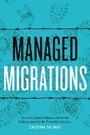
Cristina Salinas
Managed Migrations
Growers, Farmworkers, and Border Enforcement in the Twentieth Century
Book
11/2018
University of Texas Press
€64.64
Shipment within 15-20 days
Content
Acknowledgments
Introduction
Chapter 1. "Where Uncle Sam Meets Mexico": Narratives of Frontier and Progress in Early Twentieth-Century South Texas
Chapter 2. The Social Space of Agriculture
Chapter 3. The Flexible Border: Mobility within Restriction in US Immigration Laws and Enforcement
Chapter 4. Exploitative Villain or Community Leader? Agricultural Labor Contractors, the State, and Control over Worker Mobility
Chapter 5. El Paso/The Passage: The 1948 El Paso Incident and the Politics of Mobility
Chapter 6. The High Price of Immigration Politics during the 1950s
Epilogue
Notes
Bibliography
Index
Introduction
Chapter 1. "Where Uncle Sam Meets Mexico": Narratives of Frontier and Progress in Early Twentieth-Century South Texas
Chapter 2. The Social Space of Agriculture
Chapter 3. The Flexible Border: Mobility within Restriction in US Immigration Laws and Enforcement
Chapter 4. Exploitative Villain or Community Leader? Agricultural Labor Contractors, the State, and Control over Worker Mobility
Chapter 5. El Paso/The Passage: The 1948 El Paso Incident and the Politics of Mobility
Chapter 6. The High Price of Immigration Politics during the 1950s
Epilogue
Notes
Bibliography
Index
