

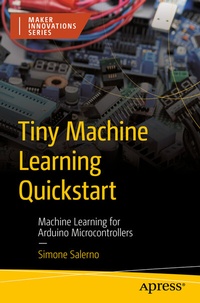
Tiny Machine Learning Quickstart
Description

Be a part of the Tiny Machine Learning (TinyML) revolution in the ever-growing world of IoT. This book examines the concepts, workflows, and tools needed to make your projects smarter, all within the Arduino platform.
You'll start by exploring Machine learning in the context of embedded, resource-constrained devices as opposed to your powerful, gigabyte-RAM computer. You'll review the unique challenges it poses, but also the limitless possibilities it opens. Next, you'll work through nine projects that encompass different data types (tabular, time series, audio and images) and tasks (classification and regression). Each project comes with tips and tricks to collect, load, plot and analyse each type of data.
Throughout the book, you'll apply three different approaches to TinyML: traditional algorithms (Decision Tree, Logistic Regression, SVM), Edge Impulse (a no-code online tools), and TensorFlow for Microcontrollers. Each has its strengths and weaknesses, and you will learn how to choose the most appropriate for your use case. TinyML Quickstart will provide a solid reference for all your future projects with minimal cost and effort.
What You Will Learn
- Navigate embedded ML challenges
- Integrate Python with Arduino for seamless data processing
- Implement ML algorithms
- Harness the power of Tensorflow for artificial neural networks
- Leverage no-code tools like Edge Impulse
- Execute real-world projects
Who This Book Is For
Electronics hobbyists and developers with a basic understanding of Tensorflow, ML in Python, and Arduino-based programming looking to apply that knowledge with microcontrollers. Previous experience with C++ is helpful but not required.
Reviews / Votes
" Tiny machine learning quickstart by Salvatore Salerno is a practical and approachable introduction to deploying machine learning (ML) models on resource-constrained embedded devices. . Tiny machine learning quickstart is a valuable guide for anyone interested in running ML models directly on microcontrollers. Its clear explanations, Arduino-centered projects, and thoughtful treatment of embedded constraints make it a timely contribution to the growing body of TinyML resources." (Wael Badawy, Computing Reviews, March 16, 2026)
More details
Other editions
Additional editions
Person
Simone Salerno has been tinkering with microcontrollers for nearly 10 years and is committed to bringing his knowledge of software engineering to the world of Arduino programming. With the advent of Tensorflow for Microcontrollers he began developing leaner, faster alternatives to neural networks for microcontrollers and started porting many traditional ML algorithms such as Decision Tree, Random Forest, and Logistic Regression from Python to self-contained, hardware-independent C++, ready to be deployed to any microcontroller. Today, he continues to focus on the development of TinyML tools and tutorials with his low-code libraries and no-code online platforms like Edge Impulse.
Content
Chapter 1: Introduction to Tiny Machine Learning.- Chapter 2: Tabular data classification.- Chapter 3: Tabular data regression.- Chapter 4: Time series classification with Edge Impulse.- Chapter 5: Time series classification without Edge Impulse.- Chapter 6: Audio Wake Word detection with Edge Impulse.- Chapter 7: Object detection with Edge Impulse.- Chapter 8: TensorFlow for Microcontrollers from scratch.
