

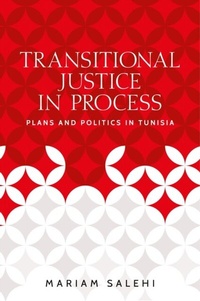
Transitional Justice in Process
Plans and Politics in Tunisia
1st Edition
Published on 15. March 2022
232 pages
978-1-5261-5537-5 (ISBN)
Description

Transitional justice in process is the first book to comprehensively study the Tunisian transitional justice process. After the fall of the Ben Ali regime in 2011, Tunisia swiftly began dealing with its authoritarian past and initiated a comprehensive transitional justice process, with the Truth and Dignity Commission as its central institution. However, instead of bringing about peace and justice, transitional justice soon became an arena of contention. Through a process lens, the book explores why and how the transitional justice process evolved, and explains how it relates to the country's political transition.
Based on extensive field research in Tunisia and the United States, and interviews with a broad range of Tunisian and international stakeholders and decision-makers, Transitional justice in process provides an in-depth analysis of a crucial period, beginning with the first initiatives aimed at dealing with the past and seeking justice and accountability. It discusses the development and design of the transitional justice mandate, and looks at the performance of transitional justice institutions in practice. It examines the role of international justice professionals in different stages of the process, as well as the alliances and frictions between different actor groups that cut across the often-assumed local-international divide.
Transitional justice in process makes an essential contribution to literature on the domestic and international politics of transitional justice, and in particular to the understanding of the Tunisian transitional justice process. -- .
Based on extensive field research in Tunisia and the United States, and interviews with a broad range of Tunisian and international stakeholders and decision-makers, Transitional justice in process provides an in-depth analysis of a crucial period, beginning with the first initiatives aimed at dealing with the past and seeking justice and accountability. It discusses the development and design of the transitional justice mandate, and looks at the performance of transitional justice institutions in practice. It examines the role of international justice professionals in different stages of the process, as well as the alliances and frictions between different actor groups that cut across the often-assumed local-international divide.
Transitional justice in process makes an essential contribution to literature on the domestic and international politics of transitional justice, and in particular to the understanding of the Tunisian transitional justice process. -- .
Reviews / Votes
'An original contribution to our understanding of the so-called Arab Spring, this erudite book illuminates the place of transitional justice in Tunisia's political prospects. A rewarding read for a broad interdisciplinary audience.'Ruti Teitel, Ernst C. Stiefel Professor of Comparative Law, author of Transitional Justice and Globalizing Transitional Justice
'In addition to offering a timely and carefully detailed portrait of Tunisians' efforts to pursue justice after 2011, Salehi's book illustrates the important role that case studies can play in theory development. The analytic clarity with which the book distinguishes between initiating, designing, and performing transitional justice helps elucidate dynamic features of a process that Salehi approaches as fundamentally non-linear and non-teleological. This processual approach is one that offers insights for scholars and practitioners alike and should be transferable to contexts beyond Tunisia.'
Stacey Philbrick Yadav, author of Yemen in the Shadow of Transition
'This is a serious and thorough treatment of an important topic that provides a number of valuable insights. It not only makes an important contribution to our understanding of the post-revolutionary politics of Tunisia, but also throws light on the global phenomenon of transitional justice in the wake of conflict and revolution.'
Charles Tripp, SOAS, University of London
'[Salehi's] findings are relevant to the specific Tunisian trajectory as well as to broader debates on transitional justice and processes of social change.'
Marc Martorell Junyent, Manara Magazine
'Salehi's book offers a first account of one of the most important efforts at transitional justice and accountability in the MENA region, one which will reward readers interested in these critically important questions.'
Marc Lynch, host of POMEPS Middle East Political Science Podcast
'The right people are interviewed to help explain the high politics of TJ policy. The right questions are asked to illuminate why planned initiatives combine with spontaneous political and social dynamics to produce outcomes nobody had initially intended. Transitional Justice in Process: Plans and Politics in Tunisia is a fine-grained, mature analysis that eschews some of the easier cliches that attend the Sisyphean task of pursuing accountability after authoritarianism in under-institutionalised states.'
Padraig McAuliffe, Netherlands International Law Review (2022)
'Transitional justice in process offers a fresh look into the microstructural transformations that Tunisia underwent between 2011 and 2019. [...] Salehi offers an original framework missing from existing studies
in the field that can be applied beyond the case-study of Tunisia and in countries undergoing similar processes. Salehi's contribution improves the existing knowledge on the technocratization and bureaucratization of transitional justice.;
Maria Gloria Polimeno, International Affairs 98:5 (2022)
'Transitional Justice in Process is a fine-grained, mature analysis that eschews some of the easier cliches that attend the Sisyphean task of pursuing accountability after authoritarianism in under-insti-tutionalised states.'
Padraig McAuliffe, Netherlands International Law Review (2022) -- .
All prices
More details
Series
Language
English
Place of publication
United Kingdom
Target group
College/higher education
Professional and scholarly
Illustrations
2 black & white illustrations; 3 tables
ISBN-13
978-1-5261-5537-5 (9781526155375)
Copyright in bibliographic data and cover images is held by Nielsen Book Services Limited or by the publishers or by their respective licensors: all rights reserved.
Schweitzer Classification
Other editions
Additional editions
Book
12/2023
Manchester University Press
€116.70
Shipment within 15-20 days
Book
03/2022
Manchester University Press
€115.80
Shipment within 15-20 days
Person
Mariam Salehi is a junior research group leader at Freie Universitaet Berlin -- .
Content
Introduction
1 The past is not another country: Tunisia background chapter
2 Transitional justice in process: Developments and dynamics
3 Initiating transitional justice
4 Designing transitional justice
5 Performing transitional justice
Conclusion
Appendix
References
Index -- .
1 The past is not another country: Tunisia background chapter
2 Transitional justice in process: Developments and dynamics
3 Initiating transitional justice
4 Designing transitional justice
5 Performing transitional justice
Conclusion
Appendix
References
Index -- .
