

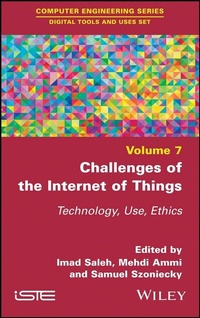
Challenges of the Internet of Things
Technique, Use, Ethics
1st Edition
Published on 8. October 2018
288 pages
978-1-119-54975-8 (ISBN)
Description

This book will examine the issues of IoT according to three complementary axes: technique, use, ethics. The techniques used to produce artefacts (physical objects, infrastructures), programs (algorithms, software) and data (Big data, linked data, metadata, ontologies) are the subject of many innovations as the field of IoT is rich and stimulating. Along with this technological boom, IoT uses colonize new fields of application in the fields of transport, administration, housing, maintenance, health, sports, well-being. ... Privileged interface with digital ecosystems now at the heart of social exchanges, the IoT develops a power to act whose consequences both good and bad make it difficult to assess a fair business.
More details
Other editions
Additional editions
Imad Saleh | Mehdi Ammi | Samuel Szoniecky
Challenges of the Internet of Things
Technique, Use, Ethics
Book
09/2018
1st Edition
Wiley-ISTE
€164.50
Shipment within 3-4 weeks
Content
- Cover
- Half-Title Page
- Title Page
- Copyright Page
- Contents
- Introduction
- 1. Internet of Things (IoT): Concepts, Issues, Challenges and Perspectives
- 1.1. Introduction
- 1.2. The connected object (CO)
- 1.3. Internet of Things: definition
- 1.3.1. Applications
- 1.4. Steps and technologies in the IoT ecosystem
- 1.4.1. IoT architecture
- 1.5. From the IoT to the Internet of Everything (IoE)
- 1.6. IoT and Big Data
- 1.7. Cloud computing applied to Big Data and the IoT
- 1.8. Data science and the IoT
- 1.9. Stakes and challenges of the IoT
- 1.9.1. Technological challenges
- 1.9.2. Societal challenges
- 1.9.3. Environmental challenges
- 1.9.4. Confidence in the IoT
- 1.9.5. Challenges for businesses
- 1.9.6. Challenges for researchers
- 1.10. Opportunities and threats in the IoT ecosystem
- 1.11. IoT security
- 1.12. Blockchain and the IoT
- 1.12.1. Definition
- 1.12.2. Operation
- 1.12.3. Applications
- 1.13. Conclusion
- 1.14. References
- 2. Deep Learning Approach of Raw Human Activity Data
- 2.1. Introduction
- 2.2. State of the art
- 2.3. Experimental configuration
- 2.4. Analysis of the activity
- 2.4.1. Neural network architecture
- 2.5. Results
- 2.6. Discussion
- 2.7. Conclusion
- 2.8. References
- 3. Study and Development of a Smart Cup for Monitoring Post-stroke Patients' Activities at Home
- 3.1. Introduction
- 3.2. Related work
- 3.2.1. Upper limbs motor assessment tools
- 3.2.2. New platforms for stroke assessment
- 3.2.3. Activity analysis and monitoring
- 3.2.4. Tasks and rehabilitation exercises for strokes
- 3.3. Design concept
- 3.3.1. Task identification
- 3.3.2. Monitored information
- 3.3.3. Sensory feedback
- 3.4. Implementation of the prototype
- 3.4.1. Grasping force detection
- 3.4.2. Liquid level detection
- 3.4.3. Orientation detection
- 3.4.4. Relative position detection
- 3.5. Data processing
- 3.5.1. Orientation calculation
- 3.5.2. Tremor detection
- 3.5.3. Activity recognition
- 3.6. Planned studies
- 3.6.1. Studies with therapists
- 3.6.2. Studies with patients
- 3.7. Conclusion and perspectives
- 3.8. References
- 4. Enabling Fast-prototyping of Connected Things using the WiNo* Family
- 4.1. Introduction
- 4.2. Context
- 4.3. State of the art
- 4.4. Introducing the WiNo* family
- 4.4.1. WiNoRF22 and TeensyWiNo
- 4.4.2. WiNoLoRa
- 4.4.3. DecaWiNo
- 4.4.4. Summary of WiNo nodes
- 4.5. Results and examples of use
- 4.5.1. WiNo and TeensyWiNo
- 4.5.2. WiNoLoRa
- 4.5.3. DecaWiNo
- 4.5.4. Summary and comparative analysis
- 4.6. Conclusion and outlook
- 4.7. Acknowledgments
- 4.8. References
- 5. Multi-standard Receiver for Medical IoT Sensor Networks
- 5.1. Introduction
- 5.2. General context
- 5.2.1. OFDM
- 5.2.2. Characteristics of IEEE 802.11a/b/g/n/ac standards
- 5.3. The IEEE 802.15.6 standard
- 5.3.1. The WBAN frame
- 5.3.2. Specificities of the WBAN physical layer
- 5.4. Physical layer design
- 5.4.1. Frame synchronization
- 5.4.2. Frequency synchronization
- 5.4.3. Time synchronization
- 5.5. Simulation results
- 5.6. Conclusion
- 5.7. References
- 6. Ambient Atoms: a Device for Ambient Information Visualization
- 6.1. Introduction
- 6.2. Previous research
- 6.2.1. Dedicated ambient displays that do not integrate a display screen
- 6.2.2. Generic ambient displays that do not include a display screen
- 6.3. Ambient Atoms: user's point of view
- 6.4. Ambient Atoms: hardware and software components
- 6.4.1. Hardware: microcontroller
- 6.4.2. Hardware: LEDs
- 6.4.3. Software
- 6.5. Ambient Atoms: prototype applied to the housing information visualization
- 6.6. Future research and conclusion
- 6.7. Acknowledgments
- 6.8. References
- 7. New Robust Protocol for IoV Communications
- 7.1. Introduction
- 7.2. Latest developments
- 7.2.1. Architecture of the IoV
- 7.2.2. Communication obstacles
- 7.2.3. Related work
- 7.3. Multi-criterion routing protocol
- 7.3.1. Applications and services
- 7.3.2. Multi-criterion routing protocols in IoV communications
- 7.4. Conclusion and perspectives
- 7.5. References
- 8. Interconnected Virtual Space and Theater: A Research-Creation Project on Theatrical Performance Space in the Network Era
- 8.1. Introduction
- 8.2. A multidisciplinary experiment involving live performance and digital art
- 8.2.1. Defining avatar and mocaptor
- 8.2.2. System description
- 8.2.3. From Kinect to Perception Neuron: a new mobility
- 8.3. Acting relationship between the mocaptor and the avatar
- 8.3.1. Controlling the avatar's spatial disposition
- 8.3.2. The mocaptor's reference space: the Ninja Theory example
- 8.3.3. A closer look at the articulation of the reference spaces
- 8.3.4. Mobility of the mocaptor in their performance space
- 8.4. From mocaptor to avatar from a technical perspective
- 8.4.1. Two-stage motion retargeting
- 8.4.2. Avatar movement: combination of multiple sources
- 8.4.3. Combination with independent behavior: pathfinding
- 8.4.4. An architecture oriented toward interconnected objects
- 8.5. A practical application that raises new questions
- 8.5.1. New experimentation spaces for actors, directors and digital artists
- 8.5.2. The problem of visual composition for augmented scenes
- 8.5.3. Redefining the role of the digital artist
- 8.6. Conclusion
- 8.7. References
- 9. Mobile Telephones and Mobile Health: a Societal Question Under Debate in the Public Domain
- 9.1. Introduction
- 9.2. An interdisciplinary activity sector and field of research: between connected health and connected well-being
- 9.3. "Boundary objects", socioeconomic strategies and innovative forms of sociotechnical mediation in equipped mobility
- 9.4. Mobile health-care service access systems: toward intermediation or disintermediation?
- 9.5. Forms of regulation of mobile health-care access: a legal, technical and sociopolitical issue under debate
- 9.6. Conclusion and new avenues of research
- 9.7. References
- 10. Modeling Power to Act for an Ethics of the Internet of Things
- 10.1. Introduction
- 10.2. Principles of ethical modeling
- 10.2.1. Theoretical principles
- 10.2.2. Graphic principles
- 10.3. Calculating the complexity of an ecosystem
- 10.3.1. Existential complexity
- 10.3.2. Comparing the complexity of points of view
- 10.4. Automatic ecosystem enrichment
- 10.4.1. Constitution of raw data corpus
- 10.4.2. Transformation of raw data
- 10.5. Conclusion
- 10.6. References
- List of Authors
- Index
- Other titles from iSTE in Information Systems, Web and Pervasive Computing
- EULA
