

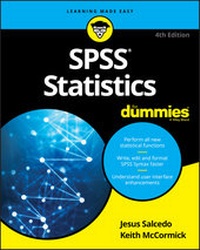
SPSS Statistics For Dummies
Description

Written by an author team with a combined 55 years of experience using SPSS, this updated guide takes the guesswork out of the subject and helps you get the most out of using the leader in predictive analysis.
Covering the latest release and updates to SPSS 27.0, and including more than 150 pages of basic statistical theory, it helps you understand the mechanics behind the calculations, perform predictive analysis, produce informative graphs, and more. You'll even dabble in programming as you expand SPSS functionality to suit your specific needs.
* Master the fundamental mechanics of SPSS
* Learn how to get data into and out of the program
* Graph and analyze your data more accurately and efficiently
* Program SPSS with Command Syntax
Get ready to start handling data like a pro--with step-by-step instruction and expert advice!
More details
Other editions
Additional editions
Persons
Content
Chapter 1
Introducing SPSS
IN THIS CHAPTER
Considering the quality of your data
Communicating with SPSS
Seeing how SPSS works
Finding help when you're stuck
A statistic is a number, but it's a special kind of number. A statistic is a measurement of some sort. It's fundamentally a count of something - occurrences, speed, amount, or whatever. A statistic is calculated using a sample. In a sense, a sample is the keyhole you have to peer through to see the population, which is what you're trying to understand. The value at the population level - the average height of an American male, for instance - is called a parameter. Unless you've got all the data there is, and you've collected a census of the population, you have to make do with the data in your sample. The job of SPSS is to calculate. Your job is to provide a good sample. Together you try to understand the population even though all you have is a sample.
In this chapter, we discuss the importance of having accurate, reliable data, and some of the implications when this is not the case. We talk also about how best to organize your data in SPSS and the different kinds of files that SPSS creates. We take a trip down memory lane and discuss the origins of SPSS so you can understand all of its many names. We discuss what can be done in the program and the different ways of communicating with the software. Finally, we spend some time discussing different ways in which you can get help when navigating SPSS.
SPSS's Job, Our Job, and Your Job
It's important to have appropriate expectations. In this section, we discuss the various roles that all parties play with regard to learning to use SPSS.
SPSS's job
After you give SPSS data and instructions, it will perform the calculations for you. The data and the metadata - the information about the data - have to be correct. (We have a lot to say about metadata.) The instructions have to be correct as well. Correct data processed with the wrong technique won't give you the results you need.
SPSS won't make math errors. That's not the kind of errors computers make. They always do exactly what we tell them to do, and sometimes that's the problem. SPSS's job is to take data that has been declared correctly and produce statistical results in the form of tables and charts that allow you to draw conclusions about your data - if you know how to interpret those results.
Our job
Your authors, Jesus and Keith, have had so many hours using SPSS that we've lost count. You may have heard of the somewhat controversial 10,000 hour rule, which states that you need that many hours of "deliberate practice" to truly master a complex subject. Well, you'll be pleased to know that Jesus and Keith each have more than 10,000 classroom hours teaching SPSS in addition to decades of using it on our own projects.
As the authors, we are primarily responsible for the following:
- Making the book easy to read: We know where to focus your attention when you're getting started because we've helped thousands of SPSS beginners get started.
- Walking you through how to set up everything properly: Parts 1 and 2 focus on getting started with SPSS as well as how to define data files, variables, and their attributes.
- Acclimating you regarding how SPSS works: Getting you familiar with the software is our number one focus and mission. We hope to get you to a point where you stop worrying about the software so you can concentrate on your analysis.
- Explaining how to tell SPSS to do basic tasks: This edition has a greatly expanded section in Parts 5 and 6 on understanding the basic theory, choosing the right technique, and interpreting results. We realize that if you're confused about SPSS, it may be because you're confused about statistics. However, we spend the rest of the book helping you understand the software.
- Starting you on your SPSS Statistics journey: You won't master statistics when you reach the end of this book, but you will be much more comfortable with SPSS software. No book of this length could cover all statistical techniques, but we selected the most important procedures for new users of SPSS.
Your job
Your number one job is to relax. You might be reading this book because you're up against a deadline or something in SPSS is causing you stress. However, if you take a little time now to understand how to work in SPSS efficiently, it will pay off in the long run. You have some other responsibilities:
- Know your data. SPSS can't put your data into context - only you can. SPSS will trust everything you give it. It will never second-guess the data you give it, and it will never ask you about it. Only you can ensure that the data is trustworthy.
- Declare your data and set it up properly. Declaring and setting up yourdata is a critical responsibility that we cover thoroughly, especially in Chapters 3 and 4. Setting up data is not just about declaring the metadata but also about other data management tasks that we cover in Part 3.
- Choose the correct statistical technique. The toughest task for you may be to choose the correct statistical technique. Dozens of techniques are available, but we know which ones are the most important to learn. We've given you a life preserver. If you feel stuck and don't know which chapter to refer to, check out Chapter 22, where we provide an overview for analyzing data and a larger context of where in the research process various statistical techniques are typically used.
- Know how to interpret the results. Finally, Parts 5 and 6 have many examples of how to interpret statistical output.
Garbage In, Garbage Out: Recognizing the Importance of Good Data
SPSS doesn't warn you when there is something wrong with your sample. Its job is to work on the data you give it. If what you give SPSS is incomplete or biased, or if there is data that doesn't belong in there, the resulting calculations won't reflect the population very well. Not much in the SPSS output will signal to anyone that there is a problem. So, if you're not careful, you can conclude just about anything from your data and your calculations.
Consider the data in Table 1-1. What if you calculated the survival rate of Titanic passengers based on this small sample? What if you calculated what fraction of the passengers were in each class of service? You can easily see that you'd be in real trouble.
TABLE 1-1 Sample of Titanic Passengers
Survived or Died
Class
Name
Sex
Age
Fare Paid
Cabin
Embarkation
Died
1
Andrews, Mr. Thomas, Jr.
Male
39
0.00
A36
Southampton
Died
1
Parr, Mr. William Henry Marsh
Male
0.00
Southampton
Died
1
Fry, Mr. Richard
Male
0.00
B102
Southampton
Died
1
Harrison, Mr. William
Male
40
0.00
B94
Southampton
Died
1
Reuchlin, Mr. John George
Male
38
0.00
Southampton
Died
2
Parkes, Mr. Francis "Frank"
Male
0.00
Southampton
Died
2
Cunningham, Mr. Alfred Fleming
Male
0.00
Southampton
Died
2
Campbell, Mr. William
Male
0.00
Southampton
Died
2
Frost, Mr. Anthony Wood "Archie"
Male
0.00
Southampton
Died
2
Knight, Mr. Robert J.
Male
0.00
Southampton
Died
2
Watson, Mr. Ennis...
