

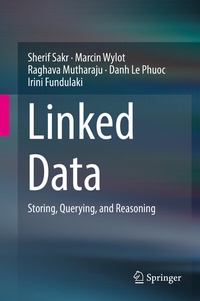
Linked Data
Storing, Querying, and Reasoning
1st Edition
Published on 1. March 2018
XX, 223 pages
978-3-319-73515-3 (ISBN)
Description

This book describes efficient and effective techniques for harnessing the power of Linked Data by tackling the various aspects of managing its growing volume: storing, querying, reasoning, provenance management and benchmarking.
To this end, Chapter 1 introduces the main concepts of the Semantic Web and Linked Data and provides a roadmap for the book. Next, Chapter 2 briefly presents the basic concepts underpinning Linked Data technologies that are discussed in the book. Chapter 3 then offers an overview of various techniques and systems for centrally querying RDF datasets, and Chapter 4 outlines various techniques and systems for efficiently querying large RDF datasets in distributed environments. Subsequently, Chapter 5 explores how streaming requirements are addressed in current, state-of-the-art RDF stream data processing. Chapter 6 covers performance and scaling issues of distributed RDF reasoning systems, while Chapter 7 details benchmarks forRDF query engines and instance matching systems. Chapter 8 addresses the provenance management for Linked Data and presents the different provenance models developed. Lastly, Chapter 9 offers a brief summary, highlighting and providing insights into some of the open challenges and research directions.
Providing an updated overview of methods, technologies and systems related to Linked Data this book is mainly intended for students and researchers who are interested in the Linked Data domain. It enables students to gain an understanding of the foundations and underpinning technologies and standards for Linked Data, while researchers benefit from the in-depth coverage of the emerging and ongoing advances in Linked Data storing, querying, reasoning, and provenance management systems. Further, it serves as a starting point to tackle the next research challenges in the domain of Linked Data management.
To this end, Chapter 1 introduces the main concepts of the Semantic Web and Linked Data and provides a roadmap for the book. Next, Chapter 2 briefly presents the basic concepts underpinning Linked Data technologies that are discussed in the book. Chapter 3 then offers an overview of various techniques and systems for centrally querying RDF datasets, and Chapter 4 outlines various techniques and systems for efficiently querying large RDF datasets in distributed environments. Subsequently, Chapter 5 explores how streaming requirements are addressed in current, state-of-the-art RDF stream data processing. Chapter 6 covers performance and scaling issues of distributed RDF reasoning systems, while Chapter 7 details benchmarks forRDF query engines and instance matching systems. Chapter 8 addresses the provenance management for Linked Data and presents the different provenance models developed. Lastly, Chapter 9 offers a brief summary, highlighting and providing insights into some of the open challenges and research directions.
Providing an updated overview of methods, technologies and systems related to Linked Data this book is mainly intended for students and researchers who are interested in the Linked Data domain. It enables students to gain an understanding of the foundations and underpinning technologies and standards for Linked Data, while researchers benefit from the in-depth coverage of the emerging and ongoing advances in Linked Data storing, querying, reasoning, and provenance management systems. Further, it serves as a starting point to tackle the next research challenges in the domain of Linked Data management.
More details
Other editions
Additional editions
Book
03/2018
Springer
€171.19
Shipment within 10-15 days
Persons
Sherif Sakr is a professor of computer and information science in the Health Informatics department at King Saud bin Abdulaziz University for Health Sciences, and is also affiliated with the University of New South Wales and DATA61/CSIRO in Australia. Sherif's research interests revolve around the areas of efficient and scalable Big Data Management, Processing and Analytics. In 2013, he was awarded the Stanford Innovation and Entrepreneurship Certificate.
Marcin Wylot is a postdoctoral researcher at TU Berlin, Germany, in the Open Distributed Systems group. His main research interests are in database systems for Semantic Web data, provenance in Linked Data, Internet of Things, and Big Data processing.
Raghava Mutharaju is a research scientist in the AI & Machine Learning Systems division of GE Global Research in Niskayuna, NY, USA. His research interests are in ontology modeling and reasoning, scalable SPARQLquery processing, Big Data, Semantic Web and its applications.
Danh Le Phuoc is a Marie Sklodowaka-Curie Fellow at TU Berlin. He is working on Pervasive Analytics which includes Linked Data/Semantic Web, Pervasive Computing, Future Internet and Big Data for Internet of Everything.
Irini Fundulaki is a Principal Researcher at the Institute of Computer Science of the Foundation for Research and Technology-Hellas. Her research interests are related to Web Data Management and more specifically the development of benchmarks for RDF engines, instance matching and link discovery systems, and the management of provenance for Linked Data.
Marcin Wylot is a postdoctoral researcher at TU Berlin, Germany, in the Open Distributed Systems group. His main research interests are in database systems for Semantic Web data, provenance in Linked Data, Internet of Things, and Big Data processing.
Raghava Mutharaju is a research scientist in the AI & Machine Learning Systems division of GE Global Research in Niskayuna, NY, USA. His research interests are in ontology modeling and reasoning, scalable SPARQLquery processing, Big Data, Semantic Web and its applications.
Danh Le Phuoc is a Marie Sklodowaka-Curie Fellow at TU Berlin. He is working on Pervasive Analytics which includes Linked Data/Semantic Web, Pervasive Computing, Future Internet and Big Data for Internet of Everything.
Irini Fundulaki is a Principal Researcher at the Institute of Computer Science of the Foundation for Research and Technology-Hellas. Her research interests are related to Web Data Management and more specifically the development of benchmarks for RDF engines, instance matching and link discovery systems, and the management of provenance for Linked Data.
Content
1 Introduction.- 2 Fundamentals.- 3 Centralized RDF Query Processing.- 4 Distributed RDF Query Processing.- 5 Processing of RDF Stream Data.- 6 Distributed Reasoning of RDF Data.- 7 Benchmarking RDF Query Engines and Instance Matching Systems.- 8 Provenance Management for Linked Data.- 9 Conclusions and Outlook.
