

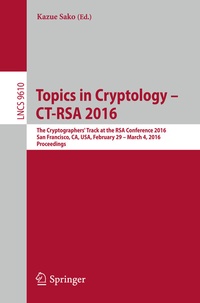
Topics in Cryptology - CT-RSA 2016
Description

This
book constitutes the refereed proceedings of the Cryptographer's Track at the
RSA Conference 2016, CT-RSA 2016, held in San Francisco, CA, USA, in February/March
2016.
The 26 papers presented in this volume were carefully reviewed and selected from 76 submissions. The focus of the track is on following subjects: secure key exchange schemes, authenticated encryption, searchable symmetric encryption, digital signatures with new functionality, secure multi party computation, how to verify procedures, side-channel attacks on elliptic curve cryptography, hardware attacks and security, structure-preserving signatures, lattice cryptography, cryptanalysis of symmetric key encryption, message authentication code and PRF-security, and security of public key encryption.
More details
Other editions
Additional editions
Content
- Intro
- Preface
- Organization
- Contents
- Secure Key Exchange Schemes
- Mitigating Server Breaches in Password-Based Authentication: Secure and Efficient Solutions
- 1 Introduction
- 2 Preliminaries
- 3 Security Model
- 4 Our Simple Protocol
- 4.1 Building Blocks
- 4.2 Login Procedure
- 5 Our Efficient Protocol
- 5.1 Building Blocks
- 5.2 Login Procedure
- 6 Conclusion
- References
- Strongly Leakage-Resilient Authenticated Key Exchange
- 1 Introduction
- 1.1 Motivations of This Work
- 1.2 Related Work
- 1.3 Our Results and Techniques
- 2 Preliminaries
- 2.1 Notation
- 2.2 Randomness Extractor
- 2.3 Pseudo-Random Function
- 2.4 Smooth Projective Hash Function
- 3 A New Strong Leakage-Resilient AKE Security Model
- 3.1 Challenge-Dependent Leakage-Resilient eCK Model
- 4 One-Round CLR-eCK-Secure AKE
- 4.1 General Framework
- 4.2 Security Analysis
- 5 An Instantiation from DDH Assumption
- References
- Authenticated Encryption
- INT-RUP Analysis of Block-cipher Based Authenticated Encryption Schemes
- 1 Introduction
- 1.1 Our Contributions
- 1.2 Significance of Our Results
- 2 Preliminaries
- 2.1 Rate of a Block-cipher Based AE Schemes
- 2.2 Block Matrices and Its Properties
- 3 Generalized ``rate-1'' Affine Mode AE Schemes
- 3.1 Affine Query and Mode
- 3.2 Affine Mode Authenticated Encryption Scheme
- 3.3 INT-RUP Insecurity of ``rate-1'' Block-Cipher Based Affine Mode AE Schemes
- 4 INT-RUP Analysis of CPFB, a Rate 34 Block-cipher Based AE Scheme
- 4.1 Revisting CPFB
- 4.2 INT-RUP Attack on CPFB
- 4.3 mCPFB: Modified CPFB with INT-RUP Security
- 4.4 INT-RUP Security for mCPFB
- 5 Conclusion and Future Work
- References
- From Stateless to Stateful: Generic Authentication and Authenticated Encryption Constructions with Application to TLS
- 1 Introduction
- 1.1 Our Contributions
- 1.2 Additional Related Work
- 2 Authentication Hierarchy
- 2.1 Definitions
- 2.2 Relations Among Authentication Notions
- 2.3 Constructing Higher Level Authentication Schemes
- 3 Authenticated Encryption Hierarchy
- 3.1 Definitions
- 3.2 Constructing Higher Level AEAD Schemes
- 4 Authenticated Encryption in TLS
- 4.1 TLS Sequence Numbers and Authentication Level
- 4.2 From TLS Level-1 AEAD to Level-4 AEAD
- References
- Searchable Symmetric Encryption
- Dynamic Symmetric Searchable Encryption from Constrained Functional Encryption
- 1 Introduction
- 2 Preliminaries
- 2.1 Bilinear Groups
- 2.2 Dual Spaces
- 2.3 Subset Membership Problem
- 2.4 Cryptographic Building Blocks
- 3 Constrained Functional Encryption over the Message Plaintext
- 3.1 Syntax
- 3.2 Security
- 3.3 Construction
- 4 Dynamic Searchable Symmetric Encryption
- 4.1 Syntax
- 4.2 Security
- 4.3 A Note on the Blue-Print
- 4.4 High-Level Idea
- 4.5 Description of the Construction
- 4.6 Security Analysis
- References
- Private Large-Scale Databases with Distributed Searchable Symmetric Encryption
- 1 Introduction
- 1.1 Related Work
- 1.2 Our Contributions
- 1.3 Roadmap
- 2 Background and Model
- 3 Overview of Our Construction
- 4 Formal Description
- 4.1 Technical Overview
- 4.2 Privacy Preserving Data Structures (PPDS)
- 4.3 General MPC
- 4.4 Weak Distributed Oblivious Permutation SPIR
- 4.5 Shared-Input Shared-Output SPIR
- 4.6 Linear Implementation
- 5 Full SSE and Range Queries
- 5.1 Weak Distributed Oblivious Permutation Range SPIR
- 5.2 FindEndpoints
- 5.3 Putting it All Together
- 6 Conclusion
- A Implementation and Benchmarking
- References
- Digital Signatures with New Functionality
- Short Randomizable Signatures
- 1 Introduction
- 1.1 Related Works
- 1.2 Our Contribution
- 1.3 Organization
- 2 Preliminaries
- 2.1 Bilinear Groups
- 2.2 Digital Signature Scheme
- 2.3 Sequential Aggregate Signature
- 3 Assumption
- 4 Our Randomizable Digital Signature Scheme
- 4.1 A Single-Message Signature Scheme
- 4.2 A Multi-message Signature Scheme
- 5 A Sequential Aggregate Signature
- 6 Useful Features
- 6.1 Signing Committed Messages
- 6.2 Proving Knowledge of a Signature
- 7 Efficiency
- 8 Conclusion
- References
- Non-Interactive Plaintext (In-)Equality Proofs and Group Signatures with Verifiable Controllable Linkability
- 1 Introduction
- 1.1 Background and Motivation
- 1.2 Related Work
- 1.3 Contribution
- 2 Preliminaries
- 2.1 Groth-Sahai (GS) Non-interactive Zero-Knowledge Proofs
- 2.2 Smooth Projective Hash Functions
- 2.3 Sign-and-Encrypt-and-Prove Paradigm
- 2.4 All-or-Nothing Public Key Encryption with Equality Tests
- 3 Non-interactive Plaintext (In-)Equality Proofs
- 3.1 A Generic Construction
- 3.2 Instantiation with PKEQ from ElGamal Encryption
- 4 GSSs with Verifiable Controllable Linkability
- 4.1 Model for GSSs with Verifiable Controllable Linkability
- 4.2 Verifiable Controllable Linkability
- References
- Secure Multi Party Computation
- Hybrid Publicly Verifiable Computation
- 1 Introduction
- 2 Background and Related Work
- 3 Hybrid Publicly Verifiable Computation
- 3.1 Security Models
- 4 Instantiating HPVC
- 4.1 Supporting Different Modes
- 4.2 Revocable Dual-Policy Attribute-Based Encryption
- 4.3 Construction
- 5 Conclusion
- References
- Efficient Concurrent Covert Computation of String Equality and Set Intersection
- 1 Introduction
- 1.1 Technical Overview
- 2 Preliminaries
- 2.1 The Ideal Cipher Model
- 2.2 Concurrent Covert Computation
- 2.3 Indexed Functionalities
- 2.4 Relaxed Covertness Notion for ISI Protocols
- 3 Compiling Single-Input TPCs to Multi-input TPCs
- 4 Instantiation of wC-covert String Equality Protocol
- References
- How to Verify Procedures
- Secure Audit Logs with Verifiable Excerpts
- 1 Introduction
- 2 Preliminaries, Notation and Conventions
- 3 Secure Logging with Verifiable Excerpts
- 3.1 Categorized Logging Schemes
- 3.2 Security Model
- 4 Our Scheme
- 4.1 Formal Description
- 4.2 Security Analysis
- 4.3 Performance Analysis
- 5 Conclusion
- References
- Efficient Culpably Sound NIZK Shuffle Argument Without Random Oracles
- 1 Introduction
- 2 Preliminaries
- 3 Unit Vector Argument
- 4 New Same-Message Argument
- 5 New Assumption: PSP
- 6 New Shuffle Argument
- References
- Side-Channel Attacks on Elliptic Curve Cryptography
- ECDH Key-Extraction via Low-Bandwidth Electromagnetic Attacks on PCs
- 1 Introduction
- 1.1 Our Contribution
- 1.2 Attack Overview
- 1.3 Targeted Software and Hardware
- 1.4 Related Work
- 2 Cryptanalysis
- 2.1 GnuPG's Elliptic Curve Encryption Implementation
- 2.2 ECDH Attack Algorithm
- 2.3 Attacking the Always-Add Algorithm
- 3 Signal Analysis and Experimental Results
- 3.1 Experimental Setup
- 3.2 Signal Analysis
- 3.3 Measuring the EM Leakage Through a Wall
- 4 Conclusion
- References
- Side-Channel Analysis of Weierstrass and Koblitz Curve ECDSA on Android Smartphones
- 1 Introduction
- 2 Background on Elliptic Curve Cryptography
- 3 Signal Processing
- 3.1 Synchronizing the Acquisitions
- 3.2 Energy Variations - Leakage Frequencies
- 4 Lattice Attack on ECDSA
- 4.1 ECDSA over Prime Fields
- 4.2 New Attack on Koblitz ECDSA
- 5 Use Case: Bitcoin Wallet
- References
- Hardware Attacks and Security
- Enhancing Side-Channel Analysis of Binary-Field Multiplication with Bit Reliability
- 1 Introduction
- 2 Fresh Re-Keying and Template Attacks
- 2.1 Fresh Re-Keying
- 2.2 Template Attacks and Leakage Model
- 3 LPN and Solving Algorithms
- 3.1 Learning Parity with Noise
- 3.2 Algorithms for Decoding Random Linear Codes
- 4 Attack Outline and Setup
- 4.1 Outline
- 4.2 Fresh Re-Keying and 8-Bit Leakage
- 4.3 128-Bit Leakage
- 5 Using Reliability to Increase Attack Performance
- 5.1 LPVN: A New LPN Variant
- 5.2 Filtering
- 5.3 Using Reliability in Stern's Attack
- 6 Simulation and Practical Experiments
- 6.1 Fresh Re-Keying on an 8-Bit Platform
- 6.2 128-Bit Leakage
- 6.3 Comparison of Algorithms
- 7 Conclusion and Future Work
- References
- Towards a Unified Security Model for Physically Unclonable Functions
- 1 Introduction
- 2 Notations
- 3 Security Model: Properties and Their Relationships
- 3.1 Output Distribution
- 3.2 One-Wayness
- 3.3 Unforgeability
- 3.4 Unclonability
- 3.5 Indistinguishability
- 3.6 Pseudorandomness
- 3.7 Tamper-Resilience
- 3.8 Relationships Between the Security Properties
- 4 Comparison to Existing Security Models
- 5 Conclusion
- References
- Structure-Preserving Signatures
- Cryptanalysis of the Structure-Preserving Signature Scheme on Equivalence Classes from Asiacrypt 2014
- 1 Introduction
- 2 Preliminaries
- 2.1 Bilinear Map
- 2.2 Structure-Preserving Signature Scheme on Equivalence Classes
- 2.3 Security of Digital Signature Scheme
- 3 The Hanser-Slamanig SPS-EQ Scheme
- 3.1 Description of the Hanser-Slamanig SPS-EQ Scheme
- 3.2 Fuchsbauer's Attack to Break the EUF-CMA of the Scheme
- 4 Our Attacks
- 4.1 Key Observation of Our Attacks
- 4.2 Procedure to Find Nontrivial Element in ker()
- 4.3 Breaking the EUF-Non-Adaptive-CMA of the Scheme
- 4.4 The Universal Forgery Attack Against the Scheme
- 4.5 Interesting Observations
- 5 Conclusion
- References
- Short Structure-Preserving Signatures
- 1 Introduction
- 2 Preliminaries
- 2.1 Bilinear Groups
- 2.2 Complexity Assumptions
- 2.3 Digital Signatures
- 2.4 Randomizable Weakly Blind Signatures
- 2.5 Groth-Sahai Proofs
- 3 Our Structure-Preserving Signature Scheme
- 3.1 Efficiency Comparison
- 4 Applications of Our Scheme
- 4.1 Direct Anonymous Attestation
- 4.2 Group Signatures and Similar Primitives
- References
- Lattice Cryptography
- Which Ring Based Somewhat Homomorphic Encryption Scheme is Best?
- 1 Introduction
- 2 Preliminaries
- 3 Ring Based SHE Schemes
- 3.1 Key Generation
- 3.2 Encryption and Decryption
- 3.3 Scale
- 3.4 Reduce Level
- 3.5 Switch Key
- 3.6 Addition and Multiplication
- 3.7 Security and Parameters
- 4 Results
- References
- NFLlib: NTT-Based Fast Lattice Library
- 1 Introduction
- 1.1 Our Contribution: NFLlib
- 1.2 Related Work
- 1.3 Outline
- 2 Preliminaries
- 3 NFLlib: A Library for Ideal-Lattice Cryptography
- 3.1 Fixed-Size CRT Representation
- 3.2 Optimizing the Modular Multiplication
- 3.3 A Lazy NTT Algorithm
- 4 Performances Evaluation and Comparison with NTL, FLINT and HElib
- 5 Implementing Ideal Lattice Cryptography with NFLlib
- 5.1 High Performance Key Exchange
- 5.2 Using NFLlib for Homomorphic Encryption
- 6 Conclusion
- References
- Cryptanalysis of Symmetric Key Encryption
- Optimization of Rainbow Tables for Practically Cracking GSM A5/1 Based on Validated Success Rate Modeling
- 1 Introduction
- 2 GSM and Related Work
- 3 Analysis of A5/1 TMTO Characteristics
- 3.1 Chain Characteristics
- 3.2 Keystream Space Shrinking
- 3.3 Intermediate Space and Chain Collisions
- 3.4 Success Rate
- 3.5 False Alarms
- 4 System Evaluation
- 4.1 Implementation and Settings
- 4.2 Performance Evaluation of the Project
- 5 Conclusions and Future Work
- A Appendix
- B Appendix
- References
- New Observations on Piccolo Block Cipher
- 1 Introduction
- 2 Description of Piccolo
- 2.1 Encryption Algorithm
- 2.2 Key Schedule Algorithm
- 3 Linear-Reflection Weak Keys of Piccolo
- 3.1 Definition of Weak Key
- 3.2 Searching Weak Keys for Piccolo
- 3.3 Weak Keys of Piccolo
- 4 New Observations on Piccolo-128
- 4.1 Property of Key Schedule of Piccolo-128
- 4.2 Observations on Piccolo-128
- 5 Conclusion
- References
- Message Authentication Code and PRF-Security
- Replacing SHA-2 with SHA-3 Enhances Generic Security of HMAC
- 1 Introduction
- 2 Preliminaries
- 3 Specification of HMAC_Sponge and Security Results
- 3.1 Specification of HMAC_Sponge
- 3.2 Security Results
- 4 Proof of Theorem1
- 5 Proof of Theorem2
- References
- Constrained PRFs for Unbounded Inputs
- 1 Introduction
- 2 Preliminaries
- 2.1 Constrained and Puncturable PRFs
- 2.2 Collision-Resistant Hash Functions
- 2.3 Indistinguishability and Differing-Input Obfuscation
- 2.4 Succinct Non-interactive Arguments of Knowledge
- 3 Constrained PRFs for Unbounded Inputs
- 3.1 A Circuit-Constrained PRF
- 3.2 A TM-Constrained PRF
- References
- Security of Public Key Encryption
- Construction of Fully CCA-Secure Predicate Encryptions from Pair Encoding Schemes
- 1 Introduction
- 2 Background
- 2.1 Predicate Families
- 2.2 Predicate Key-Encapsulation Mechanisms
- 2.3 Composite Order Bilinear Groups
- 2.4 Security Assumptions
- 3 Framework for CCA-Secure P-KEMs
- 3.1 Pair Encoding Schemes
- 3.2 Additional Requirements of CCA-Secure Framework
- 3.3 Fully CCA-Secure Framework
- 4 Main Theorem and Extended Proof Technique
- 5 Comparison with Generic Constructions and Conclusion
- References
- Factoring N=prqs for Large r and s
- 1 Introduction
- 2 Background
- 2.1 LLL and Simultaneous Diophantine Approximation
- 2.2 Coppersmith's Algorithm
- 2.3 The Boneh-Durfee-Howgrave-Graham Algorithm
- 3 Factoring N=prqs for Large r
- 3.1 Proof of Theorem7
- 4 Generalization to N=i=1k piri for Large ri's
- 5 Experiments
- A Coppersmith's Second Theorem for Factoring N=prqs
- B Coppersmith's First Theorem
- C The BDH Method for Factoring N=prq
- D Proof of Theorem6
- References
- Author Index
