

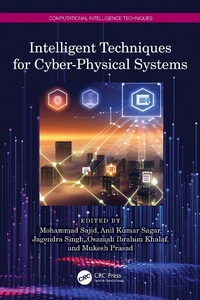
Intelligent Techniques for Cyber-Physical Systems
1st Edition
Published on 20. October 2023
356 pages
978-1-000-96427-1 (ISBN)
Description

Intelligent Techniques for Cyber-Physical Systems covers challenges, opportunities, and open research directions for cyber-physical systems (CPS). It focuses on the design and development of machine learning and metaheuristics-enabled methods as well as blockchain for various challenges like security, resource management, computation offloading, trust management, and others in edge, fog, and cloud computing, Internet of Things (IoT), Internet of Everything (IoE), and smart cities. It also includes the design and analysis of deep learning-based models, sensing technologies, metaheuristics, and blockchain for complex real-life systems for CPS.
Offers perspectives on the research directions in CPS;
Provides state-of-the-art reviews on intelligent techniques, machine learning, deep learning, and reinforcement learning-based models for cloud-enabled IoT environment;
Discusses intelligent techniques for complex real-life problems in different CPS scenarios;
Reviews advancements in blockchain technology and smart cities;
Explores machine learning-based intelligent models for combinatorial optimization problems.
The book is aimed at researchers and graduate students in computer science, engineering, and electrical and electronics engineering.
Offers perspectives on the research directions in CPS;
Provides state-of-the-art reviews on intelligent techniques, machine learning, deep learning, and reinforcement learning-based models for cloud-enabled IoT environment;
Discusses intelligent techniques for complex real-life problems in different CPS scenarios;
Reviews advancements in blockchain technology and smart cities;
Explores machine learning-based intelligent models for combinatorial optimization problems.
The book is aimed at researchers and graduate students in computer science, engineering, and electrical and electronics engineering.
More details
Series
Edition
1. Auflage
Language
English
Place of publication
London
United Kingdom
Publishing group
Taylor & Francis Ltd
Target group
College/higher education
Professional and scholarly
Product notice
Reflowable
Illustrations
30 Tables, black and white; 98 Line drawings, black and white; 12 Halftones, black and white; 110 Illustrations, black and white
ISBN-13
978-1-000-96427-1 (9781000964271)
Copyright in bibliographic data and cover images is held by Nielsen Book Services Limited or by the publishers or by their respective licensors: all rights reserved.
Schweitzer Classification
Other editions
Additional editions
Mohammad Sajid | Anil Kumar Sagar | Jagendra Singh
Intelligent Techniques for Cyber-Physical Systems
Book
05/2025
1st Edition
CRC Press
€77.30
Shipment within 10-20 days
Mohammad Sajid | Anil Kumar Sagar | Jagendra Singh
Intelligent Techniques for Cyber-Physical Systems
Book
10/2023
1st Edition
CRC Press
€186.90
Shipment within 10-20 days
Persons
Mohammad Sajid is Assistant Professor in the Department of Computer Science at Aligarh Muslim University, India. He has completed his Ph.D., M.Tech., and MCA degrees at the School of Computer and Systems Sciences, Jawaharlal Nehru University (JNU), New Delhi. His research interests include parallel and distributed computing, cloud computing, bio-inspired computation, and combinatorial optimization problems. He has published one patent and was awarded a research start-up grant in 2017 from University Grants Commission (UGC), India.
Anil Kumar Sagar is Professor in the Department of Computer Science and Engineering at Sharda University Greater Noida, India. He completed his B.E., M.Tech., Ph.D. in Computer Science. His research interests include mobile ad hoc networks and vehicular ad hoc networks, IoT, and artificial intelligence. He has received a Young Scientist Award for the year 2018-2019 from the Computer Society of India and the Best Faculty Award for the years 2006 and 2007 from SGI, Agra.
Jagendra Singh is Associate Professor in the School of Computer Science, Engineering and Technology, Bennett University, Greater Noida. He received his Ph.D. in Computer Science from Jawaharlal Nehru University, New Delhi. His areas of interest are natural language processing (information retrieval system, recommendation system, sentiment analysis) and machine learning (deep learning, neural network, and data analytics).
Osamah Ibrahim Khalaf is Senior Assistant Professor in Engineering and Telecommunications at Al-Nahrain University/College of Information Engineering. He holds 10 years of university-level teaching experience in computer science and network technology, holds patents, and has received several medals and awards due to his innovative work and research activities. He earned his Ph.D. in Computer Networks from the Faculty of Computer Systems and Software Engineering, University of Malaysia Pahang. He has overseas work experience at Binary University in Malaysia and University of Malaysia Pahang.
Mukesh Prasad is Senior Lecturer at the School of Computer Science in the Faculty of Engineering and IT at the University of Technology Sydney. His research interests include big data, computer vision, brain-computer interface, and evolutionary computation. He is also working in the field of image processing, data analytics, and edge computing. His research is backed by industry experience, specifically in Taiwan, where he was the principal engineer (2016-2017) at the Taiwan Semiconductor Manufacturing Company (TSMC). He received a Ph.D. from the Department of Computer Science at the National Chiao Tung University in Taiwan (2015).
Anil Kumar Sagar is Professor in the Department of Computer Science and Engineering at Sharda University Greater Noida, India. He completed his B.E., M.Tech., Ph.D. in Computer Science. His research interests include mobile ad hoc networks and vehicular ad hoc networks, IoT, and artificial intelligence. He has received a Young Scientist Award for the year 2018-2019 from the Computer Society of India and the Best Faculty Award for the years 2006 and 2007 from SGI, Agra.
Jagendra Singh is Associate Professor in the School of Computer Science, Engineering and Technology, Bennett University, Greater Noida. He received his Ph.D. in Computer Science from Jawaharlal Nehru University, New Delhi. His areas of interest are natural language processing (information retrieval system, recommendation system, sentiment analysis) and machine learning (deep learning, neural network, and data analytics).
Osamah Ibrahim Khalaf is Senior Assistant Professor in Engineering and Telecommunications at Al-Nahrain University/College of Information Engineering. He holds 10 years of university-level teaching experience in computer science and network technology, holds patents, and has received several medals and awards due to his innovative work and research activities. He earned his Ph.D. in Computer Networks from the Faculty of Computer Systems and Software Engineering, University of Malaysia Pahang. He has overseas work experience at Binary University in Malaysia and University of Malaysia Pahang.
Mukesh Prasad is Senior Lecturer at the School of Computer Science in the Faculty of Engineering and IT at the University of Technology Sydney. His research interests include big data, computer vision, brain-computer interface, and evolutionary computation. He is also working in the field of image processing, data analytics, and edge computing. His research is backed by industry experience, specifically in Taiwan, where he was the principal engineer (2016-2017) at the Taiwan Semiconductor Manufacturing Company (TSMC). He received a Ph.D. from the Department of Computer Science at the National Chiao Tung University in Taiwan (2015).
Content
1. Delay-Aware Partial Computational Offloading and Resource Allocation in Fog-Enabled Cyber-Physical Systems 2. Enhancing the Security of Cryptographic Algorithms in Cloud-Based Cyber-Physical Systems (CCPS) 3. Containerized Deployment of Microservices in Cloud Computing 4. RSS-Based Smart Device Localization using Few-Shot Learning in IoT Networks 5. Data-Driven Risk Modelling of Cyber-Physical Systems 6. Automation of the Process of Analysis of Information Security Threats in Cyber-Physical Systems 7. IoT in Healthcare: Glucose Tracking System 8. Intelligent Application to Support Smart Farming Using Cloud Computing: Future Perspectives 9. Cybersecurity in Automous Vehicles 10. Use of Virtual Payment Hubs over Cryptocurrencies 11. Akaike's Information Criterion Algorithm for Online Cashback in Vietnam 12. Capacitated Vehicle Routing Problem Using Algebraic Harris Hawks Optimization Algorithm 13. Technology for Detecting Harmful Effects on the UAV Navigation and Communication System 14. Current and Future Trends of Intelligent Transport System Using AI in Rural Areas 15. Future Technology: Internet of Things (IoT) in Smart Society 5.0 16. IoT, Cloud Computing, and Sensing Technology for Smart Cities 17. Utilization of Artificial Intelligence in Electrical Engineering 18. Major Security Issues and Data Protection in Cloud Computing and IoT
