

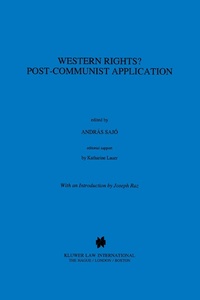
Western Rights? Post-Communist Application
Published on 1. July 1996
406 pages
978-90-411-7240-2 (ISBN)
Description

This work provides a complete record of the discussisons held and papers presented at a conference on 'The Individual v. The State', held in Budapest at the Central European University, which focused on various theories about the nature and role of rights.
Rights have the function of protecting the individual against collectivity, against restrictions of individual freedom and against the imposition of burdens on individuals for the sake of the common good. Joseph Raz argues in his introduction that rights cannot be understood in terms of these functions as this would distort the understanding of their role in morality and law.
The book is divided into six parts, covering the following key topics:
Concepts of Rights
Transition to Rights--Rights in Transition
Equality and Social Rights
Minorities and Citizenship
The International Dimension
Economics of Rights
It shows how varied the understanding of rights is among different theorists and in the practice of different countries, and will be of prime interest to academics involved in legal theory.
Rights have the function of protecting the individual against collectivity, against restrictions of individual freedom and against the imposition of burdens on individuals for the sake of the common good. Joseph Raz argues in his introduction that rights cannot be understood in terms of these functions as this would distort the understanding of their role in morality and law.
The book is divided into six parts, covering the following key topics:
Concepts of Rights
Transition to Rights--Rights in Transition
Equality and Social Rights
Minorities and Citizenship
The International Dimension
Economics of Rights
It shows how varied the understanding of rights is among different theorists and in the practice of different countries, and will be of prime interest to academics involved in legal theory.
More details
Other editions
Additional editions
Andras Sajo
Western Rights?:Post-Communist Application
Book
07/1996
1st Edition
Kluwer Law International
€125.19
Shipment within 10-20 days
Content
- Cover
- Half Title Page
- Title Page
- Copyright Page
- Table of Contents
- INTRODUCTION THE IMPORTANCE OF RIGHTS AND THEIR LIMITS
- 1.
- 2.
- 3.
- 4.
- 5.
- PART I CONCEPTS OF RIGHTS
- CHAPTER 1 STATIC AND DYNAMIC DIMENSIONS OF RIGHTS
- CHAPTER 2 PROCEDURAL RIGHTS IN ADMINISTRATIVE CONTEXTS
- 1. Introduction
- 2. Procedural Fairness and Procedural Due Process
- 3. Procedural Rights
- 4. Procedural Rights in Context
- CHAPTER 3 PRIVACY AS A RIGHT
- 1. Privacy and Its Enemies
- 2. Main Issues Relating to Privacy
- 3. Concluding Remarks
- PART II TRANSITION TO RIGHTS - RIGHTS IN TRANSITION
- CHAPTER 4 THE STRUGGLE FOR LAW IN POST-SOVIET RUSSIA
- CHAPTER 5 NEW RIGHTS AND OLD RIGHTS, NEW SYMBOLS AND OLD MEANINGS: RE-DESIGNING LIBERTIES AND FREEDOMS IN POST-SOCIALIST AND POST-SOVIET CONSTITUTIONS
- 1. Introduction
- 2. Basic Rights in the New Constitutions
- 3. Basic Duties
- 4. Limitations, Restrictions and Patterns of Balancing
- 5. Shortcomings, Omissions and Misunderstandings
- 6. Summary: The Post -Socialist Constitutional Cocktail and its Ingredients
- CHAPTER 6 FROM RIGHTS TO MYTHS: TRANSFORMATION IN POST-COMMUNIST EUROPE
- 1. Introduction
- 2. The Transformation
- 3. Conflicting Rhetoric: Rights in Sociological Perspective
- 4. Rights and Myths
- 5. Conclusions: Rights Discourse and Legacy of the Past
- CHAPTER 7 RIGHTS, CIVIL SOCIETY, AND POST-COMMUNIST SOCIETY
- 1. Liberalism and Rights
- 2. Rights and Civil Society
- 3. Civil Society and Post-Communist Society
- CHAPTER 8 RIGHTS IN POST-COMMUNISM
- 1. Clarifying Rights
- 2. "Rights" in State-Socialism
- 3. After the Collapse: The Formative Period
- 4. Unfinished Rights Revolution
- 5. Are Rights Needed in Transition?
- 6. Conclusions
- PART III EQUALITY AND SOCIAL RIGHTS
- CHAPTER 9 TOWARDS A RECONSTRUCTION OF CONSTITUTIONAL EQUALITY
- 1. Centrality and Elusiveness of Constitutional Equality
- 2. The Framework for Reconstruction: Setting Normative Ideals Against the Dialectics of Equality
- 3. The Interplay Between Identity and Difference, Inclusion and Exclusion
- 4. The Nexus Between Comprehensive Pluralism and Constitutional Equality
- 5. Concluding Remarks: On the Broad Outlines of the Reconstruction of Constitutional Equality
- CHAPTER 10 SOCIAL RIGHTS, CITIZENSHIP AND THE MARKET
- 1. Introduction
- 2. An Outline of Marshall's Thesis
- 3. Three Critiques of Marshall's Thesis
- 4. Citizenship as a Contested Concept
- 5. Implications for Hungary
- CHAPTER 11 THE CONCEPTUAL DIFFICULTIES OF WELFARE RIGHTS
- 1. Introduction: The Controversial Issue of Welfare Rights in the Idea of Constitutionalism
- 2. The Dynamic Character of Modern Law
- 3. The "Irreponsibility" of Subjective Rights
- 4. The Distributive Rights of the Welfare State
- 5. Difficulties in the Underlying Assumptions of Distributive Rights
- 6. Concluding Remark
- CHAPTER 12 AGAINST POSITIVE RIGHTS
- CHAPTER 13 SOCIAL AND ECONOMIC RIGHTS IN A NEW CONSTITUTION FOR POLAND
- 1. Summary
- 2. Introduction
- 3. Social and Economic Rights as Human Rights
- 4. Social and Economic Rights as Legal and Constitutional Rights
- 5. The Need for Social and Economic Policies During Transition to Democracy and Market
- 6. The Debate on the Inclusion of Social and Economic Rights in Post-Communist Constitutions
- 7. The Consequences of the Constitutionalization of Social and Economic Rights
- 8. Protecting Social and Economic Rights: A Two-Tier Scheme
- 9. Conclusions
- PART IV MINORITIES AND CITIZENSHIP
- CHAPTER 14 THE EFFECT OF ETHNO-NATIONALISM ON CITIZENS' RIGHTS IN THE FORMER COMMUNIST COUNTRIES
- 1. The Meaning of Ethno-Nationalism
- 2. Operation of Ethno-Nationalism in Eastern European Law-Making
- 3. Concern for the "Ethnics Abroad
- 4. Restricting the Rights of Non-Dominant Ethnics
- 5. The Dangers of Ethno-Nationalism
- 6. Palliatives to Ethno-Nationalism
- CHAPTER 15 THE CONCEPT OF GROUP RIGHTS IN THE FIELD OF PROTECTION OF MINORITIES
- 1. Origins of the Group Concept
- 2. The Meaning of Group Rights
- 3. International Law
- 4. National Law in Eastern Europe
- 5. Problems with the Holder of Group Rights
- VI. Conclusion
- CHAPTER 16 THE GUARANTEE OF HUMAN RIGHTS AND FUNDAMENTAL FREEDOMS: FROM THE THEORY OF NATIONAL SOVEREIGNTY TO THE INTERNATIONAL DECLARATIONS AND COVENANTS
- PART V THE INTERNATIONAL DIMENSION
- CHAPTER 17 ARE THERE EQUAL STANDARDS FOR THE PROTECTION OF INDIVIDUAL RIGHTS AND "STATE RIGHTS"? THE CASE OF THE EUROPEAN COMMUNITY
- CHAPTER 18 THE RIGHT TO LIBERTY AND SECURITY OF PERSON UNDER THE EUROPEAN CONVENTION ON HUMAN RIGHTS
- 1. Introduction
- 2. Article 5 and its Provisions
- 3. Personal Liberty in the United Kingdom's Constitutional Tradition
- 4. The Article 5 Law -- A Selective Analysis
- 5. Some Conclusions
- PART VI ECONOMICS OF RIGHTS
- CHAPTER 19 THE IMPACT OF RIGHTS ON ECONOMIC PERFORMANCE
- 1. Human Rights in Modern Constitutions
- 2. Conceptions of Economic Performance
- 3. The Impact of Rights on Performance
- 4. Conclusion
- CHAPTER 20 CONSTITUTIONAL COSTS TO FREE MARKET TRANSITIONS
- 1. Dual Transitions: Constitutions and Markets
- 2. Some Transitional Experiences
- 3. The Economic Reform Power and the Authoritarian Executive
- 4. Economic Transitions and Economic Rights
- 5. Constitutional Corollaries to Economic Reform: A Transitional Account
- LIST OF CONTRIBUTORS
- Back Cover
