

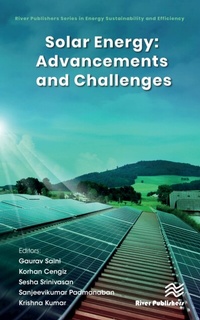
Solar Energy: Advancements and Challenges
1st Edition
Published on 8. March 2023
188 pages
978-1-000-84733-8 (ISBN)
Description

Energy is a key source of economic growth due to its involvement as the primary input. Energy drives economic productivity and industrial growth. It can be considered as the prime requirement for the modern economy. Solar energy is a renewable source of energy that can be used to produce heat or generate electricity. The total amount of solar energy available on Earth's surface is vastly in excess of the world's current and anticipated energy requirements. In the 21st century, solar energy is expected to become increasingly attractive as a renewable energy source. An increase in the share of solar energy may destabilize the grid. To overcome the issues of grid instability, specifically in remote areas, BIM and GIS-based microgrid planning based on data can be effectively used. BIM and GIS are used to assess alternative solutions and big data analytics in building solar electrical systems according to planning requirements and managing assets. The integration of BIM and GIS information systems for microgrid planning is appealing due to its potential benefits, such as it decreases the microgrid planning time and cost.
The present book is about the advancements in technology for harnessing solar energy and the challenges associated with different modes of utilizing this inexhaustible renewable energy source. This book will be helpful for researchers, academicians, technologists, innovators, and industry experts working in the area of solar energy, artificial intelligence, and smart grids.
The present book is about the advancements in technology for harnessing solar energy and the challenges associated with different modes of utilizing this inexhaustible renewable energy source. This book will be helpful for researchers, academicians, technologists, innovators, and industry experts working in the area of solar energy, artificial intelligence, and smart grids.
More details
Series
Edition
1. Auflage
Language
English
Place of publication
London
United Kingdom
Publishing group
Taylor & Francis Ebooks
Target group
Professional and scholarly
Illustrations
25 Tables, black and white; 74 Illustrations, color; 25 Illustrations, black and white
ISBN-13
978-1-000-84733-8 (9781000847338)
Copyright in bibliographic data and cover images is held by Nielsen Book Services Limited or by the publishers or by their respective licensors: all rights reserved.
Schweitzer Classification
Other editions
Additional editions
Gaurav Saini | Korhan Cengiz | Sesha Srinivasan
Solar Energy: Advancements and Challenges
Advancements and Challenges
Book
03/2023
1st Edition
River Publishers
€151.00
Article not available for order
Persons
Dr. Gaurav Saini is presently working as Assistant Professor at the Indian Institute of Engineering Science and Technology, Shibpur, India. He did his Doctorate and Master's in renewable energy from the Indian Institute of Technology Roorkee and graduated in Mechanical Engineering from Gautam Buddha Technical University Lucknow, India. He has more than five years of teaching and research experience in the field of renewable energy and related technology. He has published several research publications in refereed journals and shared his research at national and international platforms like IEEE, Elsevier, Springer, and Wiley. His research field includes renewable energy technology, hydraulic turbines, computational fluid dynamics, and optimization.
Dr. Korhan Cengiz received a Ph.D. degree in electronics engineering from Kadir Has University, Turkey in 2016. Since 2021 he has been the department vice-chair of Electrical-Electronics Engineering, Trakya University, Turkey. He is the author of over 40 articles in publications including IEEE Internet of Things Journal and IEEE Access, has four international patents, and has written four book chapters. His research interests include WSNs, indoor positioning systems, IoT, and 5G. He is Handling Editor of Microprocessors and Microsystems, Elsevier, and associate editor of IET Electronics Letters. He has served as a Guest Editor for IEEE Internet of Things Magazine.
Dr. Sesha Srinivasan is presently working as a Professor at the Florida Polytechnic University. Prior to that, he spent five years as a tenure-track assistant professor of physics at Tuskegee University, Alabama. Srinivasan has more than a decade of research experience in the interdisciplinary areas of solid-state and condensed matter physics, inorganic chemistry, and chemical and materials science engineering. He and his post-doctoral advisor have collaborated extensively with scientists around the world on hydrogen storage on lightweight complex hydrides, which was funded by the U.S. Department of Energy (DOE) and the World Energy Network (WE-NET), Japan. He has also served as an associate director of the Florida Energy Systems Consortium (FESC). He coordinated a number of research projects on clean energy and the environment, funded by a $9 million grant from the Florida Office of Energy. Srinivasan has been awarded several research grants worth more than $1 million from both federal (DOE, National Science Foundation, Office of Naval Research) and private (BP-Oil Spill, QuantumSphere Inc.) funding sources. He was recently awarded two U.S. patents on hydrogen storage nanomaterials development and methodologies, and two U.S. patents are pending.
Dr. Sanjeevikumar Padmanaban (Member'12-Senior Member'15, IEEE) received a Ph.D. degree in electrical engineering from the University of Bologna, Bologna, Italy, in 2012. He was an Associate Professor with VIT University from 2012 to 2013. In 2013, he joined the National Institute of Technology, India as a Faculty Member. In 2014, he was invited as a Visiting Researcher at the Department of Electrical Engineering, Qatar University, Doha, Qatar, funded by the Qatar National Research Foundation (Government of Qatar). He continued his research activities with the Dublin Institute of Technology, Dublin, Ireland, in 2014. Further, he served as an Associate Professor with the Department of Electrical and Electronics Engineering, University of Johannesburg, South Africa from 2016 to 2018. Since 2018, he has been a Faculty Member with the Department of Energy Technology, Aalborg University, Esbjerg, Denmark. He is an Editor/Associate Editor/Editorial Board member for refereed journals, in particular the IEEE Systems Journal, IEEE Transactions on Industry Applications, IEEE ACCESS, IET Power Electronics, IET Electronics Letters, and Wiley-International Transactions on Electrical Energy Systems. He is the Subject Editorial Board Member for Energy Sources, Energies Journal, MDPI, and the Subject Editor for the IET Renewable Power Generation, IET Generation, Transmission and Distribution, and FACTS journal (Canada)
Er. Krishna Kumar is presently working as a Research and Development Engineer at UJVN Ltd. Before joining UJVNL. He worked as Assistant Professor at BTKIT, Dwarahat. He received his B.Eng. (Electronics and Communication Engineering) from Govind Ballabh Pant Engineering College, Pauri Garhwal, and M.Tech. (Digital Systems) from Motilal Nehru NIT Allahabad. He is currently pursuing his Ph.D. from the Indian Institute of Technology, Roorkee. He has over 11 years of experience and has published numerous research papers in international journals. His research areas include renewable energy and artificial intelligence.
Dr. Korhan Cengiz received a Ph.D. degree in electronics engineering from Kadir Has University, Turkey in 2016. Since 2021 he has been the department vice-chair of Electrical-Electronics Engineering, Trakya University, Turkey. He is the author of over 40 articles in publications including IEEE Internet of Things Journal and IEEE Access, has four international patents, and has written four book chapters. His research interests include WSNs, indoor positioning systems, IoT, and 5G. He is Handling Editor of Microprocessors and Microsystems, Elsevier, and associate editor of IET Electronics Letters. He has served as a Guest Editor for IEEE Internet of Things Magazine.
Dr. Sesha Srinivasan is presently working as a Professor at the Florida Polytechnic University. Prior to that, he spent five years as a tenure-track assistant professor of physics at Tuskegee University, Alabama. Srinivasan has more than a decade of research experience in the interdisciplinary areas of solid-state and condensed matter physics, inorganic chemistry, and chemical and materials science engineering. He and his post-doctoral advisor have collaborated extensively with scientists around the world on hydrogen storage on lightweight complex hydrides, which was funded by the U.S. Department of Energy (DOE) and the World Energy Network (WE-NET), Japan. He has also served as an associate director of the Florida Energy Systems Consortium (FESC). He coordinated a number of research projects on clean energy and the environment, funded by a $9 million grant from the Florida Office of Energy. Srinivasan has been awarded several research grants worth more than $1 million from both federal (DOE, National Science Foundation, Office of Naval Research) and private (BP-Oil Spill, QuantumSphere Inc.) funding sources. He was recently awarded two U.S. patents on hydrogen storage nanomaterials development and methodologies, and two U.S. patents are pending.
Dr. Sanjeevikumar Padmanaban (Member'12-Senior Member'15, IEEE) received a Ph.D. degree in electrical engineering from the University of Bologna, Bologna, Italy, in 2012. He was an Associate Professor with VIT University from 2012 to 2013. In 2013, he joined the National Institute of Technology, India as a Faculty Member. In 2014, he was invited as a Visiting Researcher at the Department of Electrical Engineering, Qatar University, Doha, Qatar, funded by the Qatar National Research Foundation (Government of Qatar). He continued his research activities with the Dublin Institute of Technology, Dublin, Ireland, in 2014. Further, he served as an Associate Professor with the Department of Electrical and Electronics Engineering, University of Johannesburg, South Africa from 2016 to 2018. Since 2018, he has been a Faculty Member with the Department of Energy Technology, Aalborg University, Esbjerg, Denmark. He is an Editor/Associate Editor/Editorial Board member for refereed journals, in particular the IEEE Systems Journal, IEEE Transactions on Industry Applications, IEEE ACCESS, IET Power Electronics, IET Electronics Letters, and Wiley-International Transactions on Electrical Energy Systems. He is the Subject Editorial Board Member for Energy Sources, Energies Journal, MDPI, and the Subject Editor for the IET Renewable Power Generation, IET Generation, Transmission and Distribution, and FACTS journal (Canada)
Er. Krishna Kumar is presently working as a Research and Development Engineer at UJVN Ltd. Before joining UJVNL. He worked as Assistant Professor at BTKIT, Dwarahat. He received his B.Eng. (Electronics and Communication Engineering) from Govind Ballabh Pant Engineering College, Pauri Garhwal, and M.Tech. (Digital Systems) from Motilal Nehru NIT Allahabad. He is currently pursuing his Ph.D. from the Indian Institute of Technology, Roorkee. He has over 11 years of experience and has published numerous research papers in international journals. His research areas include renewable energy and artificial intelligence.
Content
1. Solar Energy and Fabrication of a Crystalline-Silicon Based Solar Cell 2. Uncertainty-based Battery Sizing in District Energy Community with Distributed Renewable Systems 3. Design and Development of a Solar-Powered Hybrid Energy Bank 4. Maximum Power Point Tracking of a P.V. System using an ANN Algorithm 5. BIM and GIS-based Residential Microgrid Modelling. Possibilities, Benefits, and Applications 6. Comparative Study on the Thermo-Hydraulic Performance of Corrugated and Impinging Jet Solar Air Heater 7. Leakage Current in Solar Photovoltaic Modules 8. Reliability and Degradation Analysis of a Crystalline Silicon Photovoltaic Module 9. Synthesis and Characterization of Botanical Dye-Sensitized Solar Cell (DSSC) Based on TiO2 Using Capsicum Annuum and Coriandrum Sativum Extracts
