

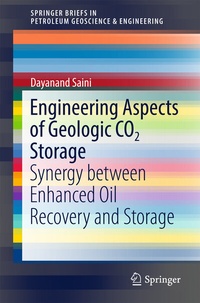
Engineering Aspects of Geologic CO2 Storage
Description

More details
Other editions
Additional editions
Person
Dr. Dayanand Saini is currently an Assistant Professor of Petroleum Engineering at California State University, Bakersfield (CSUB), where, apart from teaching various core engineering and petroleum engineering electives and developing the petroleum engineering program, as a co-principal investigator for a four-year-long Notational Science Foundation (NSF) funded multimillion dollar research project, he is investigating the feasibility of using CO2 injection as a drive mechanism to produce water formation for beneficial reuses.
Prior to joining CSUB, Dr. Saini worked as Research Manager-Reservoir Engineering at the Energy and Environmental Research Center (EERC) of the University of North Dakota, Grand Forks, ND, where he supervised and managed compositional reservoir simulation, special core analysis (SCAL), and other reservoir engineering related activities for two multimillion-dollar projects. Simultaneously, he worked on CO2 enhanced oil recovery (EOR) and storage demonstration projects funded by the US Department of Energy (DOE)-National Energy Technology Laboratory (NETL). He also conducted CO2 EOR potential evaluation studies of candidate (depleted) oil fields as per client's needs, and worked as Reservoir Engineer with Oil and Natural Gas Corporation Limited, India, from 2001 to 2006.
Dr. Saini has authored and co-authored several journal articles in the area of geologic CO2 storage (GCS) and has assisted industry clients in making essential business decisions when acquiring depleted oil fields. In November 2015, in recognition of the significant research conducted in the last five years, he was nominated for the ?200,000 "Protection of the Environment" Award by the ENI, an Italian multinational oil and gas company headquartered in Rome, in 2016.
Content
Climate Change and the Petroleum Industry.- Relevance of Geologic CO2 Storage to the Petroleum Industry.- Basic Concepts of CO2 Injection-Based Enhanced Oil Recovery Processes.- Selection of Candidate Sites: Recent Advancements in Selection Methodologies.- Review of Successfully Implemented CO2-EOR Projects: Key Features and Challenges.- Simultaneous CO2-EOR and Storage: An Economically Viable and Environmentally Sensible E&P Business Model in a Low Carbon Economy.- CO2-Oil Miscibility: A Key Design Parameter for CO2-EOR Projects.- Recent Technological Advancements for Maximizing CO2 Storage in EOR Operations.- Dedicated Geologic CO2 Storage: Deep Saline Formations.- Past and Current Geologic CO2 Storage Projects.- Monitoring of Injected CO2: Lessons Learned from Tested Monitoring Technologies in the Field.- Geologic CO2 Storage: A Mean to Extract Water from Deep Saline Formations for Beneficial Reuses.
