

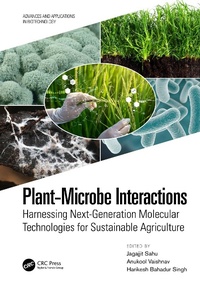
Plant-Microbe Interactions
Harnessing Next-Generation Molecular Technologies for Sustainable Agriculture
1st Edition
Published on 11. July 2022
324 pages
978-1-000-61398-8 (ISBN)
Description

A constant research effort to understand plant-microbe interactions makes it indispensable to keep abreast of the latest research developments. Researchers from a range of disciplines have used multiple approaches to infer this field. With the advent of next-generation techniques, both molecular and computational, the field has entered a new phase. These approaches often result in massive information, which is sometimes tangled and in need of further analysis. These types of analyses also require cutting-edge data analytics as well as efficient statistical models.
Plant-Microbe Interactions: Harnessing Next-Generation Molecular Technologies for Sustainable Agriculture provides a comprehensive picture of the modern-day analytics and approaches being used to provide insights into the interactions between plant and microbe. A wide range of technologies are explored along with practical guides toward these techniques. A detailed understanding of omics data in various areas could be obtained from this compilation.
Key Features:
* Crosstalk between plant and microbe
* Overview of advanced molecular techniques used to study plant-microbe interaction
* Practical guide to technologies such as NGS
* Omics data analysis used to study plant-microbe interaction
* Role of soil metagenomics
* Advanced technologies such as nanotechnology and CRISPR serving to study plant-microbe interaction
This book will serve as a great reference to various next-generation techniques in the field of plant-microbe interaction, thereby helping to better understand the mechanism. This will also help budding researchers to shape their research in similar areas.
Plant-Microbe Interactions: Harnessing Next-Generation Molecular Technologies for Sustainable Agriculture provides a comprehensive picture of the modern-day analytics and approaches being used to provide insights into the interactions between plant and microbe. A wide range of technologies are explored along with practical guides toward these techniques. A detailed understanding of omics data in various areas could be obtained from this compilation.
Key Features:
* Crosstalk between plant and microbe
* Overview of advanced molecular techniques used to study plant-microbe interaction
* Practical guide to technologies such as NGS
* Omics data analysis used to study plant-microbe interaction
* Role of soil metagenomics
* Advanced technologies such as nanotechnology and CRISPR serving to study plant-microbe interaction
This book will serve as a great reference to various next-generation techniques in the field of plant-microbe interaction, thereby helping to better understand the mechanism. This will also help budding researchers to shape their research in similar areas.
More details
Series
Edition
1. Auflage
Language
English
Place of publication
London
United Kingdom
Publishing group
Taylor & Francis Ltd
Target group
College/higher education
Adult education
Product notice
Reflowable
Illustrations
29 Tables, black and white; 10 Line drawings, color; 40 Line drawings, black and white; 10 Illustrations, color; 40 Illustrations, black and white
ISBN-13
978-1-000-61398-8 (9781000613988)
Copyright in bibliographic data and cover images is held by Nielsen Book Services Limited or by the publishers or by their respective licensors: all rights reserved.
Schweitzer Classification
Other editions
Additional editions
Jagajjit Sahu | Anukool Vaishnav | Harikesh Bahadur Singh
Plant-Microbe Interactions
Harnessing Next-Generation Molecular Technologies for Sustainable Agriculture
Book
07/2022
1st Edition
CRC Press
€228.80
Shipment within 15-20 days
Persons
Professor Harikesh Bahadur Singh is Distinguished Professor, Department of Biotechnology, GLA University, Mathura, India. He has served as Professor & Head, Department of Mycology and Plant Pathology at Institute of Agricultural Sciences, Banaras Hindu University, India. His major research focus is on bioinoculats, biological control of plant pathogens and nano-biotechnology. Prof. Singh has been decorated with several prestigious National awards and honors for his scientific contributions in the field of organic farming and translational agriculture, notable being CSIR Technology Prize for Biological Sciences by Hon'ble Prime Minister of India, M.S. Swaminathan award by Society for Plant Research, Vigyan Bharti Award, Prof. V.P. Bhide Memorial Award, Society for Plant Research, and many more. To his credit, he has 20 U.S. patents which have been successfully transferred for commercial production of biopesticides to several industrial houses in India. He has been able to add more than 300 publications and 27 books.
Dr. Anukool Vaishnav is working as an Assistant professor in the Department of Biotechnology, GLA University, Mathura, India. He has operated SERB-National Postdoctoral Fellowship (NPDF) at Department of Mycology and Plant Pathology, Institute of Agricultural Sciences, Banaras Hindu University, Varanasi, India. He has 7 years of research experience in plant-microbe interaction field. His research is mainly focused on microbial mediated plant protection against biotic and abiotic stress, characterization of signaling molecules and secondary metabolites (soluble and VOCs) in plant holobionts. As an active researcher, he has published more than 45 publications and 2 Books. He has filed 9 Indian patents in association with his research group. He is an editorial member of Current Genomics Journal published by Bentham Science. He has been awarded with Swiss Excellence Fellowship and Young Scientist Awards from different agencies.
Dr Jagajjit Sahu is currently working as a Domain Expert in Manav - Human Atlas Initiative at National Centre for Cell Science, Pune, India. His primary area of expertise is Bioinformatics, especially in the field of genomics and data science. His research interests focus on the improvement and development of efficient approaches for data analysis. He received his PhD from the Department of Life Science and Bioinformatics, Assam University, India and post-doctoral research experiences from University of Aberdeen, Banaras Hindu University, and Assam Agricultural University. Dr Sahu has a background in Mathematics, Biotechnology and Bioinformatics. Having more than 11 years of experience, he has been able to publish 37 journal articles and a few book chapters. Dr Sahu has edited 12 manuscripts for the journal Archives of Phytopathology and Plant Protection and 2 special issues for Current Genomics. He has presented his research at several international conferences and been acted as a resource person in many workshops. He has also reviewed several manuscripts for reputed journals such as Briefings in Bioinformatics, International Journal of Molecular Sciences, Genes and Sensors.
Dr. Anukool Vaishnav is working as an Assistant professor in the Department of Biotechnology, GLA University, Mathura, India. He has operated SERB-National Postdoctoral Fellowship (NPDF) at Department of Mycology and Plant Pathology, Institute of Agricultural Sciences, Banaras Hindu University, Varanasi, India. He has 7 years of research experience in plant-microbe interaction field. His research is mainly focused on microbial mediated plant protection against biotic and abiotic stress, characterization of signaling molecules and secondary metabolites (soluble and VOCs) in plant holobionts. As an active researcher, he has published more than 45 publications and 2 Books. He has filed 9 Indian patents in association with his research group. He is an editorial member of Current Genomics Journal published by Bentham Science. He has been awarded with Swiss Excellence Fellowship and Young Scientist Awards from different agencies.
Dr Jagajjit Sahu is currently working as a Domain Expert in Manav - Human Atlas Initiative at National Centre for Cell Science, Pune, India. His primary area of expertise is Bioinformatics, especially in the field of genomics and data science. His research interests focus on the improvement and development of efficient approaches for data analysis. He received his PhD from the Department of Life Science and Bioinformatics, Assam University, India and post-doctoral research experiences from University of Aberdeen, Banaras Hindu University, and Assam Agricultural University. Dr Sahu has a background in Mathematics, Biotechnology and Bioinformatics. Having more than 11 years of experience, he has been able to publish 37 journal articles and a few book chapters. Dr Sahu has edited 12 manuscripts for the journal Archives of Phytopathology and Plant Protection and 2 special issues for Current Genomics. He has presented his research at several international conferences and been acted as a resource person in many workshops. He has also reviewed several manuscripts for reputed journals such as Briefings in Bioinformatics, International Journal of Molecular Sciences, Genes and Sensors.
Content
1. Novel Approaches and Advanced Molecular Techniques for Crop Improvement
Dhanawantari L. Singha, Debajit Das, Ricky Raj Paswan, Channakeshavaiah Chikkaputtaiah, and Sanjeev Kumar
2. The Chemical Dialogue during Plant-Microbe Interaction: Implications in Sustainable Agriculture
Gunajit Goswami, Sudipta Sankar Bora, Jugabrata Das, Trishna Sarmah, and Madhumita Barooah
3. Implication of Microbial Signals: Plant Communication
Manmeet Kaur and H.S. Sodhi
4. Molecular Aspects of Host- Pathogen Interaction
Ashim Debnath, Ratul Moni Ram, Asha Kumari, Paromita Saikia, and Dharmendra Singh Lagoriya
5. Omics: A Potential Tool to Delineate the Mechanism of Biocontrol Agents against Plant Pathogens
S. Harish, S. Parthasarathy, S.R. Prabhukarthikeyan, Arabinda Mahanty, Basavaraj Teli, K. Anandhi, and P.C. Rath
6. Bioinformatics Approaches to Improve and Enhance the Understanding of Plant-Microbe Interaction: A Review
Surojit Sen and Sunayana Rathi
7. Plant-Microbe Interactions in the Age of Sequencing
Kuntal Kumar Dey and Sebantee Ganguly
8. Metaomics Technologies in Understanding Ethnomedicinal Plants and Endophyte Microbiome
Bishal Pun, Fenella M.W. Nongkhlaw, and S.R. Joshi
9. Plant-Rhizomicrobiome Interactive Ecology through the Lenses of Multi-Omics and Relevant Bioinformatics Approaches
Siddhartha Pal and Kriti Sengupta
10. Future Prospects of Next-Generation SequencingAbdul Rehman, Hafiza Iqra Almas, Abdul Qayyum, Hongge Li, Zhen Peng,
Guangyong Qin, Yinhua Jia, Zhaoe Pan, Shoupu He, and Xiongming Du
11. Revisiting Molecular Techniques for Enhancing Sustainable Agriculture
Ankita Chatterjee
12. Nanotechnology in Plant Pathology: An Overview
Ratul Moni Ram, Prakash Jyoti Kalita, and H.B. Singh
13. An Overview of CRISPR and Gene Chip Technology to Study Plant-Microbe Interaction
Prassan Choudhary
14. Functional Genomic Approaches to Improve Rice Productivity through Leaf Architecture
Robert Nepomuceno, Cristine Marie B. Brown, and Marilyn B. Brown
15. Tapping the Role of Plant Volatiles Inducing Multi-Trophic Interactions for Sustainable Agricultural Production
Ratul Moni Ram, Ashim Debnath, Khumbarti Debbarma, Yengkhom Linthoingambi Devi, and Jayakumar Pathma
16. Desiccation Tolerance in Orthodox and Recalcitrant Seeds
Bahman Fazeli-Nasab, Raheba Jami, Naser Vahabi, Abdolhosein Rezaei, Ramin Piri, and Moharam Valizadeh
17. Chemical Ecology in Belowground Plant Communication
Marcela Claudia Pagano, Bakhytzhan Yelikbayev, Eduardo J. Azevedo Correa, and Neimar F. Duarte
18. Possible Bioremediation Strategies for Arsenic Detoxification by Consortium of Beneficial Bacteria
Sathi Paul, Akansha Jain, Surbhi Shriti, and Sampa Das
Dhanawantari L. Singha, Debajit Das, Ricky Raj Paswan, Channakeshavaiah Chikkaputtaiah, and Sanjeev Kumar
2. The Chemical Dialogue during Plant-Microbe Interaction: Implications in Sustainable Agriculture
Gunajit Goswami, Sudipta Sankar Bora, Jugabrata Das, Trishna Sarmah, and Madhumita Barooah
3. Implication of Microbial Signals: Plant Communication
Manmeet Kaur and H.S. Sodhi
4. Molecular Aspects of Host- Pathogen Interaction
Ashim Debnath, Ratul Moni Ram, Asha Kumari, Paromita Saikia, and Dharmendra Singh Lagoriya
5. Omics: A Potential Tool to Delineate the Mechanism of Biocontrol Agents against Plant Pathogens
S. Harish, S. Parthasarathy, S.R. Prabhukarthikeyan, Arabinda Mahanty, Basavaraj Teli, K. Anandhi, and P.C. Rath
6. Bioinformatics Approaches to Improve and Enhance the Understanding of Plant-Microbe Interaction: A Review
Surojit Sen and Sunayana Rathi
7. Plant-Microbe Interactions in the Age of Sequencing
Kuntal Kumar Dey and Sebantee Ganguly
8. Metaomics Technologies in Understanding Ethnomedicinal Plants and Endophyte Microbiome
Bishal Pun, Fenella M.W. Nongkhlaw, and S.R. Joshi
9. Plant-Rhizomicrobiome Interactive Ecology through the Lenses of Multi-Omics and Relevant Bioinformatics Approaches
Siddhartha Pal and Kriti Sengupta
10. Future Prospects of Next-Generation SequencingAbdul Rehman, Hafiza Iqra Almas, Abdul Qayyum, Hongge Li, Zhen Peng,
Guangyong Qin, Yinhua Jia, Zhaoe Pan, Shoupu He, and Xiongming Du
11. Revisiting Molecular Techniques for Enhancing Sustainable Agriculture
Ankita Chatterjee
12. Nanotechnology in Plant Pathology: An Overview
Ratul Moni Ram, Prakash Jyoti Kalita, and H.B. Singh
13. An Overview of CRISPR and Gene Chip Technology to Study Plant-Microbe Interaction
Prassan Choudhary
14. Functional Genomic Approaches to Improve Rice Productivity through Leaf Architecture
Robert Nepomuceno, Cristine Marie B. Brown, and Marilyn B. Brown
15. Tapping the Role of Plant Volatiles Inducing Multi-Trophic Interactions for Sustainable Agricultural Production
Ratul Moni Ram, Ashim Debnath, Khumbarti Debbarma, Yengkhom Linthoingambi Devi, and Jayakumar Pathma
16. Desiccation Tolerance in Orthodox and Recalcitrant Seeds
Bahman Fazeli-Nasab, Raheba Jami, Naser Vahabi, Abdolhosein Rezaei, Ramin Piri, and Moharam Valizadeh
17. Chemical Ecology in Belowground Plant Communication
Marcela Claudia Pagano, Bakhytzhan Yelikbayev, Eduardo J. Azevedo Correa, and Neimar F. Duarte
18. Possible Bioremediation Strategies for Arsenic Detoxification by Consortium of Beneficial Bacteria
Sathi Paul, Akansha Jain, Surbhi Shriti, and Sampa Das
