

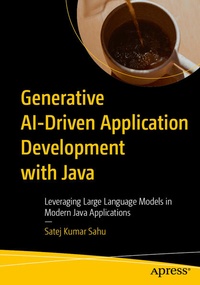
Generative AI-Driven Application Development with Java
Description

This is the first hands-on guide that takes you from a simple "Hello, LLM" to production-ready microservices, all within the JVM. You'll integrate hosted models such as OpenAI's GPT-4o, run alternatives with Ollama or Jlama, and embed them in Spring Boot or Quarkus apps for cloud or on-pre deployment.
You'll learn how prompt-engineering patterns, Retrieval-Augmented Generation (RAG), vector stores such as Pinecone and Milvus, and agentic workflows come together to solve real business problems. Robust test suites, CI/CD pipelines, and security guardrails ensure your AI features reach production safely, while detailed observability playbooks help you catch hallucinations before your users do. You'll also explore DJL, the future of machine learning in Java.
This book delivers runnable examples, clean architectural diagrams, and a GitHub repo you can clone on day one. Whether you're modernizing a legacy platform or launching a green-field service, you'll have a roadmap for adding state-of-the-art generative AI without abandoning the language-and ecosystem-you rely on.
What You Will Learn
- Establish generative AI and LLM foundations
- Integrate hosted or local models using Spring Boot, Quarkus, LangChain4j, Spring AI, OpenAI, Ollama, and Jlama
- Craft effective prompts and implement RAG with Pinecone or Milvus for context-rich answers
- Build secure, observable, scalable AI microservices for cloud or on-prem deployment
- Test outputs, add guardrails, and monitor performance of LLMs and applications
- Explore advanced patterns, such as agentic workflows, multimodal LLMs, and practical image-processing use cases
Who This Book Is For
Java developers, architects, DevOps engineers, and technical leads who need to add AI features to new or existing enterprise systems. Data scientists and educators will also appreciate the code-first, Java-centric approach.
More details
Other editions
Additional editions
Person
Satej Kumar Sahu is a Principal Engineer at Zalando SE with 15 years of hands-on experience designing large-scale, data-intensive systems for global brands including Boeing, Adidas, and Honeywell. A specialist in software architecture, big-data pipelines, and applied machine learning, he has shepherded multiple projects from whiteboard sketches to production deployments serving millions of users.
Satej has been working with Large Language Models since their earliest open-source releases, piloting Retrieval-Augmented Generation (RAG) and agentic patterns long before they became industry buzzwords. He is the author of two previous programming books-Building Secure PHP Applications and PHP 8 Basics-and is a frequent speaker at developer conferences and meet-ups across the world.
When he isn't translating cutting-edge AI research into practical code, you'll find him mentoring engineering teams, contributing to open-source projects, or tinkering with the newest transformer models in his home lab.
Content
1: Megabrains 101: Generative AI & LLMs Unboxed.- 2: First Contact: "Hello, LLM" with Spring Boot.- 3: Bring Your Own Model: Self-Hosting with Ollama.- 4: Power Tools: LangChain4j Quick-Start.- 5: Integrating LLMs with Java Applications.- 6: From Chatty to Clever: Retrieval-Augmented Generation.- 7: Spring AI Ninja Moves.- 8: Prompt Alchemy: Patterns that Make Models Look Smarter.- 9: Swiss-Army LLMs: Tool Calls in Spring AI.- 10: Agents Assemble! Building Autonomous Workflows.- 11: The Transformer Saga-From Attention to Fine-Tuning.- 12: Does It Even Work? Testing & Evaluating LLM Apps.- 13: Cloud Power-Ups-Bedrock, Vertex & Azure OpenAI.- 14: Talking in Protocols: The MCP Revolution.- 15: Quarkus + LangChain4j: Lightning-Fast Gen AI.- 16: Jlama & Friends: Hosting Models the Java Way.- 17: Seeing Is Believing: Multimodal LLMs & Image Hacking.- 18: Native-Speed Machine Learning in Java: DJL, ONNX & JNI.- 19: Can You See Me Now? Observability for LLM Pipelines.- 20: Architectures of Tomorrow: From Monoliths to Modular Minds.
