

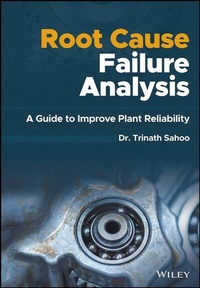
Root Cause Failure Analysis
Description

Provides the knowledge and failure analysis skills necessary for preventing and investigating process equipment failures
Process equipment and piping systems are essential for plant availability and performance. Regularly exposed to hazardous service conditions and damage mechanisms, these critical plant assets can result in major failures if not effectively monitored and assessed--potentially causing serious injuries and significant business losses. When used proactively, Root Cause Failure Analysis (RCFA) helps reliability engineers inspect the process equipment and piping system before any abnormal conditions occur. RCFA is equally important after a failure happens: it determines the impact of a failure, helps control the resultant damage, and identifies the steps for preventing future problems.
Root Cause Failure Analysis: A Guide to Improve Plant Reliability offers readers clear understanding of degradation mechanisms of process equipment and the concepts needed to perform industrial RCFA investigations. This comprehensive resource describes the methodology of RCFA and provides multiple techniques and industry practices for identifying, predicting, and evaluating equipment failures. Divided into two parts, the text first introduces Root Cause Analysis, explains the failure analysis process, and discusses the management of both human and latent error. The second part focuses on failure analysis of various components such as bolted joints, mechanical seals, steam traps, gearboxes, bearings, couplings, pumps, and compressors. This authoritative volume:
* Illustrates how failures are associated with part integrity, a complete system, or the execution of an engineering process
* Describes how proper design, operation, and maintenance of the equipment help to enhance their reliability
* Covers analysis techniques and industry practices including 5-Why RCFA, fault tree analysis, Pareto charts, and Ishikawa diagrams
* Features a detailed case study of process plant machinery and a chapter on proactive measures for avoiding failures
Bridging the gap between engineering education and practical application, Root Cause Failure Analysis: A Guide to Improve Plant Reliability is an important reference and guide for industrial professionals, including process plant engineers, planning managers, operation and maintenance engineers, process designers, chemical engineers, and instrument engineers. It is also a valuable text for researchers, instructors, and students in relevant areas of engineering and science.
More details
Other editions
Additional editions
Person
Trinath Sahoo, PhD, is currently General Manager at M/S Indian Oil Corporation Limited. He has more than 30 years of experience in technical and management fields. Dr. Sahoo has published papers in numerous international journals including Hydrocarbon Processing, Chemical Engineering, and Chemical Engineering Progress, and has conducted workshops at various national and international conferences. He was given the lifetime achievement award by The Institution of Engineers, India.
Content
Part- A
1- Introduction
2-What Is Root Cause Analysis
3-Failure Analysis Process
4-Managing Human Error and Latent Error
Part-B
5- Metallurgical Failure Analysis
6- Piping Failure -Causes and Cure
7-Bolted Joint Failure
8- Coupling Failure
9-Bearing Failure
10- Mechanical Seal Failure
11-Failure of Centrifugal Pump
12- Failure of Reciprocating Pump
13- Failure of Centrifugal Compressor
14- Failure of Reciprocating Compressor
15-Lubrication Related Failure
16-Steam Trapfailure
17- Proactive Measures to Avoid Failure
