

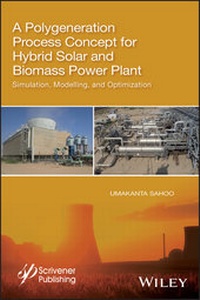
A Polygeneration Process Concept for Hybrid Solar and Biomass Power Plant
Description

The global warming phenomenon as a significant sustainability issue is gaining worldwide support for development of renewable energy technologies. The term "polygeneration" is referred to as "an energy supply system, which delivers more than one form of energy to the final user." For example, electricity, cooling and desalination can be delivered from a polygeneration process. The polygeneration process in a hybrid solar thermal power plant can deliver electricity with less impact on the environment compared to a conventional fossil fuel-based power generating system. It is also THE next generation energy production technique with the potential to overcome the undesirable intermittence of renewable energy systems.
In this study, the polygeneration process simultaneous production of power, vapor absorption refrigeration (VAR) cooling and multi-effect humidification and dehumidification (MEHD) desalination system from different heat sources in hybrid solar-biomass (HSB) system with higher energy efficiencies (energy and exergy), primary energy savings (PES) and payback period are investigated, focusing on several aspects associated with hybrid solar-biomass power generation installations, such as wide availability of biomass resources and solar direct normal irradiance (DNI), and other technologies. Thermodynamic evaluation (energy and exergy) of HSB power has also been investigated, along with the VAR cooling system, the modelling, simulation, optimization and cost analysis of the polygeneration hybrid solar biomass system, all accompanied by multiple case studies and examples for practical applications.
This volume provides the researcher, student and engineer with the intellectual tool needed for understanding new ideas in this rapidly emerging field. The book is also intended to serve as a general source and reference book for the professional (consultant, designer, contractor etc.) who is working in the field of solar thermal, biomass, power plant, polygeneration, cooling and process heat. It is a must-have for anyone working in this field.
More details
Other editions
Additional editions
Person
Umakanta Sahoo, PhD, is Research Scientist at the National Institute of Solar Energy, India. He received his undergraduate degree in mechanical engineering from the Institute of Technical Education and Research, Bhubaneswar, India and his PhD in mechanical engineering at the Delhi Technological University, Delhi, India. He has seven years of research experience in the fields of solar, thermal and biomass energy. He has published many research papers in international journals one one book in the field of solar and biomass energy and six books in the field of mechanical engineering. His research interest areas are energy, exergy, hybrid solar-biomass power in co- and poly-generation processes, primary energy saving, waste heat utilization for industrial processes, and many others in alternative and renewable energy. He has conducted voluminous training on designing, operation and maintenance of solar thermal systems.
Content
Contents
Foreword ix
Preface xi
1. Introduction 1
1.1. Global Scenario on Renewable Energy 3
1.2. Indian Scenario on Renewable Energy 6
Exercise 8
References 9
2. State-of-the-Art Concentrated Solar Thermal Technologies for End Use Applications 11
2.1. Solar Thermal Technologies for Low Grade Heat Applications 11
2.1.1. Flat Plate Collector System 12
2.1.2. Built-In Storage Solar Water Heating System 15
2.1.3. Evacuated Tubular Collector System 16
ETC Water Heating System Specification 18
2.1.4. Cumulative Growth of SWHS Installation Capacity 20
2.1.5. Performance Evaluation of SWHs 20
2.1.6. Cost Benefits Analysis 23
2.2. Solar Cooking 25
2.2.1. Thermal Performance of Solar Box Type Cooker 30
2.3. Solar Thermal Cooling 35
2.4. Desalination System 38
2.5. Industrial Process Heat applications 45
2.6. Solar Thermal Technologies for Power Generation 49
2.6.1. Parabolic Trough Collector 49
2.6.2. Linear Fresnel Reflector 51
2.6.3. Central Solar Tower 53
2.6.4. Parabolic Dish 54
2.7. Cooling with Process Heat in Cogeneration Process for Industrial Applications 57
2.7.1. System Description 58
Exercise 61
References 62
3. Resource Assessment of Solar and Biomass for Hybrid Thermal Power Plant 69
3.1. Apparent Solar Time 70
3.2. Solar Angles 71
3.3. Solar Resources (DNI) In India 76
3.3.1. Solar DNI from Satellite and Ground Measured Data 76
3.3.2. DNI Assessment at NISE 78
3.4. Biomass Resources in India 81
3.5. Analysis of Solar DNI And Biomass Resources for Hybrid Power Plants 83
Exercise 106
References 106
4. Solar Thermal Power Plant 109
4.1. A Case Study of 1 MWe Solar Thermal Power Plant 122
4.2. Major Components 124
4.2.1. Parabolic Trough Collector 124
4.2.2. Linear Fresnel Reflector 125
4.2.3. Storage 127
4.2.4. Nitrogen Blanketing System 129
4.2.5. Heat Exchanger 129
4.2.6. Power Block 132
4.2.7. Balance of Plant-Utility Systems 134
4.3. Performance of the Plant 136
Exercise 161
References 162
5. Modeling and Simulation of Hybrid Solar and Biomass Thermal Power Plant 163
5.1. Modeling Approach of a Hybrid Solar-Biomass Thermal Power Plant 167
5.2. Thermodynamic Evaluation 168
5.2.1. Energy Evaluation 169
5.2.2. Exergy Evaluation 174
5.3. Analysis of Hybrid Solar and Biomass Thermal Power Plant 177
Exercise 181
References 182
6. Modeling, Simulation, Optimization and Cost Analysis of a Polygeneration Hybrid Solar Biomass System 187
6.1. Modeling Approach of Polygeneration Process in an HSB Thermal Power Plant 191
6.2. Thermodynamic Evaluation 193
6.2.1. Energy Evaluation 193
6.2.2. Exergy Evaluation 201
6.3. Primary Energy Savings on the Polygeneration Process in an HSB Thermal Power Plant 206
6.4. Optimization 207
6.4.1. Objective Functions 207
6.4.2. Decision Variable and Constraints 207
6.4.3. Genetic Algorithm (GA) 207
6.5. Cost Analysis 209
6.6. Analysis Of Polygeneration Process in an HSB Thermal Power Plant for Power, Cooling, and Desalination 211
6.7. Optimization of the Polygeneration System 216
6.8. Cost Analysis of a Polygeneration System 220
Exercise 224
References 226
Appendix 1 231
Nomenclature 231
Greek 233
Subscripts 233
Acronyms 234
Appendix 2. 237
EES Software Coding 237
Appendix 3. 253
Multiple Choice Questions (MCQ) with Answers. 253
Answers 274
About the Author 275
Index 277
Preface
The global warming phenomenon, as a significant sustainability issue, is gaining worldwide support for the development of renewable energy technologies. The term 'polygeneration' is referred to as "an energy supply system, which delivers more than one form of energy to the final user", for example, electricity, cooling, and desalination can be delivered from the polygeneration process. The polygeneration process in a hybrid solar thermal power plant can deliver electricity with a lesser impact on the environment compared to a conventional fossil fuel based power generating system. It is the next generation energy production technique with a potential to overcome the intermittence of renewable energy.
In this study, the polygeneration process simultaneously with production of power, vapor absorption refrigeration (VAR) cooling, and multi-effect humidification and dehumidification (MEHD) desalination systems from different heat sources in hybrid solar-biomass (HSB) systems with higher energy efficiencies (energy and exergy), primary energy savings (PES) and payback period, are investigated.
There are several aspects associated with hybrid solar-biomass power generation installations, such as state wise availability of biomass resources and solar direct normal irradiance (DNI), have been analyzed. Month wise solar and biomass heat utilization has also been analyzed for hybrid systems in four regions of India (East: Guwahati, Assam; West: Udaipur, Rajasthan; North: Delhi, South: Madurai, Tamil Nadu). The month wise daily average solar radiation is considered as 20%, 40%, 60%, and 80% and remaining heat is taken from biomass resources in the northern region (Delhi) in the proposed hybrid plant.
The thermodynamic evaluation (energy and exergy) of the HSB power plant has also been investigated. The total input energy of the proposed hybrid system is taken from the heat transfer fluid through a parabolic trough collector (PTC) per availability of solar resources and from remaining biomass to maintain steam, at a superheated state of 500°C and 60 bar, and supplied to turbines at a steam mass flow rate of 5 kg/sec. The energy and exergy analyses of a 5 MW HSB system with series mode was carried out to identify the effects of various operating parameters like DNI, condenser pressure, turbine inlet temperatures, boiler pressure on net power output energy, and exergy efficiencies.
The VAR cooling system operates using the extracted heat taken from turbine and condenser heat of the VAR cooling system is used in a MEHD system for production of drinking water, per demand requirement. Though the production of electricity decreases due to extraction of heat from turbine for VAR cooling and MEHD desalination, the complete system meets the energy requirements & increases the PES.
The thermodynamic evaluation (energy and exergy), optimization and payback period of the polygeneration process in an HSB thermal power plant for combined power, cooling, and desalination is investigated to identify the effects of various operating parameters. The system has achieved a maximum energy efficiency of 49.85% and exergy efficiency of 20.94%. The primary energy savings of the polygeneration process (PESPP) in an HSB system is achieved at 50.5%. The electricity generation from the polygeneration process increased to 78.12%, as compared to a simple thermal power plant. The payback period of the polygeneration process in an HSB thermal power plant is 1.5 years, which is less than a solar thermal power plant, HSB thermal power plant, an cogeneration in an HSB thermal power plant.
The modeling, simulation, optimization, and cost analysis of polygeneration hybrid solar biomass systems has been carried out in this book. The simulation is performed in EES Software. Availability of both solar resources (DNI, ambient temperature, and wind speed) and biomass in the same regions/places is highly desirable to design and simulate for a hybrid solar thermal power plant. An introduction to this discussion begins in Chapter 1 and state of art of concentrated solar thermal technologies for end use applications are addressed in Chapter 2. Resource assessment of solar and biomass technologies for hybrid thermal power plants in India is discussed in Chapter 3. In this chapter, several aspects associated with hybrid solar and biomass power generation installations, such as state wise availability of biomass resources and DNI, have been discussed. The DNI is based on daily averaging of DNI mapping, resulting from the data available with the National Renewable Energy Laboratory (NREL) and National Institute of Solar Energy (NISE). These DNI resource analysis results are a reliable indication of solar potential. For assessing the solar energy potential, only 10% of the total waste land area available has been considered in major biomass energy contributing states like Punjab, Uttar Pradesh, Haryana, Maharashtra, Madhya Pradesh, Karnataka, Tamil Nadu, Gujarat, Rajasthan, Kerala, Bihar, Andhra Pradesh, West Bengal, Odisha, and Assam. For biomass resources, the assessment of scale up potential on biomass has been carried out separately for biomass crop residues and energy plantations. The major agricultural based biomass crop wise potential for different states of India are mapped by analyzing the energy potential of the biomass. The solar thermal power plant and case study is discussed in Chapter 4. A simulation study of biomass consumption in the power plant at different radiation conditions to meet heat requirements for the operation of solar hybrid power plants is also carried out. The modeling and simulation of hybrid solar and biomass thermal power plants is discussed in Chapter 5. For the hybrid system, a biomass boiler arrangement is taken to operate on the biomass whenever it is needed at different load conditions. A solar field is utilized to heat the heat transfer fluid per availability of DNI. Hot water from a feed water heater gets heated through heat transfer fluid using a heat exchanger. The total input energy of the proposed hybrid system is taken from the heat transfer fluid through PTC per availability of solar resource and remaining biomass to maintain the steam at a superheated state supplied to turbine. The detailed performance analysis (energy and exergy) of solar and biomass hybrid thermal power plants are carried out to identify the effects of various operating parameters like DNI, condenser pressure, turbine inlet temperatures, boiler pressure on net power output energy, and exergy efficiencies. A 5 MW hybrid solar and biomass power plant has been designed. The hybrid solar and biomass power plant is an extremely promising energy system and is likely to provide a major share of renewable bulk electricity production. Taking this into account, the government of India is creating biomass policies to minimize biomass feed stock in the hybrid power plant for establishing the market. The energy demand for cooling and process heat applications are increasing continuously due to increasing industries, office campuses, and institutions demanding results requiring huge amounts of electricity. Globally, in the industrial sector, about two-thirds of total consumption of energy is used for process heat applications. This increasingly huge amount of electricity demand results in higher consumption of conventional energy, for example coal and fossil fuels, which results in increasing greenhouse gas (GHG) emissions and the negative impact of climate change in this country. Presently, these industries either buy power from the state electricity boards or generate their own power largely. Finally, to reduce their net power consumption, some of industries produce power, as well as process heat, for their use through cogeneration. Although cogeneration is playing as advanced technology for generation of both electricity and process heat application, it is not possible to provide more than two such outputs, like space cooling and water desalination, for their requirement. To reduce energy demand and provide more than two such outputs like cooling and water desalination using different reject heat sources, a new concept of polygeneration processes has been developed in hybrid solar-biomass power plants. The modeling, simulation, and optimization of polygeneration hybrid solar and biomass system for power, cooling, and desalination and, for the economic aspect, cost analysis are discussed in the Chapter 6 of the book. In the polygeneration process, simultaneous production of power, cooling, and desalination from different heat sources in hybrid solar-biomass systems with higher energy efficiency takes place. It is one of the solutions to fulfill energy requirements from renewable sources and helps in the reduction of carbon dioxide emissions. The turbine is designed so that condensation heat of a power plant can be input for vapor absorption refrigeration (VAR) and condensation heat of a VAR cooling system is used as a heat input source for the desalination system. The VAR cooling system operates using the extracted heat taken from the turbine and condenser heat of the VAR cooling system and is used in the desalination system for production of drinking water per demand requirement. Though the production of electricity decreases due to extraction of heat from the turbine for the VAR cooling system and the evaporator load decreases due to heat taken from the condenser of a VAR cooling system for desalination, the complete system meets the energy requirements and increases the overall performance and PES. The technical modeling and thermodynamic analysis (energy and exergy) of polygeneration processes in HSB thermal power plants for combined power, cooling, and...
