

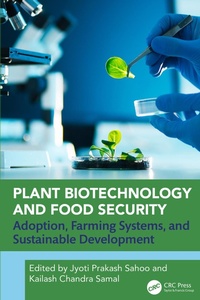
Plant Biotechnology and Food Security
Adoption, Farming Systems, and Sustainable Development
1st Edition
Published on 6. November 2025
276 pages
978-1-040-44431-3 (ISBN)
Description

The global agricultural sector faces mounting pressures from climate change, population growth, and the urgent need for sustainable food production. As the world moves toward a population of nearly 10 billion by 2050, innovative solutions are essential to ensure food security. Plant Biotechnology and Food Security: Adoption, Farming Systems, and Sustainable Development provides a comprehensive examination of how biotechnological advancements can transform agriculture, enhance productivity, and promote environmental sustainability. This book bridges the gap between traditional farming practices and cutting-edge technologies, offering a balanced perspective on the role of biotechnology in modern agriculture.
Key Features:
Agricultural Evolution and Biotech Integration: Examines the development of agriculture and the need for biotechnological advances.
GM Crops and RNAi Technology: Explores genetically modified crops and the use of RNA interference for creating stress-resistant crops.
Genome Editing and CRISPR: Discusses CRISPR/Cas9 and HI-Edit technology as tools for enhancing climate resilience in agriculture.
Genomics and Molecular Breeding: Focuses on next-generation sequencing and molecular breeding techniques for crop improvement.
Precision Agriculture and Biofortification: Highlights digital tools in agriculture, biotech for plant protection, and the role of biofortified crops in addressing malnutrition.
This book is an essential resource for researchers, policymakers, agricultural professionals, and students seeking to understand how biotechnology can drive food security while balancing economic, environmental, and ethical considerations. By presenting scientific advancements alongside real-world applications, it aims to foster collaboration in building a resilient and sustainable agricultural future.
Key Features:
Agricultural Evolution and Biotech Integration: Examines the development of agriculture and the need for biotechnological advances.
GM Crops and RNAi Technology: Explores genetically modified crops and the use of RNA interference for creating stress-resistant crops.
Genome Editing and CRISPR: Discusses CRISPR/Cas9 and HI-Edit technology as tools for enhancing climate resilience in agriculture.
Genomics and Molecular Breeding: Focuses on next-generation sequencing and molecular breeding techniques for crop improvement.
Precision Agriculture and Biofortification: Highlights digital tools in agriculture, biotech for plant protection, and the role of biofortified crops in addressing malnutrition.
This book is an essential resource for researchers, policymakers, agricultural professionals, and students seeking to understand how biotechnology can drive food security while balancing economic, environmental, and ethical considerations. By presenting scientific advancements alongside real-world applications, it aims to foster collaboration in building a resilient and sustainable agricultural future.
More details
Edition
1. Auflage
Language
English
Place of publication
London
United Kingdom
Publishing group
Taylor & Francis Ltd
Target group
College/higher education
Professional and scholarly
Illustrations
19 Tables, black and white; 24 Line drawings, black and white; 2 Halftones, black and white; 26 Illustrations, black and white
File size
13,86 MB
ISBN-13
978-1-040-44431-3 (9781040444313)
Copyright in bibliographic data and cover images is held by Nielsen Book Services Limited or by the publishers or by their respective licensors: all rights reserved.
Schweitzer Classification
Other editions
Additional editions
Jyoti Prakash Sahoo | Kailash Chandra Samal
Plant Biotechnology and Food Security
Adoption, Farming Systems, and Sustainable Development
Book
11/2025
1st Edition
CRC Press
€167.10
Shipment within 10-20 days
Persons
Jyoti Prakash Sahoo is a dynamic researcher and academician currently serving as an Assistant Professor in the Faculty of Agriculture and Allied Sciences at C.V. Raman Global University, Bhubaneswar, India. He completed his M.Sc. (2016) and PhD (2023) in Agricultural Biotechnology from Assam Agricultural University, Jorhat, India and Odisha University of Agriculture and Technology (OUAT), Bhubaneswar, India respectively. His notable works include dissecting genetic architecture for Cercospora leaf spot and charcoal rot disease resistance in mung bean landraces, molecular breeding strategies for stress resilience in crops, sustainable management of viral pathogens in okra, and drought tolerance genetics in rice using microsatellite markers. He has guided 10 M.Sc. (Biotechnology) students. He regularly publishes in high-impact journals indexed by Scopus, UGC-CARE, and Clarivate, while also authoring important chapters for widely-referenced agricultural biotechnology books. He actively contributes as a peer reviewer for prestigious journals including Frontiers in Plant Science, BMC Genomics, Scientific Reports, and holds life memberships in professional societies including the Society of Biotechnology and Bioinformatics and Indian Society of Plant Breeders. His outstanding contributions to plant molecular biology and biotechnology have been recognized with prestigious honors, including the young scientist award (2021), the university best PhD thesis award of OUAT (2023), and multiple best oral presentation awards (2023) at national and international conferences.
Kailash Chandra Samal is the current Dean of the College of Horticulture at Odisha University of Agriculture and Technology (OUAT), Chiplima, India. He holds an M.Sc. in Agricultural Biotechnology from Tamil Nadu Agricultural University, Coimbatore, India (1991), and a PhD in Biotechnology from Utkal University, Bhubaneswar, India (2011). With 32 years of academic and research experience at OUAT, he has taught undergraduate, postgraduate, and PhD students while conducting pioneering research in plant molecular biology, plant tissue culture, microbial technology, DNA fingerprinting, and computational biology. He has developed cost-effective protocols for the large-scale micropropagation of several crops, including banana, ginger, turmeric, sugarcane, stevia, and sarpagandha. His work includes the development of molecular marker techniques for assessing the clonal fidelity of micro-propagated plants and the creation of a DNA fingerprint database for promising rice varieties in Odisha, India. He has studied the phenotypic, biochemical, and molecular characteristics of indigenous aromatic rice varieties from Odisha, India and molecular fingerprints of other crops such as ragi, wheat, rapeseed, sesame, black gram, green gram, eggplant, and tomato. He has guided 40 M.Sc. (Ag) and PhD students in molecular biology and biotechnology. He has also secured 10 externally funded projects from Department of Biotechnology (DBT), Rashtriya Krishi Vikas Yojana (RKVY), and the Ministry of Agriculture, Government of India. A member of several professional bodies, he has published 10 books and over 128 research papers. His research contributions include the isolation and characterization of abiotic stress-related genes such as DREB, deposited in GenBank (NCBI), USA.
Kailash Chandra Samal is the current Dean of the College of Horticulture at Odisha University of Agriculture and Technology (OUAT), Chiplima, India. He holds an M.Sc. in Agricultural Biotechnology from Tamil Nadu Agricultural University, Coimbatore, India (1991), and a PhD in Biotechnology from Utkal University, Bhubaneswar, India (2011). With 32 years of academic and research experience at OUAT, he has taught undergraduate, postgraduate, and PhD students while conducting pioneering research in plant molecular biology, plant tissue culture, microbial technology, DNA fingerprinting, and computational biology. He has developed cost-effective protocols for the large-scale micropropagation of several crops, including banana, ginger, turmeric, sugarcane, stevia, and sarpagandha. His work includes the development of molecular marker techniques for assessing the clonal fidelity of micro-propagated plants and the creation of a DNA fingerprint database for promising rice varieties in Odisha, India. He has studied the phenotypic, biochemical, and molecular characteristics of indigenous aromatic rice varieties from Odisha, India and molecular fingerprints of other crops such as ragi, wheat, rapeseed, sesame, black gram, green gram, eggplant, and tomato. He has guided 40 M.Sc. (Ag) and PhD students in molecular biology and biotechnology. He has also secured 10 externally funded projects from Department of Biotechnology (DBT), Rashtriya Krishi Vikas Yojana (RKVY), and the Ministry of Agriculture, Government of India. A member of several professional bodies, he has published 10 books and over 128 research papers. His research contributions include the isolation and characterization of abiotic stress-related genes such as DREB, deposited in GenBank (NCBI), USA.
Content
1. Traditional Farming and Modern Biotechnology: Bridging the Gap for Sustainable Agriculture 2. Genetically Modified Crops for Climate Change Adaptation 3. Leveraging RNA Interference for Strengthening Crop Resilience to Biotic and Abiotic Stress Challenges 4. Genome Editing in Crops for Climate Change Adaptation 5. Haploid Inducer Mediated Genome Editing (HI-Edit) Technology for Climate Change 6. Next Generation Sequencing and Crop Genomics for Climate Change Adaptation 7. Molecular Breeding for Climate Change Adaptation in Crops 8. Integrating Biotechnology and Precision Agriculture for Plant Disease Management 9. Addressing Global Nutritional Security Through Crop Biofortification 10. Bioinformatics and Crop Improvement: Revolutionizing Plant Biotechnology in Achieving Food Security 11. Environmental Benefits of Biotech Crops 12. Biotechnology and Smallholder Farmers: Navigating Challenges and Unlocking Economic Pathways 13. Global Acceptance and Challenges of GMO-Free CRISPR/Cas9 Crops 14. Integrating Biotechnology into Sustainable Agricultural Practices: Opportunities and Challenges 15. Socio-Economic Implications of Biotech Innovations (GMOs Regulations): Ensuring Inclusivity and Sustainability 16. Opposition to Global Acceptance of Biotech Crops 17. Digital Agriculture and Biotechnology: Synergies for Sustainable Development 18. Nanobiotechnology Approaches for Climate Change Adaptation in Crops
