

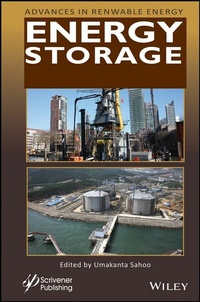
Energy Storage
Description

Written and edited by a team of well-known and respected experts in the field, this new volume on energy storage presents the state-of-the-art developments and challenges in the field of renewable energy systems for sustainability and scalability for engineers, researchers, academicians, industry professionals, consultants, and designers.
The world's energy landscape is very complex. Fossil fuels, especially because of hydraulic fracturing, are still a mainstay of global energy production, but renewable energy sources, such as wind, solar, and others, are increasing in importance for global energy sustainability. Experts and non-experts agree that the next game-changer in this area will be energy storage.
Energy storage is crucial for continuous operation of power plants and can supplement basic power generation sources over a stand-alone system. It can enhance capacity and leads to greater security, including continuous electricity supply and other applications. A dependable energy storage system not only guarantees that the grid will not go down, but also increases efficacy and efficiency of any energy system.
This groundbreaking new volume in this forward-thinking series addresses all of these issues, laying out the latest advances and addressing the most serious current concerns in energy storage. Whether for the veteran engineer or the student, this latest volume in the series, "Advances in Renewable Energy," is a must-have for any library.
This outstanding new volume:
* Is practically oriented and provides new concepts and designs for energy storage systems, offering greater benefit to the researcher, student, and engineer
* Offers a comprehensive coverage of energy storage system design, which is also useful for engineers and other professionals who are working in the field of solar energy, biomass, polygeneration, cooling, and process heat
* Filled with workable examples and designs that are helpful for practical applications, also offers a thorough, novel case study on hybrid energy systems with storage
* Is useful as a textbook for researchers, students, and faculty for understanding new ideas in this rapidly emerging field
More details
Other editions
New editions
Additional editions
Person
Umakanta Sahoo, PhD, is a research scientist at the National Institute of Solar Energy, India. He received his PhD in mechanical engineering at Delhi Technological University, Delhi, India. He has vast research experience in the field of solar energy and biomass. He is the author of many research papers in international journals and books in renewable energy and mechanical engineering. He has conducted numerous training on designing, operation and maintenance of solar energy systems, and he is the author of several books on renewable energy also available from Wiley-Scrivener.
Content
List of Contributors xi
Preface xiii
1 Thermal Energy Storage Systems for Concentrating Solar Power Plants 1
Dr. Pratibha Biswal
1.1 Introduction 2
1.2 Concentrating Solar Power (CSP) Technology 2
1.2.1 CSP Receiver Concepts 4
1.2.1.1 Parabolic Trough System 4
1.2.1.2 Linear Fresnel Reflector Systems 5
1.2.1.3 Central Receiver Plants 6
1.2.1.4 Dish System 7
1.3 Thermal Energy Storage in CSP 7
1.3.1 Active Two-Tank System 9
1.3.1.1 Active Two-Tank Direct 9
1.3.2 Active Single-Tank Thermocline 20
1.3.3 Other TES Systems 21
1.3.3.1 Packed-Bed Storage System 21
1.3.3.2 Passive Thermal Storage System 22
1.3.4 Types of Thermal Energy Storage (TES) 22
1.3.4.1 Sensible Energy Storage 22
1.3.4.2 Latent Heat Storage 24
1.3.4.3 Thermochemical Energy Storage 25
1.4 Corrosion Problem in TES-CSP System 26
1.5 Conclusion 26
References 27
2 Solar Thermal Power Plant with Thermal Energy Storage 31
Anil Kumar, Umakanta Sahoo and BK Jayasimha Rathod
2.1 Introduction 32
2.2 Literature Review 39
2.2.1 Power Installed Capacity of India 39
2.2.2 Energy Storage Systems 40
2.2.3 Thermal Storage Systems 40
2.3 Energy Demand of World 44
2.4 Experimental Set Up 48
2.4.1 Description of Experimental Set Ups 49
2.5 Experimental Data Analysis, Results and Discussions 55
2.5.1 Performance of Reflector Round the Year (Experimental Set up I) 58
2.5.1.1 Simulation Results 63
2.5.1.2 Typical PID of a Solar Module from 'India One' Solar Power Plant 66
2.5.1.3 Quantity of Steam to Turbine 67
2.6 Experimental Data Analysis, Results and Discussions 69
2.7 Conclusions 75
Symbols 76
Acknowledgement 77
References 77
3 Efficient Energy Storage Systems for Wind Power Application 81
Pradeep Kumar Sahu, Satyaranjan Jena and Umakanta Sahoo
3.1 Introduction 82
3.2 Energy Storage Devices 84
3.2.1 Electrical Energy Storage 84
3.2.1.1 Superconducting Magnetic Energy Storage (SMES) 85
3.2.1.2 Supercapacitors 86
3.2.2 Mechanical Energy Storage 87
3.2.2.1 Flywheel Energy Storage (FES) 87
3.2.2.2 Pumped Hydroelectric Storage (PHS) 88
3.2.2.3 Compressed Air Energy Storage 89
3.2.3 Chemical Energy Storage 89
3.2.3.1 Battery Storage System (BSS) 90
3.2.3.2 Fuel Cells 90
3.2.3.3 Solar Fuel 90
3.2.4 Thermal Energy Storage 93
3.3 Hybrid Energy Storage System (HESS) 93
3.4 Power Converter Topologies for Hybrid Energy Storage 95
3.4.1 Passive Topology 95
3.4.2 Semi-Active Topology 97
3.4.3 Active Topology 97
3.4.4 Comparison of Different Topologies 98
3.5 HESS Energy Management and Control 99
3.5.1 HESS Control Schemes 99
3.5.1.1 Classical Control Scheme 100
3.5.1.2 Intelligent Control Schemes 102
3.5.2 Comparison of Different Control Schemes 103
3.6 Applications of the Storage Technologies in Wind Power 104
3.6.1 Power Fluctuation Mitigation 104
3.6.2 Low Voltage Ride Through (LVRT) 105
3.6.3 Voltage Control Support 105
3.6.4 Oscillation Damping 106
3.6.5 Peak Shaving 106
3.6.6 Spinning Reserve 107
3.6.7 Time Shifting 108
3.6.8 Transmission Line Curtailment 108
3.6.9 Load Following 109
3.6.10 Unit Commitment 110
3.7 Conclusion 110
References 112
4 Advances in Electrochemical Energy Storage Device: Supercapacitor 119
Swagatika Kamila, Bikash Kumar Jena and Suddhasatwa Basu
4.1 Introduction 120
4.2 Types of Energy Storage Devices 120
4.3 Overview of Supercapacitor and Its Global Scenario 122
4.4 Status of Supercapacitor in India 125
4.5 Types of Supercapacitor According to the Energy Storage Mechanism 126
4.5.1 Electrical Double-Layer Capacitor (EDLC) 126
4.5.2 Pseudocapacitor 128
4.5.3 Hybrid Supercapacitor 129
4.5.3.1 Composite Supercapacitor 129
4.5.3.2 Asymmetric Supercapacitor 130
4.5.3.3 Battery Type 130
4.6 Basic Components of Supercapacitor 130
4.6.1 Current Collector 130
4.6.2 Electrode Materials 131
4.6.2.1 EDLC Materials 131
4.6.2.2 Pseudocapacitive Materials 132
4.6.3 Electrolytes 138
4.6.4 Binders 138
4.6.5 Separators 139
4.7 Conclusion 140
References 140
5 Thermal Energy Storage Systems for Cooling and Heating Applications 149
Pankaj Kalita, Debangsu Kashyap and Urbashi Bordoloi
5.1 Introduction 150
5.2 Classification of Storage Systems 151
5.3 Sensible Heat Storage 151
5.3.1 Water-Based Storage 153
5.3.2 Packed Beds 156
5.3.3 Aquifers 158
5.3.4 Borehole 160
5.4 Latent Heat Storage 163
5.4.1 Enhancement Methods for Thermal Conductivity Enhancement 164
5.4.1.1 Macro and Microencapsulation 165
5.4.1.2 Addition of Fins 166
5.4.1.3 Multiple PCM Technology 167
5.4.1.4 Immersion Through Material Pores 167
5.5 Thermochemical Heat Storage 168
5.5.1 Absorption Cycle 172
5.5.2 Adsorption Cycles 173
5.5.3 Chemical Reaction 174
5.6 Application of Thermal Energy Storage Systems 176
5.6.1 Absorption Refrigeration System 176
5.6.2 Solar Pumps Application in Space Cooling/Heating 177
5.6.3 Solar Pond Integrated Packed-Bed TES System for Space Heating 178
5.6.4 Solar FPC 179
5.6.5 Solar PV/T 181
5.6.6 Solar Air Heater 183
5.7 Design Problems 184
5.8 Conclusion 196
References 196
6 Optimistic Technological Approaches for Sustainable Energy Storage Devices/Materials 201
Benjamin Raj, Arya Das, Suddhasatwa Basu and Mamata Mohapatra
6.1 Introduction 202
6.2 Advancements in Supercapacitor Technology 202
6.2.1 The Current Global Supercapacitor Market 205
6.2.2 Challenges: From Lab to Market 207
6.2.3 Current Trends and Opportunities 209
6.2.4 Composites and Novel Architectures 209
6.2.5 Microsupercapacitors 210
6.2.6 Hybrid Supercapacitors 211
6.2.7 Flexible, Wearable and Smart Supercapacitors 211
6.3 Advancements in Battery Technology 212
6.3.1 Challenges 213
6.3.2 Nickel-Cadmium Batteries 213
6.3.3 Nickel-Metal Hydride Batteries 214
6.3.4 Lead Storage Battery 214
6.3.5 Sodium Sulphur Battery 215
6.3.6 Flow Batteries 217
6.3.7 Lithium Ion Batteries (LIBs) 218
6.4 Conclusion and Outlook 221
References 222
7 Electro-Chemical Battery Energy Storage Systems - A Comprehensive Overview 229
Nikhil P G and G Sivaramakrishnan
7.1 Introduction 229
7.2 Electro-Chemical Storage Devices 231
7.2.1 Definition and Types 231
7.2.2 Energy Storage Landscape and Benefits of Electro-Chemical Storage 235
7.2.3 Drivers and Barriers in Implementation of Energy Storage Systems 240
7.3 Design and Performance Parameters for Electro-Chemical Storage 240
7.3.1 Design Basis for Large Storage Application 240
7.4 Case Study From Industry 243
7.5 Best Practices in Battery Maintenance 245
7.6 End of Life Cycle of Batteries 247
7.6.1 Major Recyclable Products from the Process 248
7.6.2 Disposal Measures 248
7.7 India Energy Storage Mission 249
7.8 Conclusion 251
References 251
8 Simulation of Charging and Discharging a Thermal Energy Storage System Involving Phase Change Material 253
S. Sanyal, A. Borgohain and S.P. Gupta
8.1 Introduction 253
8.2 Design of Latent Heat Storage (LHS) System 256
8.2.1 Identification of Suitable PCM 256
8.2.2 Design of Heat Exchanger 260
8.2.3 Performance Evaluation 261
8.3 Analysis of Phase Change Systems 261
8.4 Simulation 263
8.4.1 Equations Involved 263
8.4.2 Modelling 265
8.4.3 Transient Analysis 269
8.5 Results and Discussion 269
8.5.1 Scalability of Mesh 269
8.5.2 Melting 270
8.5.3 Solidification 271
8.5.4 Performance 273
8.6 Conclusion 274
Acknowledgement 274
Abbreviation 275
References 275
Index 277
1
Thermal Energy Storage Systems for Concentrating Solar Power Plants
Dr. Pratibha Biswal
Indian Institute of Petroleum and Energy, Visakhapatnam, Andhra Pradesh, India
Email: biswal.pratibha9@gmail.com
Abstract
This chapter presents the relevance and integration of TES for CSP technologies. A TES system consists of the storage material, heat transfer equipment, and storage tank. The TES material stores the thermal energy either in the form of sensible heat, latent heat and thermochemical energy via chemical reactions. There are several requirements that must be considered to ensure optimal storage dynamics and longevity in a TES. These requirements are analysed and discussed. A broad spectrum of storage technologies, materials and methods are explored for the selection of suitable TES for CSP technologies. Materials for heat transfer fluid and material for energy storage that are generally used in TES are presented. Various limitations and problems of TES systems, such as high temperature corrosion with their proposed solutions, as well as successful implementations are reported. Further, storage media and storage type selection for CSPs based on their stability, material characterization and compatibility of materials are explained. Various available CSP technologies such as parabolic trough collector technology, linear Fresnel collector technology, solar tower technology, Stirling dish technology, etc., are discussed in detail and compared. Factors to be considered at different hierarchical levels for each CSP technologies with TES are explained.
Keywords: Solar thermal, thermal energy storage, parabolic trough collector, solar tower, stirling dish technology
1.1 Introduction
According to the International Energy Agency (IEA) in 2019, global energy demand will rise by 1.3% each year to 2040. Non-renewable energy takes up a major percentage of the global energy sector. The awareness and use of renewable energy is one of the ways to meet sustainable energy goals and to alleviate the associated environmental problems including carbon emission. Also, the development on renewable energy is significantly slow-paced as observed in the last few decades. The development of renewable energy is seen only in very few countries. The most popular renewable energy sources currently under consideration are wind energy, solar energy, tidal energy, geothermal energy, hydro energy, etc. Due to many benefits including ready availability, the larger proportion of interest is taken by solar energy among various types of renewable energy sources (Regin et al., 2008). However, the momentum of renewable energy technologies is not as significant as is needed with the expansion of the global economy and growth of population.
In the solar energy field, two major breakthrough technologies that have attracted significant attention in many countries are Solar Photovoltaic (PV) power generation and Concentrated Solar Power (CSP) plants. In solar PV plants, the solar energy is directly converted to electricity by using solar cells (Muhammad and Arshad, 2020; Jain et al., 2020; Khajepour and Ameri, 2020; Ahmed et al., 2020; Zhang et al., 2013). The solar energy to electrical energy conversion efficiency of a commercial grade PV is observed to be less than that of CSP systems and power dispatch is not possible in PV-based solar power production. Other than larger energy efficiency, one of the major advantages of CSP is its ability to provide electrical power at nighttime and during cloudy hours. This can be made possible by incorporating Thermal Energy Storage (TES) system. The capacity to dispatch power is more in a CSP system than that of a PV-based solar power system.
1.2 Concentrating Solar Power (CSP) Technology
Solar energy is the most viable and abundant renewable energy source. The Concentrating Solar Power (CSP) technology is promising especially for countries having an abundance of solar resources. Implementation of CSP technology can secure the energy supply and reduce carbon footprint, resulting in achieving sustainable development goals. A Concentrating Solar Power (CSP) system includes a concentrator (to concentrate solar radiation), a receiver (converts solar radiation to thermal energy) and a power block (with the turbine to convert thermal energy to electrical energy). A CSP system receives and concentrates sunlight followed by converting solar radiation to thermal energy (Shouman and Khattab, 2015; Tian and Zhao, 2013; Cavallaro, 2009; Barlev et al., 2011; Desai et al., 2014; Islam et al., 2018). The thermal energy is then carried by a fluid called Heat Transfer Fluid (HTF) to the power block for power generation.
The CSP concept materialized on an industry scale in the 1980s in California where nine separate Solar Electric Generating Systems (SEGS) based on parabolic trough receiver, totalling 354 MWe of installed capacity were constructed. These systems used oil as the HTF involving parabolic trough receivers based on steam turbines for power generation. As observed from the data provided by NREL, the growth of solar power plants based on CSP concepts has been led predominantly by Spain followed by the United States. New and ongoing CSP projects are also being developed in other countries as shown in Figure 1.1. As per the data provided by NREL, currently 188 worldwide CSP-based power plants are documented, out of which 71% are operational [see Figure 1.2].
Figure 1.1 Number of CSP projects in various countries
(source: NREL).
Figure 1.2 Current status of worldwide CSP plants
(data source: NREL).
1.2.1 CSP Receiver Concepts
There are two ways by which the solar radiation is concentrated from the solar panel: line focusing and point focusing systems. In the line focusing system, solar collectors concentrate the radiation along a focal line. In the point focusing system, solar radiation is concentrated on a single focal point. A single axis tracking system is needed to follow the sun during the day for the line-focusing systems. On the other hand, two axis tracking systems are needed for the mirrors in point focusing systems. Based on the focusing concepts and receiver geometry, currently four design concepts are used, such as parabolic trough system, linear Fresnel system, power towers and parabolic dish systems. A summary of these receiver concepts is illustrated in Figure 1.3 and briefly explained below.
1.2.1.1 Parabolic Trough System
In parabolic trough systems, solar radiation is focused to a receiver tube located at the focal point using mirrored parabolic troughs to focus. The receiver tube carries the HTF which can be heated up to a temperature of 390ºC. The HTF is then pumped through a heat exchanger where superheated steam at high pressure is produced. Further, the steam is fed into a steam turbine connected to a generator to produce electricity. Synthetic oil, direct steam and molten salt are a few examples of HTF used in parabolic trough systems. The parabolic shaped reflectors implement a line-focusing system.
Figure 1.3 CSP receiver concepts.
Parabolic trough systems are one of the promising technologies and most preferred configurations of CSP in the solar energy market. Most of today's commercial CSP plants are based on this concept, making up 65% (101 out of 188) of total CSP plants [Figure 1.4]. There are a good number of research works found in the literature on the parabolic trough system (Herrmann and Kearney, 2002; Herrmann et al., 2004; Tamme et al., 2004; Llorente et al., 2011; Kolb, 2011).
1.2.1.2 Linear Fresnel Reflector Systems
Linear Fresnel reflector systems use a field of narrow long mirrors. The mirrors are rotated independently to concentrate solar radiation on a stationary receiver tube. The mirrors are either flat or curved that track the sun and focus solar radiation [Figure 1.3]. The fixed absorber tube allows for easier Direct Steam Generation (DSG). Due to direct DSG, the operating temperature for such systems can be larger. This system also works with line focusing concept.
Figure 1.4 CSP receiver concepts as used worldwide.
One of the major advantages of such systems is the simple design of the reflector leading to lesser capital cost. Overall, Linear Fresnel CSP receiver system offers lowest start-up and maintenance cost. In addition, cheap and simple flat mirrors allow high reflectors density per square meter. However, linear Fresnel receivers have the lowest solar-to-electrical efficiency compared to other receivers due to high optical loss. Now 9% of all CSP plants opt for such collector concept [Figure 1.4]. As observed from the literature, there is a good amount of fundamental and academic research work going on to enhance the performance of the CSP system with linear Fresnel receiver (Desai and Bandyopadhyay, 2015; Mills et al., 2000; Morin et al., 2012; Xie et al., 2011).
1.2.1.3 Central Receiver Plants
A circular array of large mirrors with sun-tracking motion (called heliostats) reflect direct sunlight onto an absorber system in central receiver. Such systems are also called power tower as the receiver is mounted on the top of a tower [Figure 1.3]. This is a point focusing system and the two axis tracking allows a higher concentration ratio and temperature. The receiver collects radiation as thermal energy...
