

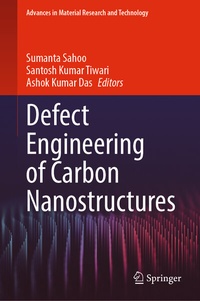
Defect Engineering of Carbon Nanostructures
Description

This book presents an analysis of the techniques used for the synthesis of innovative functional carbon nanostructures. The chapters describe the research and development of various layered carbon nanostructures. Emphasis is given to the impact of defects on carbon nanostructures. The application of carbon nanostructured materials in biomedical field and energy storage is described.
More details
Other editions
Additional editions
Persons
Santosh K. Tiwari received his PhD (2017) from IIT Dhanbad, India in Graphene-based Polymer nanocomposites and then worked with HSCL, Hanyang University, Seoul, South Korea for 1.5 years. In 2019, he joined the University of Guangxi, Nanning, China as a research faculty and then moved to Poland where he got a NAWA research grant from Govt. of Poland and presently working as a scientist at the Faculty of Chemistry, University of Warsaw, Poland. He published more than 55 research articles in reputed scientific journals and presented his works as an invited speaker in different countries. His main research interests are synthesis and characterization of new materials, 2D materials, polymer composites, biomass, and self-healing materials.
Ashok Kumar Das received his PhD from the Indian Institute of Technology Kharagpur, India. He published 29 research articles in various reputed scientific journals. After Completion of Ph.D. he worked as postdoctoral researcher in various institutes including, Chonbuk National University, Yeungnam University, Chungnam National University, South Korea; Indian Institute of Technology Kharagpur, India. He is currently working as an assistant professor in the Dept. of Chemistry, Madanapalle Institute of Technology & Science, India. His research interests are the synthesis and characterization of mixed metal oxides for various electrochemical applications including supercapacitor, electrocatalyst, electrochemical sensors etc.
