

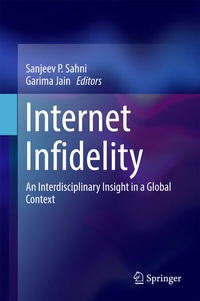
Internet Infidelity
Description

This volume discusses the phenomenon of internet infidelity by looking at the psychological, social, legal, and technological aspects involved in such behaviour. The rise of social media as well as technological advancements that create 'real' experiences online have made it possible for people to engage in multiple kinds of online relationships. These create concerns about regulating such activities via national and international law, as well as psychological and social concerns of understanding the overall impact of such behaviour. Therefore, this volume, which includes perspectives from across the world, asks and addresses some fundamental questions: Does internet infidelity amount to cheating? How is virtual infidelity different from actual infidelity? What are the social, interpersonal and psychological impacts of internet infidelity? Do people in different cultures view online infidelity differently? What are the myths associated with online infidelity? What are the various intervention measures or therapeutic techniques for treating people who are addicted to cybersex or pornography? The legal dimensions of internet cheating are equally important since adultery is considered as a criminal offence in some countries. As yet, there is no universally accepted definition of internet infidelity and legal perspectives become very important in understanding the phenomenon.
This volume includes grand theory approaches as well as detailed case studies and provides unique and multidisciplinary insights into internet cheating. It is ideal for marital therapists, counsellors, criminologists, legislators, and both researchers and students.
More details
Other editions
Additional editions
Persons
Sanjeev P. Sahni is a PhD in criminal psychology from Panjab University, Chandigarh, India. He is Principal Director of the Jindal Institute of Behavioural Sciences, O.P. Jindal Global University, Haryana, India, and has founded two research centers: Center for Victimology and Psychological Studies and Center for Leadership and Change. He served as Head, Education of Jindal Steel and Power Limited (JSPL) for three years. In 2015, he was awarded Edupreneur of the Year by ASSOCHAM. In appreciation of his contribution to the field of social sciences, he was honoured with the Serbian Academy Award of Arts and Sciences. He has been nominated as Director General to represent India on the International Forum on 'Crime and Criminal law in Global Era' in China (with consultative status of UN). He has served as scientist at the Ministry of Human Resource and Development and Ministry of Sports and Youth Affairs (Sports Authority of India). His research interests include police science studies,cybercrime, gender studies and criminal psychology.
Garima Jain is Assistant Director, Jindal Institute of Behavioural Sciences, O.P. Jindal Global University, Haryana, India.
