

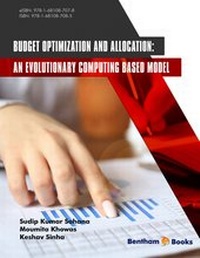
Budget Optimization and Allocation: An Evolutionary Computing Based Model
1st Edition
Published on 30. July 2018
170 pages
978-1-68108-707-8 (ISBN)
Description

Budget Optimization and Allocation: An Evolutionary Computing Based Model is a guide for computer programmers for writing algorithms for efficient and effective budgeting. It provides a balance of theory and practice.
All prices
More details
Other editions
Additional editions
Moumita Khowas | Keshav Sinha | Sudip Kumar Sahana
Budget Optimization and Allocation
An Evolutionary Computing Based Model
Book
07/2018
Bentham Science Publishers
€113.06
Shipment within 3-4 weeks
Content
- Intro
- CONTENTS
- FOREWORD
- PREFACE
- DEDICATION
- SUMMARY
- Introduction
- 1.1. IMPORTANCE AND CHALLENGES OF BUDGET ALLOCATION IN NATIONAL AND GLOBAL ECONOMY
- Military
- Health Care
- Education
- 1.2. ADVANTAGES AND DISADVANTAGES OF BUDGET ALLOCATION
- 1.2.1. Benefits of Budget Allocation
- 1.2.2. Disadvantage of Budget Allocation
- CONCLUDING REMARKS
- CONSENT FOR PUBLICATION
- CONFLICT OF INTEREST
- ACKNOWLEDGEMENTS
- REFERENCES
- Literature Review
- 2.1. TRADITIONAL BUDGET ALLOCATION TECHNIQUE
- 2.1.1. Rank and Selection Technique
- 2.1.2. Incremental Budgeting Technique
- 2.1.3. Zero-based Budgeting Technique
- 2.1.4. Ordinary Least Squares Technique (OLST)
- 2.1.5. Two-stage Least Squares Technique (2SLST)
- 2.2. LINEAR OPTIMIZATION
- 2.3. NONLINEAR OPTIMIZATION
- 2.4. METAHEURISTIC OPTIMIZATION
- 2.4.1. Pareto Efficiency or Pareto Optimality
- Marginal Conditions of Pareto Optimality
- Pareto Efficiency in Social welfare
- 2.4.2. Optimal Computing Budget Allocation (OCBA)
- 2.4.3. Genetic Algorithm (GA)
- 2.5. LITERATURE SURVEY
- 2.6. PROBLEM STATEMENT
- CONCLUDING REMARKS
- CONSENT FOR PUBLICATION
- CONFLICT OF INTEREST
- ACKNOWLEDGEMENTS
- REFERENCES
- Research Methodology
- 3.1. BUDGET ALLOCATION SCHEME/MODEL
- 3.2. BUDGET OPTIMIZATION TECHNIQUE
- 3.2.1. Proposed Evolutionary Computing based Framework for Budget Allocation and Optimization
- 3.2.1.1. Mathematical Finance
- 3.2.1.2. Evolutionary Computing Approach
- Pseudo code for the Crossover Process
- 3.3. BUDGET ALLOCATION TECHNIQUE
- CONCLUDING REMARKS
- CONSENT FOR PUBLICATION
- CONFLICT OF INTEREST
- ACKNOWLEDGEMENTS
- REFERENCES
- Result and Discussion
- 4.1. TEST CASE 1: GROWTH RATE CALCULATION
- 4.2. TEST CASE 2: PERCENT GROWTH RATE
- 4.3. TEST CASE 3: MEAN AND STANDARD DEVIATION TECHNIQUE
- 4.4. OPTIMIZATION TECHNIQUE 1: OCBA TECHNIQUE
- 4.5. OPTIMIZATION TECHNIQUE 2: EA TECHNIQUE
- 4.6. OPTIMIZATION TECHNIQUE 3: GA OPTIMIZATION
- 4.7. BUDGET ALLOCATION TECHNIQUE
- 4.7.1. Scheme 1: National Council of Education Research and Training (NCERT)
- 4.7.2. Scheme 2: Kendriya Vidyalaya Sangathan (KVS)
- 4.7.3. Scheme 3: Central Tibetan School Society Administration
- 4.7.4. Scheme 4: Scheme for Setting Up 6000 Model Schools
- 4.7.5. Scheme 5: Rashtriya Madhyamik Shiksha Abhiyan (RMSA)
- 4.7.6. Scheme 6: Navodaya Vidyalaya Samiti (NVS)
- 4.8. OUTPUT OF BUDGET ALLOCATION
- CONCLUDING REMARKS
- CONSENT FOR PUBLICATION
- CONFLICT OF INTEREST
- ACKNOWLEDGEMENTS
- REFERENCES
- APPENDIX A
- ALLOCATION OCBA
- Public Class Allocation_OCBA
- Applet Window Code for Simulation
- Simulation Pane Code for simulation
- OCBA and EA Simulation Run
- Optimal Computing Budget Allocation Simulation
- Equal Allocation (EA) Simulation
- Graph Generation
- APPENDIX B
- SIMULATION OF MEAN AND STANDARD DEVIATION
- Calculation of Growth Rate
- Department Wise Budget Allocation
- Percentage Growth Rate Calculation
- APPENDIX C
- BUDGET ALLOCATION USING GENETIC ALGORITHM APPROACH FITNESS CALCULATION
- GA Algorithm
- GA Population Selection
- Chart Preparation
- Java Bean for Mean Calculation
- Java Bean for Growth Rate Calculation
- LIST OF ABBREVIATIONS
