

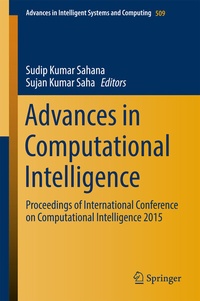
Advances in Computational Intelligence
Description

This volume comprises the proceedings of the International Conference on Computational Intelligence 2015 (ICCI15). This book aims to bring together work from leading academicians, scientists, researchers and research scholars from across the globe on all aspects of computational intelligence. The work is composed mainly of original and unpublished results of conceptual, constructive, empirical, experimental, or theoretical work in all areas of computational intelligence . Specifically, the major topics covered include classical computational intelligence models and artificial intelligence, neural networks and deep learning, evolutionary swarm and particle algorithms, hybrid systems optimization, constraint programming, human-machine interaction, computational intelligence for the web analytics, robotics, computational neurosciences, neurodynamics, bioinspired and biomorphic algorithms, cross disciplinary topics and applications. The contents of this volume will be of use to researchers and professionals alike.
More details
Other editions
Additional editions
Persons
Dr. Sudip Kumar Sahana was born in Purulia West Bengal, India on 8 th October, 1976. He received the B.E degree in Computer Technology from Nagpur University, India in 2001, the M.Tech. Degree in Computer Science in 2006 and Ph.D in Engineering in 2013 from the B.I.T. (Mesra), Ranchi, India. His major field of study is in Computer Science. He is currently working as Assistant Professor in the Department of Computer Science and Engineering, B.I.T. (Mesra), Ranchi, India. His research and teaching interests include soft computing, grid computing, network traffic management and artificial intelligence. He is author of number of research papers in the field of Computer Science. He is a lifetime member of Indian Society for Technical Education (ISTE).
Dr. Sujan Kumar Saha is currently a faculty member in the department of Computer Science and Engineering of Birla Institute of Technology Mesra, Ranchi, India. He has done his Ph.D. from the Computer Science and Engineering department of IIT Kharagpur (2010) and M.Tech. from IIT Delhi (2005). His main research interests include Natural Language Processing, Machine Learning, Web Mining and Educational Technology. He has authored around 25 research articles in various reputed international Journals and Conferences. Total citation count of his research papers is 156. He has also served as reviewer of various journals and conferences.
Content
PART 1: Fuzzy Logic.- PART 2: Artificial Neural Network.- PART 3: Genetic Algorithm and Bio-Inspired Computing.- PART 4: Applications in Cloud Computing. PART 5: Applications in Image Processing.- PART 6: Applications in Security.- PART 7: Other Applications of Computational Intelligence.
