

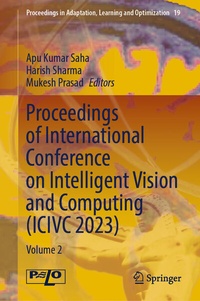
Proceedings of International Conference on Intelligent Vision and Computing (ICIVC 2023)
Description

This book contains outstanding research papers as the proceedings of the 3rd International Conference on Intelligent Vision and Computing (ICIVC 2023). ICIVC 2023 has been organized by National Institute of Technology Agartala, India under the technical sponsorship of the Soft Computing Research Society, India. It was held on November 25-26, 2023 at National Institute of Technology Agartala, India. The conference was conceived as a platform for disseminating and exchanging ideas, concepts, and results of the researchers from academia and industry to develop a comprehensive understanding of the challenges of the advancements of intelligence in computational viewpoints. This book will help in strengthening congenial networking between academia and industry. The conference focused on collective intelligence, soft computing, optimization, cloud computing, machine learning, intelligent software, robotics, data science, data security, big data analytics, signal and natural language processing.
More details
Other editions
Additional editions
Persons
Dr. Apu Kumar Saha is working as a professor in the Department of Mathematics, National Institute of Technology Agartala. He completed his M.Sc. degree in Mathematics from Tripura University with gold medal and completed his PhD from National Institute of Technology Agartala. He is an active researcher for the past ten plus years. His fields of research are Population-Based Optimization Algorithms, Decision Support Systems, Fuzzy Mathematics, Topological Spaces etc. He has published over one hundred and thirty research papers in reputed international journals, two books, twenty book chapters and over sixty international conferences. Twelve candidates received PhD under his guidance and five more candidates are currently pursuing PhD under him.
Dr. Harish Sharma is an Associate professor at Rajasthan Technical University, Kota in Department of Computer Science & Engineering. He has worked at Vardhaman Mahaveer Open University Kota, and Government Engineering College Jhalawar. He received his B.Tech and M.Tech degree in Computer Engg. from Govt. Engineering College, Kota and Rajasthan Technical University, Kota in 2003 and 2009 respectively. He obtained his Ph.D. from ABV - Indian Institute of Information Technology and Management, Gwalior, India. He is secretary and one of the founder member of Soft Computing Research Society of India. He is a life time member of Cryptology Research Society of India, ISI, Kolkata. He is an Associate Editor of "International Journal of Swarm Intelligence (IJSI)" published by Inderscience. He has also edited special issues of the many reputed journals like "Memetic Computing", "Journal of Experimental and Theoretical Artificial Intelligence", "Evolutionary Intelligence" etc. His primary area of interest is nature inspired optimization techniques. He has contributed in more than 105 papers published in various international journals and conferences.
Dr Mukesh Prasad is a Senior Lecturer at School of Computer Science in the Faculty of Engineering and IT at UTS who has made substantial contributions to the fields of machine learning, artificial intelligence and the internet of things. Mukesh's research interests include also big data, computer vision, brain computer interface, and evolutionary computation. He is working also in the evolving and increasingly important field of image processing, data analytics and edge computing, which promise to pave the way for the evolution of new applications and services in the area of healthcare, biomedical, agriculture, smart cities, education, marketing and finance. His research has appeared in numerous prestigious journals, including IEEE/ACM Transactions and conferences, he has written more than 100 research papers. Dr. Mukesh started his academic career as a lecturer with UTS in 2017 and became a core member of the University's world-leading Australian Artificial Intelligence Institute (AAII), which has a vision to develop theoretical foundations and advanced technologies for AI and to drive progress in related areas. His research is backed by industry experience, specifically in Taiwan, where he was the principal engineer (2016-17) at the Taiwan Semiconductor Manufacturing Company (TSMC). There, he developed new algorithms for image processing and pattern recognition using machine learning techniques. He was also a postdoctoral researcher leading a Big Data and computer vision team at National Chiao Tung University, Taiwan (2015). Mukesh received an M.S. degree from the School of Computer and Systems Sciences, Jawaharlal Nehru University, New Delhi, India (2009), and PhD from the Department of Computer Science, National Chiao Tung University, Taiwan (2015).
Content
1. FashionWhiz: A Novel Realtime Virtual Fashion Recommender with Try-On Feature.- 2. An efficient intrusion detection systems in the IoT and its challenges: A critical review.- 3. Artificial Intelligence in the detection of autism spectrum disorders (ASD): a systematic review.- 4. Revolutionizing Underwater Imaging: Unveiling The Impact and Advancements Enabled by The Keras UNet Family.- 5. Trustworthy Machine Emotion Intelligence Using Facial Micro-Expressions.- 6. A data management system for a uro-oncology medical clinic.- 7. Designing Energy Efficient Reinforcement Learning Based Routing Protocol for Next Generation Large Area WSN: EE-RLRP.- 8. COVID-19 Imposes Rethinking of Conferencing - Environmental Impact Assessment of Artificial Intelligence Conferences.- 9. Tackling Road Hazards: Classification and Detection of Crack and Potholes using deep learning.- 10. ECPX: Empowering Commodity Price Prediction Using XGBoost AlgorithmHRIDAYA- A Cardiovascular Disease Prediction Model.
