

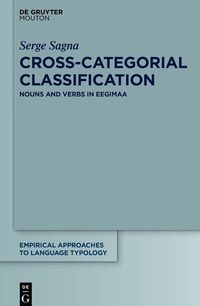
Cross-Categorial Classification
Description

Languages in which non-finite verbs (infinitives, gerunds etc.) are classified using the same linguistic means as nouns are rare. This typologically unusual phenomenon is found in some Atlantic (Niger-Congo) languages, including Jóola languages like Eegimaa, Fogny and Kwatay, where several different noun class/gender prefixes (NCPs) are used to classify both nouns and verbs. In this book, it is argued following Sagna (2008), that these parallel morphosyntactic classifications in the nominal domain and verbal domains also reflect parallel semantic categorisation of entities and events. The main topics investigated in this book are word class flexibility between nouns and verbs, non-finiteness, noun class/gender (where morphological classes are analysed separately from agreement classes) and the semantic principles underlying the categorisation of entities and events. One of the central findings proposed in this book is that instances of NCP alternations on non-finite verbs reflect strategies of event delimitation. This book will be of interest to scholars investigating parts-of-speech systems, finiteness, systems of nominal and verbal classification, and linguistic categorization.
More details
Other editions
Additional editions
Person
Content
- Intro
- Preface
- Acknowledgements
- Contents
- List of figures
- List of tables
- Abbreviations
- 1 Overt verb classification in spoken language: An introduction and a typology
- 2 Nouns, verbs and polycategorial stems in Eegimaa
- 3 The Eegimaa noun class/gender system
- 4 Non-finite verbs and their classification
- 5 Noun class semantics
- 6 Semantics of overt verb classes
- 7 Event delimitation: NCP alternations on non-finite verbs
- 8 Conclusion
- References
- Appendix A: Classification and location of Eegimaa
- Appendix B: Phonological sketch of Eegimaa
- Index
