

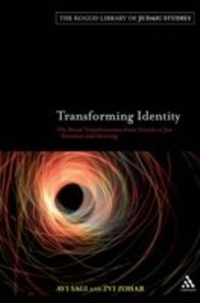
Transforming Identity
The Ritual Transition from Gentile to Jew - Structure and Meaning
1st Edition
Published on 29. November 2007
320 pages
978-1-4411-0128-0 (ISBN)
Description

Of all Judaic rituals, that of giyyur is arguably the most radical: it turns a Gentile into a Jew - once and for all and irrevocably. The very possibility of such a transformation is anomalous, according to Jewish tradition, which regards Jewishness as an ascriptive status entered through birth to a Jewish mother.
What is the internal logic of the ritual of giyyur, that seems to enable a Gentile to acquire an 'ascribed' identity? It is to this question, and others deriving from it, that the authors address themselves.
Interpretation of a ritual such as giyyur is linked to broad issues of anthropology, religion and culture: the relation of 'nature' and 'culture' in the construction of group boundaries; the tension between ethnicity and religion; the interrelation of individual identity and membership in a collective. Fully aware of these issues, this groundbreaking study focuses upon a close reading of primary halakhic texts from Talmudic times down to the present as key to the explication of meaning within the Judaic tradition.
In our times, the meaning of Jewish identity is a core issue, directly affecting the public debate regarding the relative weight of religion, nationality and kinship in determining basic aspects of Jewish life throughout the world. This book constitutes a seminal contribution to this ongoing discussion: it enables access to a wealth of halakhic sources previously accessible only to rabbinic scholars, fleshes out their meanings and implications within the cultural history of halakha, and in doing so situates halakha at the nexus of contemporary cultural discourse.
What is the internal logic of the ritual of giyyur, that seems to enable a Gentile to acquire an 'ascribed' identity? It is to this question, and others deriving from it, that the authors address themselves.
Interpretation of a ritual such as giyyur is linked to broad issues of anthropology, religion and culture: the relation of 'nature' and 'culture' in the construction of group boundaries; the tension between ethnicity and religion; the interrelation of individual identity and membership in a collective. Fully aware of these issues, this groundbreaking study focuses upon a close reading of primary halakhic texts from Talmudic times down to the present as key to the explication of meaning within the Judaic tradition.
In our times, the meaning of Jewish identity is a core issue, directly affecting the public debate regarding the relative weight of religion, nationality and kinship in determining basic aspects of Jewish life throughout the world. This book constitutes a seminal contribution to this ongoing discussion: it enables access to a wealth of halakhic sources previously accessible only to rabbinic scholars, fleshes out their meanings and implications within the cultural history of halakha, and in doing so situates halakha at the nexus of contemporary cultural discourse.
Reviews / Votes
'This book is a tour de force, a rare combination of comprehensive scholarship, insight, fresh thinking and wisdom...This is by far, the best book on this topic in the English language. It is at once a rich survey of the rabbinic dialogue on giyyur through the generations and a sophisticated deconstruction of the paradigms underlying the various and changing halachic rulings in history. It is also tacitly a polemic with the ideological rejection of conversion which has grown apace in the past century. This book is not to be missed!' Rabbi Irving Yitz Greenberg "Of all Judaic rituals, that of giyyur is arguably the most radical: it turns a Gentile into a Jew-once and for all and irrevocably. The very possibility of such a transformation is anomalous, according to Jewish tradition, which regards Jewishness as an ascriptive status entered through birth to a Jewish mother. This book provides a close reading of primary halakhic texts as a key to the explication of meaning within the Judaic tradition." - Shofar, Fall 2008More details
Series
Edition
1. Auflage
Language
English
Place of publication
New York
United States
Target group
Professional and scholarly
ISBN-13
978-1-4411-0128-0 (9781441101280)
Copyright in bibliographic data and cover images is held by Nielsen Book Services Limited or by the publishers or by their respective licensors: all rights reserved.
Schweitzer Classification
Other editions
Additional editions
Avi Sagi | Zvi Zohar
Transforming Identity
The Ritual Transition from Gentile to Jew - Structure and Meaning
Book
11/2007
Continuum International Publishing Group Ltd.
€99.40
Shipment within 15-20 days
Avi Sagi | Zvi Zohar
Transforming Identity
The Ritual Transition from Gentile to Jew - Structure and Meaning
Book
11/2007
Continuum International Publishing Group Ltd.
€232.80
Shipment within 15-20 days
Persons
Avi Sagi is Professor of Philosophy, and Founder and Director of the Interdisciplinary Graduate Program in Hermeneutics and Cultural Studies, at Bar-Ilan University, Israel. He is Senior Research Fellow at the Shalom Hartman Institute, Israel. He has written and edited numerous books and articles in Jewish and general philosophy, among them Religion and Morality (with Daniel Statman, New York: 1995) and the recently released Judaism: Between Religion and Morality (Tel Aviv: 1998) and Albert Camus and the Philosophy of the Absurd (New York: 2002).
Zvi Zohar is Chauncey Stillman Professor of Sephardic Law and Ethics at Bar Ilan University, where he teaches in the Faculty of Law and the Faculty of Jewish Studies. At the Shalom Hartman Institute, Prof. Zohar heads the Alan A. and Loraine Fischer Family Center for Contemporary Halakha. He has published over 60 scholarly articles in Hebrew, English and French, as well as several book-length studies in Hebrew, including: Tradition and Change: Halakhic Responses of Middle Eastern Rabbis to Legal and Technological Change; The Luminous Face of the East - Studies in the Legal and Religious Thought of Sephardic Rabbis of the Middle East; and A Socio-Cultural Drama in Aleppo in the French Mandatory Period. His previous publication with Continuum [written with Avi Sagi] is Transforming Identity, on the history and development of Judaic norms concerning conversion.
Zvi Zohar is Chauncey Stillman Professor of Sephardic Law and Ethics at Bar Ilan University, where he teaches in the Faculty of Law and the Faculty of Jewish Studies. At the Shalom Hartman Institute, Prof. Zohar heads the Alan A. and Loraine Fischer Family Center for Contemporary Halakha. He has published over 60 scholarly articles in Hebrew, English and French, as well as several book-length studies in Hebrew, including: Tradition and Change: Halakhic Responses of Middle Eastern Rabbis to Legal and Technological Change; The Luminous Face of the East - Studies in the Legal and Religious Thought of Sephardic Rabbis of the Middle East; and A Socio-Cultural Drama in Aleppo in the French Mandatory Period. His previous publication with Continuum [written with Avi Sagi] is Transforming Identity, on the history and development of Judaic norms concerning conversion.
Content
Introduction
Part I: The Proselyte's Motivation as a factor in Giyyur
Prologue
Chapter One: The Proselyte's Motivation in Talmudic Sources
Chapter Two: The Proselyte's Motivation in Post-Talmudic Sources up to the Sixteenth Century
Chapter Three: The Motivation for Giyyur in Modern Halakhic Sources:
Adaptivist Positions
Chapter Four: The Motivation for Giyyur in Modern Halakhic Sources:
Rejectionist and Transformationist Positions
Part II: The Giyyur Ritual
Introduction
Chapter Five: Giyyur as a Voluntaristic Normative Commitment in Talmudic Literature
Chapter Six: Giyyur as a Bodily Ritual in Talmudic Literature
Chapter Seven: Chapter Seven: The Canonical Formulation of the Ritual of Giyyur
Chapter Eight: The Yevamot Paradigm in Medieval Halakha
Chapter Nine: The Ritual of Giyyur: Aspects of the Demai Paradigm in Medieval Halakha
Chapter Ten: The Two Paradigms of Giyyur -- from the Arba'ah Turim to the Shulhan 'Arukh
Chapter Eleven: The Hermeneutical Controversy Regarding Rabbi Caro's Position - and its Significance
Part III: The Polyphonic Meaning of Acceptance of the Commandments in Halakhic Literature
Introduction
Chapter Twelve: Acceptance of the Commandments as a Formal Declaration
Chapter Thirteen: Acceptance of the Commandments as Subjective Intent
Chapter Fourteen: Ex post facto Annulment of Giyyur
Part IV: The Meaning of Giyyur
Introduction
Chapter 15: Giyyur and Jewish Identity
Bibliography
Part I: The Proselyte's Motivation as a factor in Giyyur
Prologue
Chapter One: The Proselyte's Motivation in Talmudic Sources
Chapter Two: The Proselyte's Motivation in Post-Talmudic Sources up to the Sixteenth Century
Chapter Three: The Motivation for Giyyur in Modern Halakhic Sources:
Adaptivist Positions
Chapter Four: The Motivation for Giyyur in Modern Halakhic Sources:
Rejectionist and Transformationist Positions
Part II: The Giyyur Ritual
Introduction
Chapter Five: Giyyur as a Voluntaristic Normative Commitment in Talmudic Literature
Chapter Six: Giyyur as a Bodily Ritual in Talmudic Literature
Chapter Seven: Chapter Seven: The Canonical Formulation of the Ritual of Giyyur
Chapter Eight: The Yevamot Paradigm in Medieval Halakha
Chapter Nine: The Ritual of Giyyur: Aspects of the Demai Paradigm in Medieval Halakha
Chapter Ten: The Two Paradigms of Giyyur -- from the Arba'ah Turim to the Shulhan 'Arukh
Chapter Eleven: The Hermeneutical Controversy Regarding Rabbi Caro's Position - and its Significance
Part III: The Polyphonic Meaning of Acceptance of the Commandments in Halakhic Literature
Introduction
Chapter Twelve: Acceptance of the Commandments as a Formal Declaration
Chapter Thirteen: Acceptance of the Commandments as Subjective Intent
Chapter Fourteen: Ex post facto Annulment of Giyyur
Part IV: The Meaning of Giyyur
Introduction
Chapter 15: Giyyur and Jewish Identity
Bibliography
