

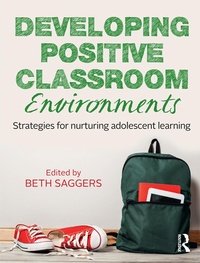
Developing Positive Classroom Environments
Strategies for nurturing adolescent learning
1st Edition
Published on 16. July 2020
346 pages
978-1-000-24920-0 (ISBN)
Description

The middle years of learning are increasingly recognised as one of the most challenging yet opportune periods for growth and development. Based on the Positive Behaviour Support (PBS) framework, this book will equip educators with the appropriate knowledge, skills and strategies to support learners in maximising their educational success, managing emotional issues and making a successful transition to adulthood.
Part A outlines the principles of the PBS framework, defines key characteristics of middle-years learners and provides insight from neuroscience into the nature of the adolescent brain. This section also looks at the importance of listening to the student voice, highlights issues that can arise during the transition into the middle years of schooling, and discusses the use of evidence-based PBS practices to encourage engagement and establish clear behavioural expectations with learners. Part B focuses on the practical aspects of implementing universal PBS strategies in the classroom, including developing strong and effective relationships with students, promoting school connectedness and supporting self-regulation. Part C examines more focused and intensive interventions, and provides strategies for working with students experiencing stress, anxiety and bullying. Finally, Part D discusses ways to support a range of perspectives and experiences in the middle-years, including trauma-affected students, ethnic and cultural diversity and students on the autism spectrum, as well as ways to use ICT to re-engage vulnerable students.
This is an essential reference for both primary and secondary educators, revealing how PBS strategies can play a profound role in positively transforming classroom behaviour.
Part A outlines the principles of the PBS framework, defines key characteristics of middle-years learners and provides insight from neuroscience into the nature of the adolescent brain. This section also looks at the importance of listening to the student voice, highlights issues that can arise during the transition into the middle years of schooling, and discusses the use of evidence-based PBS practices to encourage engagement and establish clear behavioural expectations with learners. Part B focuses on the practical aspects of implementing universal PBS strategies in the classroom, including developing strong and effective relationships with students, promoting school connectedness and supporting self-regulation. Part C examines more focused and intensive interventions, and provides strategies for working with students experiencing stress, anxiety and bullying. Finally, Part D discusses ways to support a range of perspectives and experiences in the middle-years, including trauma-affected students, ethnic and cultural diversity and students on the autism spectrum, as well as ways to use ICT to re-engage vulnerable students.
This is an essential reference for both primary and secondary educators, revealing how PBS strategies can play a profound role in positively transforming classroom behaviour.
Reviews / Votes
'The authors of this book share their knowledge, expertise and enthusiasm to provide teachers and pre-service teachers with practical insights into managing diverse classroom environments that are inclusive of students' learning needs.'Karen Peel, Lecturer, School of Teacher Education and Early Childhood, The University of Southern Queensland
More details
Edition
1. Auflage
Language
English
Place of publication
London
United Kingdom
Publishing group
Taylor & Francis Ltd
Target group
Professional and scholarly
ISBN-13
978-1-000-24920-0 (9781000249200)
Copyright in bibliographic data and cover images is held by Nielsen Book Services Limited or by the publishers or by their respective licensors: all rights reserved.
Schweitzer Classification
Other editions
Additional editions
Book
03/2021
1st Edition
Routledge
€148.56
Shipment within 15-20 days
Book
10/2017
1st Edition
Allen & Unwin
€62.08
Shipment within 3-4 weeks
Person
DR BETH SAGGERS is senior lecturer in the Faculty of Education at Queensland University of Technology. She has almost thirty years of teaching experience with students on the autism spectrum and is an active research participant in the Cooperative Research Centre for Living with Autism. She has worked with students in all phases of schooling, across a diverse range of educational settings, and has extensive experience in working with students with challenging behaviours.
Content
List of tables and figures
Contributors
Preface
Part A: The Positive Behaviour Support framework and middle-years learners
1. Positive Behaviour Support: An overview of the three-tiered framework
2. Middle-years learners: Supporting the development of lifelong learners
3. Brain development in adolescence
4. The authentic inclusion of child and adolescent voices in educational provision
5. Evidence-based PBS practices: Encouraging engagement and establishing clear behavioural expectations
6. Coping with transition: Supporting the change from primary to secondary school
Part B: Tier 1-Universal interventions: Key elements of PBS and classroom practice
7. Tier 1: Universal interventions that support PBS and classroom practice
8. Developing and supporting teacher resilience: A foundation of PBS
9. Building relationships: Strategies to increase collaboration, cooperation and participation
10. Accessing language in the classroom: Critical considerations for implementing positive behaviour strategies in the classroom
11. Promoting school connectedness, promoting a sense of belonging
12. Self-regulation: Supporting social and emotional wellbeing and academic learning
13. PBS in practice: A teacher's perspective
Part C: Tiers 2 and 3-Targeted group interventions and intensive individual interventions
14. Tiers 2 and 3: Strategies to support more challenging behaviours in middle-years learners
15. Promoting good mental health and supporting social and emotional wellbeing: Managing stress and anxiety, and supporting autonomy and resilience in middle-years learners
16. What to do about bullying in middle-years learners
Part D: Catering for diversity as part of a PBS approach
17. A Tier 3 approach to complex childhood trauma
18. Inclusion in the middle years: Supporting ethnic and cultural diversity
19. Students on the autism spectrum: Influences on the middle-years learner
20. ICT in adolescence: Using technology to re-engage vulnerable students
Acknowledgements
Index
Contributors
Preface
Part A: The Positive Behaviour Support framework and middle-years learners
1. Positive Behaviour Support: An overview of the three-tiered framework
2. Middle-years learners: Supporting the development of lifelong learners
3. Brain development in adolescence
4. The authentic inclusion of child and adolescent voices in educational provision
5. Evidence-based PBS practices: Encouraging engagement and establishing clear behavioural expectations
6. Coping with transition: Supporting the change from primary to secondary school
Part B: Tier 1-Universal interventions: Key elements of PBS and classroom practice
7. Tier 1: Universal interventions that support PBS and classroom practice
8. Developing and supporting teacher resilience: A foundation of PBS
9. Building relationships: Strategies to increase collaboration, cooperation and participation
10. Accessing language in the classroom: Critical considerations for implementing positive behaviour strategies in the classroom
11. Promoting school connectedness, promoting a sense of belonging
12. Self-regulation: Supporting social and emotional wellbeing and academic learning
13. PBS in practice: A teacher's perspective
Part C: Tiers 2 and 3-Targeted group interventions and intensive individual interventions
14. Tiers 2 and 3: Strategies to support more challenging behaviours in middle-years learners
15. Promoting good mental health and supporting social and emotional wellbeing: Managing stress and anxiety, and supporting autonomy and resilience in middle-years learners
16. What to do about bullying in middle-years learners
Part D: Catering for diversity as part of a PBS approach
17. A Tier 3 approach to complex childhood trauma
18. Inclusion in the middle years: Supporting ethnic and cultural diversity
19. Students on the autism spectrum: Influences on the middle-years learner
20. ICT in adolescence: Using technology to re-engage vulnerable students
Acknowledgements
Index
