

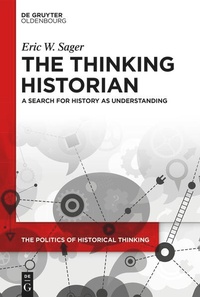
The Thinking Historian
Description

What is history? What are historians doing, when we create our histories? The need for answers is more urgent than ever. We live in an era when history is often rejected or ignored, and when all teachers of history confront formidable challenges. In the culture of screen capitalism and social media, historical knowledge is evaded in an expanding present-minded consciousness. How can history be defended, and what is it that we are defending?
This book argues that history is a mode of thinking, a form of imaginative reasoning with its own informal logic. In non-technical language and using examples from important works of history, the book defines core elements in historical thinking. These include contingency, complexity, temporality, parts and wholes, consilience, perspectives, analogy, and abduction. These elements are subsumed into the concept of imaginative reasoning. The overall argument echoes the work of hermeneutic philosophers. History is a disciplined imagination, tempered and empowered by its forms of reasoning. It embraces ethical imperatives that the historian has a duty to declare. Equipped with such understanding, historians may answer the many rejections of history and secure its place in our shared futures.
Winner of this year's Choice' s Outstanding Academic Titles: www.choice360.org/choice-pick/outstanding-academic-titles-2025
Reviews / Votes
"The manuscript is greatly to be welcomed at this juncture in the history of the discipline of history. It offers a refreshing perspective on questions that can hold the profession together." - Benjamin Zachariah , Senior Research Fellow, Trier University, Germany.
"An excellent choice for an introductory book for students of historiography." - Marnie Hughes-Warrington , Bradley Distinguished Professor, University of South Australia.
"Writing as a practicing historian with a lifetime of experience in teaching and researching the past, Eric Sager offers a crisp, concise, and personally introspective exploration of how historical thinking works. In its use of real examples of historical scholarship, and by linking these to philosophical and social scientific concepts in a style free of both oversimplification and jargon, The Thinking Historian will be of great value to anyone seeking to understand both the possibilities and the limits of history." - Daniel Woolf , Professor and Principal Emeritus, Queen's University, Canada.
More details
Other editions
Additional editions
Person
Eric W. Sager , University of Victoria, Canada.
