

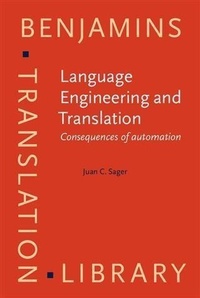
Language Engineering and Translation
Consequences of automation
1st Edition
Published on 22. April 1994
XX, 345 pages
978-90-272-8364-1 (ISBN)
Description

At a time when information technology has become a regular tool of specialised translators in all aspects of their work, it is useful to place the activity of technical translation into its appropriate environment and to describe it from the point of view of its role in the broader context of communication in which it occurs. The advent of automated alternatives to human translation has fundamentally affected the profession, its products and the relationship between translators and their clients.This book presents and discusses the process of translation against this background. The context in which translation is normally studied is widened in order to re-examine the process of translation as part of interlingual text production and to analyse the manner in which the new tools affect the product of translation.This book is of particular relevance in modern translator training courses.
More details
Other editions
Additional editions
Book
04/1994
John Benjamins Publishing Co
€127.20
Shipment within 10-15 days
Person
Content
- LANGUAGE ENGINEERING AND TRANSLATION CONSEQUENCES OF AUTOMATION
- Editorial page
- Title page
- Copyright page
- Acknowledgements
- Table of contents
- Preface. Translation in an Industrial Setting
- Chapter One. The Language Industry and its Raw Material
- 1. The Language Industry and Translation
- 1.1 The industrialisation of communication
- 1.2 The scope of 'Language Industry'
- 1.2.1 Support industry
- 1.2.2 Industry for processing languages
- 1.2.3 Industry for the production of languages
- 1.2.4 Tools and Products
- 1.3 The evolution of the language industry
- 1.3.1 The present situation
- 1.3.2 The role of linguistic research
- 1.4 The structure of the language industry
- 1.4.1 Science and application
- 1.4.2 Range of written and spoken languages
- 1.4.3 Reception and production
- 1.4.4 Applications and products
- 1.5 Conditions for the design and application of industrial tools
- 1.5.1 Conditions for the development of the machine translation industry
- 2. Theoretical Aspects of Language
- 2.1 The nature and uses of language
- 2.2 The intention of speech acts
- 2.2.1 The pragmatic dimension of speech acts
- 2.3 The concept of sublanguages
- 2.3.1 Criteria for establishing sublanguages
- 2.4 Evolution and types of language varieties
- 2.5 Natural and artificial languages
- 2.5.1 Characteristics of natural language
- 2.5.2 Characteristics of artificial languages
- 2.6 The evolution of restricted languages
- 2.7 Definition of special subject languages
- 2.7.1 Disciplines and subject fields
- 2.7.1.1 Special knowledge reflected in texts
- 2.7.1.2 Special knowledge and reference
- 2.7.2 Special usage
- 2.7.3 Special restrictions
- Chapter Two. Communication Theory for Translation
- 3. Elements of a Communication Theory
- 3.1 The environment of communication
- 3.2 Preconditions of communication
- 3.2.1 Communicative situations
- 3.2.2 The situation of the written speech act
- 3.2.3 Components of the speech act
- 3.2.3.1 The stimulus
- 3.2.3.2 Temporal factors
- Point of time
- Duration
- Time lag
- Regularity
- 3.2.3.3 Spatial factors
- 3.2.3.4 Personal factors
- 3.3 Choices in communication
- 3.3.1 Choice of content of the message (its topic and aspect)
- 3.3.1.1 Topic
- 3.3.1.2 Aspect
- 3.3.2 Choice of purpose (Intention + Expectation)
- 3.3.2.1 Social purpose
- 3.3.2.2 Informative purpos
- 3.3.2.3 Directive purpose
- 3.3.2.4 Discursive purpose
- 3.3.2.5 Evaluative purpose
- 3.3.3 Choice of affectivity
- 3.3.4 Choice of language
- 3.3.5 Choice oftext types
- 3.3.6 Choice of techniques of communication
- 3.3.6.1 Choice of non-linguistic vs mixed linguistic/nonlinguistic communication
- 3.3.6.2 Choice of external form
- 3.3.6.3 Choice of technical means
- 3.3.6.4 Choice of axes of expression
- 3.3.6.4.1 Geographical variation
- 3.3.6.4.2 Topic dependence
- 3.3.6.4.3 Level
- 33.6.4.4 Formality
- Frozen & formal
- Casual & intimate
- Consultative
- 4. A Theory of Text Types and Messages
- 4.1 Text types
- 4.1.1 Macro text types in science and technology
- 4.1.1.1 Schedule
- 4.1.1.2 Memo
- 4.1.1.3 Essay
- 4.1.1.4 Report
- 4.1.2 Reader recognition of text type
- 4.1.3 Criteria for defining a textual unit
- 4.1.3.1 The concept of textuality
- 4.1.3.2 Text types as efficient units of communication
- 4.1.4 Inter-related texts
- 4.1.4.1 Formal inter-relation
- 4.1.4.2 Content inter-relation
- 4.1.4.3 Inter-relation by imitation
- 4.2 A model of document production and reception
- 4.2.1 The role of participants in production and reception
- 4.2.2 Production
- 4.2.3 Reception and understanding
- 4.2.3.1 Primary and secondary reader
- 4.2.3.2 Assistance in reading-understanding
- 4.2.4 The product
- 4.2.4.1 Text and message from the writer perspective
- 4.2.4.2 Text and message from the reader' s viewpoint
- 4.3 Criteria for successful communication
- 4.3.1 Knowledge
- 4.3.2 Cooperation
- 4.3.3 Relevance
- 4.4 Text modification
- 4.4.1 Types of document modification
- 4.4.1.1 Correction
- 4.4.1.2 Editing
- 4.4.1.3 Derivation
- 4.4.2 Types of derived texts
- 4.4.3 Methods of modification
- 4.4.3.1 Transformation
- 4.4.3.2 Translation
- 4.4.4 The professions concerned with text modification
- 4.4.5 Criteria for successful modification
- Chapter Three. Theoretical Aspects of Translation
- 5. The Nature of Translation
- 5.1 The scope of theories of translation
- 5.1.1 Two aspects of translation
- 5.1.1.1 Process
- 5.1.1.2 Products
- 5.1.2 Dimensions of a theory
- 5.1.2.1 Communicative/author dimension
- 5.1.2.2 Document or product dimension
- 5.1.2.3 Reader/agent/recipient dimension
- 5.1.2.4 Motivation/translator dimension
- 5.1.2.5 Situational dimension
- 5.1.3 Machine translation as a new activity and product
- 5.2 The meanings of translation
- 5.2.1 Existing definitions of translation
- 5.2.2 Other meanings of translation
- 5.3 The concept of translatability
- 5.3.1 The legitimacy of translation
- 5.3.2 Cultural arguments
- 5.3.3 Philosophical arguments
- 5.3.4 Measures of translatability
- 5.4 The basis of a theory of translation
- 5.4.1 Process model of translation
- 5.4.2 Translation situations
- 5.5 The concept of equivalence
- 5.6 Evaluation of translation
- 5.6.1 Criteria for evaluation
- 6. Specifications: Factors Influencing the Translation Process
- 6.1 Conditions for modelling the translation process
- 6.1.1 Basic approaches to translation techniques
- 6.2 Existing models of the translation process
- 6.3 Major types of translation activities
- 6.3.1 Literary translation
- 6.3.2 Bible translation
- 6.3.3 Industrial translation
- 6.4 Analysis of the translation task
- 6.4.1 Alternative views of the task
- 6.5 Specification phase
- 6.5.1 Identification of source language document
- 6.5.1.1 Recognition of text type and topic
- 6.5.1.2 Recognition of intention
- 6.5.2 Interpretation of specifications
- 6.5.2.1 The situation of the translation process
- 6.5.2.2 Time and cost factors
- 6.5.2.3 The condition of the translator
- 6.5.2.4 Writer and reader factors
- 6.5.2.5 User expectation
- 6.5.2.6 Source and product (textual) factors
- 6.6 Functional types of translation
- 6.6.1 Autonomous documents
- 6.6.2 Interdependent documents
- 6.6.2.1 Parallel documents
- 6.6.2.2 Full equal document
- 6.6.3 Derived documents
- 6.6.3.1 Selective document translation (Excerpts)
- 6.6.3.2 Reduced document translation (Abstracts)
- 6.6.3.3 Translations with the same function
- 6.6.3.4 Translations with a different function
- Target language text type
- Translation text type
- 6.6.4 Functional types of translation by intention
- 6.6.5 Other functional types of translation
- Chapter Four. A Model of the Translation Process
- 7 Preparation for Translation
- 7.1 Choice of target language text type
- 7.2 Choice of translation strategy
- 7.2.1 Motivation of diverse translation strategies
- 7.2.1.1 Full, reduced and selective translation
- 7.2.1.2 Temporal segmentation of the process
- 7.2.2 The impact of electronic devices on the choice of strategy
- 7.2.2.1 Choice of machine assistance or MT
- 7.2.3 The interaction of choices
- 7.3 Reading Comprehension: Human text understanding
- 7.3.1 The knowledge dimension of text understanding
- 7.3.2 The pragmatic dimension of text understanding
- 7.3.3 The linguistic dimension of text understanding
- 7.3.4 The limits imposed on comprehension
- 7.3.4.1 Implications for the automatic analysis of texts
- 7.3.4.2 Translator competence
- 7.4 Dictionary look-up
- 7.4.1 Modes of dictionary consultation
- 7.5 Electronic tools to support dictionary consultation
- 8 Steps in Translation
- 8.1 The translation process
- 8.1.1 Translation units
- 8.1.2 A psycholinguistic model
- 8.1.3 Modes of processing
- 8.1.4 Extension of the existing model
- 8.2 Resolution of ambiguity
- 8.3 Search for equivalents
- 8.3.1 Units of equivalence
- 8.4 Translation techniques
- 8.5 Matching
- 8.5.1 Lexical matching
- 8.5.2 Syntactic matching
- 8.5.3 Pragmatic matching
- 8.5.4 The need for pre-established match
- 8.5.5 Criteria for efficient matching
- 8.6 Compensation
- 8.7 Text production/encoding
- 8.8 Evaluation and revision
- 8.8.1 Content comparison and contr
- 8.8.2 Revision
- 8.8.3 Criteria for evaluation
- 8.9 Presentation
- Chapter Five. The Automated Dimension of Translation
- 9 Human and Machine Translation
- 9.1 Modes of comparison
- 9.2 Comparison of the translation processes
- 9.2.1 Translation as problem solving
- 9.2.2 The expert system view
- 9.2.2.1 The type and nature of knowledge bases
- 9.2.3 The nature of the modules in the MT process
- 9.2.3.1 Comprehension vs. analysis
- 9.2.3.2 Matching vs. transfer
- 9.2.3.3 Writing vs. generation
- 9.2.4 Current limitations of MT
- 9.3 Comparison of human and machine translation products
- 9.3.1 Human vs. machine-produced texts
- 9.3.1.1 The nature of machine-generated (MT) language
- 9.3.2 Flexibility vs. rigidity in text types
- 9.4 Uses of MT
- 9.5 Comparative evaluation of MT produced texts
- 9.5.1 Methods of MT evaluation
- 10 The Pragmatic Circumstances of Automation in Translation
- 10.1 Methods of MT
- 10.1.1 Linguistic approaches
- 10.1.2 The semantic approach
- 10.2 Users of MT systems
- 10.2.1 The translator as producer
- 10.2.2 The writer as translation producer
- 10.2.3 Readers of translations
- 10.2.4 The information supplier
- 10.3 Brief description of MT systems
- 10.4 Functional types of machine translation
- 10.4.1 MT as human translation aid
- 10.4.2 Translation by reference to existing models
- 10.4.3 MT as text-type specific independent systems
- 10.4.3.1 Reader-oriented MT
- 10.4.3.2 Writer-oriented MT
- 10.4.3.3 Writer-oriented editing of pre-translated text
- 10.4.4 MT of machine-readable restricted language texts
- 10.4.5 ?T of machine-readable artificial language text
- 10.4.6 Outlook
- 10.5 Other Applications of MT technology
- 10.6 Other ways of classifying MT systems
- 10.6.1 Typology of MT systems by text types
- 10.6.2 Typology of MT systems by degree of automation
- 10.7 Criteria for the use of MT
- 10.7.1 Cost factors
- 10.7.2 Document selection for MT processing
- Chapter Six. Industrialisation of Translation
- 11 Translation in an Information Technology Environment
- 11.1 Industrial aspects of translation
- 11.1.1 The cost and value of translation
- 11.1.2 Growth in demand
- 11.1.3 The market for MT
- 11.2 A pragmatic view of the development of MT
- 11.2.1 MT system designers and producers
- 11.2.2 Translators as users of information technology and MT
- 11.2.3 Survey of the evolution of MT
- 11.2.4 Practical achievements of MT
- 11.3 Future prospects for the language industry
- Bibliography
- Glossary
- Subject Index
- Author Index
