

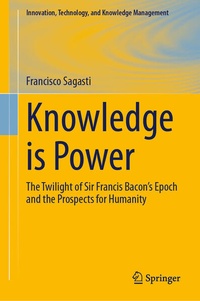
Knowledge is Power
Description

This book explores the life and legacy of Francis Bacon, tracing how his vision of mastering nature through knowledge influenced centuries of scientific and technological progress. Using scattered writings as a foundation, the author reconstructs the so-called Baconian Program and traces its evolution through the Scientific Revolution, the Enlightenment, and the Industrial Revolution, ultimately reaching its zenith in the 20th century.
Although Bacon's ideas were extraordinarily successful, they also had unintended consequences that now challenge their original foundations. As the Baconian epoch comes to a close, the book reflects on the uncertainties of our time and explores emerging paradigms that could lead humanity into a post-Baconian future. This book will appeal to scholars, researchers, and students interested in the development of science and innovation studies, as well as anyone seeking to understand the historical roots and future implications of knowledge-driven progress.
More details
Other editions
Additional editions
Person
Francisco Sagasti is a Peruvian scholar, author, and former President of the Republic of Peru. With a PhD from the University of Pennsylvania, he has held senior roles at the World Bank, United Nations, and numerous academic institutions. His work spans science and technology policy, innovation, development strategy, and governance. Sagasti has published over 30 books and 150 academic papers, and served on advisory boards for global organizations. He was the first recipient of the Robert K. Merton Award for lifetime contributions to the social studies of science. His career reflects a deep commitment to understanding the role of knowledge in shaping society and guiding progress.
Content
Part I: Sir Francis Bacon's Life and Legacy.- Chapter 1: Bacon's Unsettled Life and Extraordinary Works.- Chapter 2: Bacon's Multifaceted and Controversial Legacy.- Chapter 3: Sir Francis Bacon's Program.- Part II: The Baconian Epoch.- Chapter 4: Towards the Baconian Epoch.- Chapter 5: Configuring Modern Science.- Chapter 6: Enlightenment, Industry and Engineering.- Chapter 7: Science-Based Technologies and Socioeconomic Transformations.- Chapter 8: Ambiguous Success.- Part III: The Twiligth of Bacon's Epoch.- Chapter 9: A New Setting for Human Endeavors.- Chapter 10: Rethinking the Baconian Program.- Chapter 11: Into a Post-Baconian Epoch.- Chapter 12. Epilogue.
