
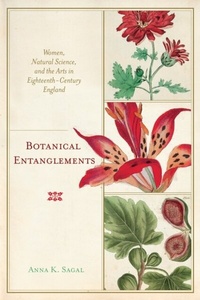
Botanical Entanglements
Description
Alles über E-Books | Antworten auf Fragen rund um E-Books, Kopierschutz und Dateiformate finden Sie in unserem Info- & Hilfebereich.
To this day, women face barriers in entering scientific professions, and in earlier eras the challenges were greater still. But in Botanical Entanglements, Anna Sagal reveals how women's active participation in scientific discourses of the eighteenth century was enabled by the manipulation of social and cultural conventions that have typically been understood as limiting factors. By taking advantage of the intersections between domesticity, femininity, and nature, the writers and artists studied here laid claim to a specific authority on naturalist subjects, ranging from botany to entomology to natural history more broadly.
Botanical Entanglements pairs studies of well-known authors-Eliza Haywood, Charlotte Lennox, Maria Edgeworth, and Charlotte Smith-with authors and artists who receive less attention in this context-Priscilla Wakefield, Maria Jacson, Elizabeth Blackwell, Henrietta Maria Moriarty, and Mary Delany-to offer a nuanced portrait of the diverse strategies women employed to engage in scientific labor. Using socially acceptable forms of textual production, including popular periodicals, didactic texts, novels, illustrated works, craftwork, and poetry, these women advocated for more substantive and meaningful engagement with the natural world. In parallel, the book also illuminates the emotional and physical intimacies between women, plants, and insects to reveal an early precursor to twenty-first-century theorizing of plant intelligence and human-plant relationships. Recognizing such literary and artistic "entanglement" facilitates a more profound understanding of the multifaceted relationship between women and the natural world in eighteenth-century England.
All prices
More details
Other editions
Additional editions
Person
Anna K. Sagal is Associate Professor of English and Creative Writing at Cornell College.
Content
1. Caterpillars in the Garden: Teaching Natural History in Women's Periodicals
2. From Native Blooms to Monster Plants: Women's Botanical Textbooks and the Lives of Plants
3. Pedagogies and Possibilities: Maria Edgeworth's Scientific Education for Women
4. Sketching Vegetality: Blackwell, Moriarty, and Illustrated Botanical Texts
5. Collecting and Creating: Mary Delany's Naturalist Career
Coda: Naming is Not Knowing: Charlotte Smith's "Flora" and Vegetal Proliferation

System requirements
File format: ePUB
Copy protection: Adobe-DRM (Digital Rights Management)
System requirements:
- Computer (Windows; MacOS X; Linux): Install the free reader Adobe Digital Editions prior to download (see eBook Help).
- Tablet/smartphone (Android; iOS): Install the free app Adobe Digital Editions or the app PocketBook before downloading (see eBook Help).
- E-reader: Bookeen, Kobo, Pocketbook, Sony, Tolino and many more (not Kindle).
The file format ePub works well for novels and non-fiction books – i.e., „flowing” text without complex layout. On an e-reader or smartphone, line and page breaks automatically adjust to fit the small displays.
This eBook uses Adobe-DRM, a „hard” copy protection. If the necessary requirements are not met, unfortunately you will not be able to open the eBook. You will therefore need to prepare your reading hardware before downloading.
Please note: We strongly recommend that you authorise using your personal Adobe ID after installation of any reading software.
For more information, see our ebook Help page.
File format: PDF
Copy-Protection: Adobe-DRM (Digital Rights Management)
System requirements:
- Computer (Windows; MacOS X; Linux): Install the free reader Adobe Digital Editions prior to download (see eBook Help).
- Tablet/smartphone (Android; iOS): Install the free app Adobe Digital Editions or the app PocketBook before downloading (see eBook Help).
- E-reader: Bookeen, Kobo, Pocketbook, Sony, Tolino and many more (only limited: Kindle).
The file format PDF always displays a book page identically on any hardware. This makes PDF suitable for complex layouts such as those used in textbooks and reference books (images, tables, columns, footnotes). Unfortunately, on the small screens of e-readers or smartphones, PDFs are rather annoying, requiring too much scrolling.
This eBook uses Adobe-DRM, a „hard” copy protection. If the necessary requirements are not met, unfortunately you will not be able to open the eBook. You will therefore need to prepare your reading hardware before downloading.
Please note: We strongly recommend that you authorise using your personal Adobe ID after installation of any reading software.
For more information, see our eBook Help page.
File format: ePUB
Copy protection: without DRM (Digital Rights Management)
System requirements:
- Computer (Windows; MacOS X; Linux): Use a reader that can handle the file format ePUB, such as Adobe Digital Editions or FBReader – both free (see eBook Help).
- Tablet/Smartphone (Android; iOS): Install the free app Adobe Digital Editions or the app PocketBook (see eBook Help).
- E-reader: Bookeen, Kobo, Pocketbook, Sony, Tolino and many more (not Kindle).
The file format ePUB works well for novels and non-fiction books – i.e., 'flowing' text without complex layout. On an e-reader or smartphone, line and page breaks automatically adjust to fit the small displays.
This eBook does not use copy protection or Digital Rights Management
For more information, see our eBook Help page.
