

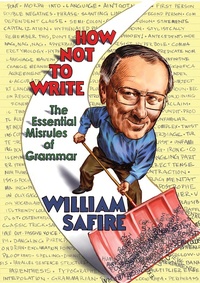
How Not to Write
The Essential Misrules of Grammar
Published on 8. September 2014
162 pages
978-0-393-35136-1 (ISBN)
Description

These fifty humorous misrules of grammar will open the eyes of writers of all levels to fine style.
How Not to Write is a wickedly witty book about grammar, usage, and style. William Safire, the author of the New York Times Magazine column "On Language," homes in on the "essential misrules of grammar," those mistakes that call attention to the major rules and regulations of writing. He tells you the correct way to write and then tells you when it is all right to break the rules. In this lighthearted guide, he chooses the most common and perplexing concerns of writers new and old. Each mini-chapter starts by stating a misrule like "Don't use Capital letters without good REASON." Safire then follows up with solid and entertaining advice on language, grammar, and life. He covers a vast territory from capitalization, split infinitives (it turns out you can split one if done meaningfully), run-on sentences, and semi-colons to contractions, the double negative, dangling participles, and even onomatopoeia. Originally published under the title Fumblerules.More details
Other editions
Additional editions
Book
08/2005
WW Norton & Co
€15.90
Article not available at the moment
Person
William Safire (1929?2009), a Pulitzer Prize-winner, was the long-time author of the "On Language" column in the New York Times Magazine.
Content
- Cover
- Title
- Contents
- Intro
- Chapter 1: No sentence fragments.
- Chapter 2: Avoid run-on sentences they are hard to read.
- Chapter 3: A writer must not shift your point of view.
- Chapter 4: Do not put statements in the negative form.
- Chapter 5: Don't use contractions in formal writing.
- Chapter 6: The adverb always follows the verb.
- Chapter 7: Make an all out effort to hyphenate when necessary but not when un-necessary.
- Chapter 8: Don't use Capital letters without good REASON.
- Chapter 9: It behooves us to avoid archaisms.
- Chapter 10: Reserve the apostrophe for it's proper use and omit it when its not needed.
- Chapter 11: Write all adverbial forms correct.
- Chapter 12: In their writing, everyone should make sure that their pronouns agree with its antecedent.
- Chapter 13: Use the semicolon properly, use it between complete but related thoughts
- and not between an independent clause and a mere phrase.
- Chapter 14: Don't use no double negatives.
- Chapter 15: Also, avoid all awkward or affected alliteration.
- Chapter 16: When a dependent clause precedes an independent clause put a comma after the dependent clause.
- Chapter 17: If I've told you once, I've told you a thousand times: Resist hyperbole.
- Chapter 18: If any word is improper at the end of a sentence, a linking verb is.
- Chapter 19: Avoid commas, that are not necessary.
- Chapter 20: Verbs has to agree with their subjects.
- Chapter 21: Avoid trendy locutions that sound flaky.
- Chapter 22: "The male pronoun embraces the female" is a nonsexist standard that should be followed by all humankind.
- Chapter 23: And don't start a sentence with a conjunction.
- Chapter 24: The passive voice should never be used.
- Chapter 25: Writing carefully, dangling participles should be avoided.
- Chapter 26: Unless you are quoting other people's exclamations, kill all exclamation points!!!
- Chapter 27: Never use a long word when a diminutive one will do.
- Chapter 28: The rigid rule of "i before e except after c" raises spelling to a sceince.
- Chapter 29: Proofread carefully to see if you any words out.
- Chapter 30: Use parallel structure when you write and in speaking.
- Chapter 31: Boycott eponyms.
- Chapter 32: Ixnay on colloquial stuff.
- Chapter 33: Of all the rules about indefinite pronouns, none is useful.
- Chapter 34: Zap onomatopoeia.
- Chapter 35: Resist new verb forms that have snuck into the language.
- Chapter 36: Better to walk through the valley of the shadow of death than to string prepositional phrases.
- Chapter 37: You should just avoid confusing readers with misplaced modifiers.
- Chapter 38: One will not have needed the future perfect tense in one's entire life.
- Chapter 39: Place pronouns as close as possible, especially in long sentences-such as those of ten or more words-to their antecedents.
- Chapter 40: Eschew dialect, irregardless.
- Chapter 41: Remember to never split an infinitive.
- Chapter 42: Take the bull by the hand and don't mix metaphors.
- Chapter 43: Don't verb nouns.
- Chapter 44: De-accession euphemisms.
- Chapter 45: Always pick on the correct idiom.
- Chapter 46: If this were subjunctive, I'm in the wrong mood.
- Chapter 47: Never, ever use repetitive redundancies.
- Chapter 48: "Avoid overuse of 'quotation "marks."'"
- Chapter 49: Never use prepositions to end sentences with.
- Chapter 50: Last but not least, avoid clichés like the plague.
- Recognitions and Thanks
- Also by William Safire
- Copyright
