

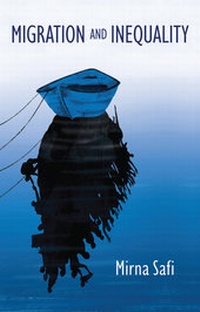
Migration and Inequality
Description

In a world of increasingly heated political debates on migration, relentlessly caught up in questions of security, humanitarian crisis, and cultural "problems," this book radically shifts the focus to address migration through the lens of inequality. Taking an innovative approach, Mirna Safi offers a fresh perspective on how migration is embedded in the elementary mechanisms that shape the landscape of inequality. She sketches out three distinct channels which lead to unequal outcomes for different migrating and non-migrating groups: the global division of labor; the production of legal and administrative categories; and the reconfiguration of symbolic ethnoracial groups. Respectively, these channels categorize migrants as "type of workers," "type of citizens," and "type of humans." Examining this intersection across the U.S. and Europe, she shows how studying international migration together with inequality can challenge nationally established paradigms of social justice. This timely book will be essential reading for all students and researchers interested in the sociology and politics of migration, ethnic and racial studies, and social inequality and stratification.
More details
Other editions
Additional editions
Person
Mirna Safi is Associate Professor of Sociology at Sciences Po.
Content
Chapter 1 From National to Migration Societies
Chapter 2 - Migration and Elementary Mechanisms of Social Inequality: a conceptual framework
Chapter 3 The Economic Channel: Migrant Workers in the Global Division of Labor
Chapter 4 The Legal Channel: Immigration Law, Administrative Management of Migrants and Civic stratification
Chapter 5 The Ethnoracial Channel: Migration, Group Boundary-Making and Ethnoracial Classification
Struggles
Conclusion: Migration, an Issue of Social Justice
1
From National to Migration Societies
This chapter provides an overview of the demographic scope of international migration and examines the main challenges it raises in contemporary societies. First, I present the definition of international migration and introduce related concepts such as immigrant generations and immigrant origins. I then move to summarizing the long-term trends in migration flows with a particular focus on Western societies. The final section summarizes the state of the field, identifying three main directions in which migration research has been developing: the driving factors of population movements, the process of assimilation of immigrants and their descendants in host societies, and the effects of migration in sending and receiving societies.
Basic Definitions and Measurements Issues
From geographic mobility to international migration
Migration is central to human history (Fisher 2014). The concept is very broad, and it concerns each one of us to varying degrees. While some people spend most of their lives migrating (nomadic groups, seasonal workers, diplomats, travelers, etc.), moving to a new place during the life course is likely to occur at least a few times, usually in relation to individual events, such as unions, family separation and re-composition, childbearing and job seeking; or collective ones, such as wars, revolutions, famines, natural disasters, etc. Major historical processes such as conquests and military conflicts, slavery, empire building, colonization and decolonization, urbanization and environmental change have all occurred in relation to intense population movements. So have most technological advancements and innovations, like hunting, sailing, agriculture, industrialization, etc.
A definition of migration that encompasses the wide diversity of migratory patterns emphasizes the "cross-community movement" that it entails (Manning 2013).1 While spatial mobility can be fundamentally understood as core human behavior, the scope and delimitation of human communities have continually changed over history, which in turn has affected the definition of human migration. Languages have been a central marker of community boundaries, and processes of differentiation and convergence of languages have been closely related to human movements across the globe; along with genetics, linguistic evidence is the most commonly used indicator for inferring ancient patterns of migration. The focus of this book is on a particular type of "modern migration," which can be called "cross-political-community migration" in a context where all the earth's land has been virtually claimed by fewer than 200 globally recognized national entities.2 It is this particular type of modern geographic mobility, referred to as international migration, that will be most relevant in the following pages. Much like the evolution of language boundaries, nation-building processes have been intertwined with human migration and continue to be affected by it.
In parallel to international migration, internal migration constitutes a considerable share of overall human migration.3 Sometimes referred to as residential mobility, it is a major phenomenon in large countries such as India and China. Despite occurring within nation-states, internal migration sometimes entails the crossing of administrative and political boundaries (states, regions, provinces, etc.). Although I do not elaborate in this book on internal migration, we should bear in mind that its relationship to labor and to its socio-legal status, as well as its effects on group boundary-making, share many aspects with international migration.
Who counts as a migrant? An ascriptive, durable, and transmissible status
When I discuss the definition of international migration with students, it is not unusual to notice that some of them are quite surprised, if not troubled, when they realize that they may fit the description. One of them once told me: "According to your definition, I would be an immigrant. There is something wrong there." The student in question was born in Egypt and lived there for only a few years, during which time his parents were working there. His family, of relatively high socioeconomic background, moved back to France, where he grew up, went to school, and attended college. The word "immigrant" was obviously negatively charged for him, and his reaction was to challenge any identification of his personal experience with the subject matter of the course.
Migrants are among the most stigmatized population categories in Western democracies. Social representations spread by the media and political debates tend to draw strong associations with the undocumented, the poor, the minorities, etc. Western workers who settle in developing countries are rarely referred to as immigrants - they are most often called "expats." And this is true even within developed countries: immigrants in France are rarely portrayed as Germans or Swiss, for example, even though these countries are the birthplaces of a considerable share of French residents and are included in immigration national statistics. The use of words such as migrant or immigrant in the public debate conveys a variety of connotations (socioeconomic, ethnoracial, legal, etc.), thus diverging from its scientific definition. But how then do we define international migrants?
One needs to migrate to be a migrant, and migration is a movement in place between two observational moments. The very concept of migration consequently requires delimiting boundaries of space and time. As mentioned above, international migration is usually defined by relying on national categorization of space: international migrants move across national boundaries. The definition also uses birth date as a time reference: international migrants move away from their country of birth.4
When one considers a given country c at a given time t, it thus becomes possible to define the immigrant population as being composed of persons who live in c at time t even though they were born in another country (c').5 This population is also referred to as "foreign-born." Relying on this definition, the international migrant population can be estimated worldwide: in 2015, the number of immigrants stood at almost 244 million, according to the UN Population Division; this means that about 3.3 percent of the earth's inhabitants currently live in a country different from their country of birth. A major share of current migration moves to the "developed countries"; 23 percent of migrants actually migrate within the Northern part of the globe, and 35 percent take the South-North migration path. South-South migration remains nonetheless considerable (around 35 percent of worldwide international migration). Top sending countries are India (15.6 million), Mexico (12.3 million), Russia (10.6 million) and China (9.5 million), while top receiving countries are the United States (46.6 million), Germany (12 million), Russia (11.6 million) and Saudi Arabia (10.2 million). In relative terms, the proportion of the foreign-born exceeds 80 percent in several Persian Gulf countries, such as the United Arab Emirates and Qatar. This share is around 13 percent in OECD countries, exceeding 25 percent in countries such as Luxembourg, Switzerland, and Australia, while countries such as the United States, the United Kingdom, Germany, and France are closer to the OECD average (see Figure 1.1 for more details).
Figure 1.1 The foreign-born as a percentage of the total population in OECD countries, 2017
Source: OECD International Migration Database
Since it is closely linked to the delimitation of national boundaries, the definition of migration is subject to political disputation. An instructive example can be found in the definition of "immigrant" in postcolonial contexts. In France, for instance, the "foreign-born" definition has been considered unsatisfactory, since it includes French return colonials ("repatriates") and French emigrants' children born abroad.6 France's public statistics institutions thus prefer a more complex definition, adding a nationality-at-birth criterion: an immigrant is a person who was born abroad and is non-French at birth. This two-criteria definition is intrinsically political, since both categories are, strictly speaking, migrants: they moved away from their place of birth and across national borders (Beauchemin and Safi 2019). Yet their migration is not considered to have crossed the "political community" borders, either because the geographic borders themselves moved in the meantime (in the case of return colonials), or because transmitting political membership (nationality) is made possible beyond the geographic limits of the state (in the case of emigrants' children). The decision to exclude them from the immigrant population is also justified by the fact that the social trajectories of these populations, who were recognized as French citizens at birth, sharply differ from those of other foreign-born populations (on political, socioeconomic, linguistic, cultural, and symbolic grounds).
This example clearly shows that while the definition of international migration derives from a country-level classification, it also relates to the concept of "society," thus involving a combination of geographic, political, social, cultural, and...
