

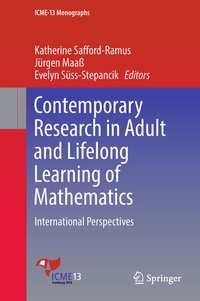
Contemporary Research in Adult and Lifelong Learning of Mathematics
Description

This book is a selection of 15 papers developed by participants in ICME 13 held in Hamburg , presenting insights from the latest research on the andragogy of adult and lifelong learning of mathematics. It also investigates open questions, such as numeracy and mathematics skills, social and psychological influences on learning environments, as well as economic and political demands.
The chapters offer examples, while at the same time highlighting important directions for further research. The book is divided into four parts: The first section provides an overview on the concept of "numeracy", and the second focuses on adult students who are learning mathematics; the third part presents a teachers' focus and the final part covers overarching themes. The book is of interest to classroom teachers, university teacher educators, and professional development providers.Reviews / Votes
"I would highly recommend this book for anybody that is involved in adult education, especially in the field of mathematics, and also for anybody that is wanting to pursue research topics in adult education, again especially in the field of mathematics." (Brent Kelderman, MAA Reviews, July 28, 2019)More details
Other editions
Additional editions
Content
Introduction.- Part I - Adult Numeracy.- Chapter 1: Defining adult & numeracy an academic and political investigation / David Kaye.- Chapter 2: Mathematics education and adult learners in Ireland / John O'Donoghue.- Chapter 3: Thinking about relations between adults learning mathematics and reality / Juergen Maasz.- Chapter 4: Scoping the development of a measure of adults' numeracy (and literacy) practices / Diana Coben and Anne Alkema.- Part II.- Chapter 5: Adults' conception of multiplicationInvestigating changes along studies / Andrea Maffia, Maria Alessandra Mariotti.- Chapter 6: Toward mathematics education for adults in Korea / Eun Young Cho and Rae Young Kim.- Chapter 7: Mathematical explorations in the adult classroom / R. Ramanujam.- Chapter 8: Parents' training in mathematics: a societal awareness study / Zekiye Morkoyunlu, Alper Cihan Konyalıoglu, and Solmaz Damla Gedik.- Part III.- Chapter 9: Mathematics in youth and adult education: a practice under construction /Neomar Lacerda da Silva and Maria Elizabete Souza Couto.- Chapter 10: "I've never cooked with my maths teacher": Moving beyond perceived dualities in mathematical belief research by focusing on adult education / Sonja Beeli-Zimmermann.- Chapter 11: Maths eyes - a concept with potential to support adult lifelong mathematics eucation / Terry Maguire and Aoife M. Smith.- Chapter 12: Danish approaches for adults learning mathematics as means for labour market and/or for bildung? / Lena Lindenskov.- Part IV.- Chapter 13: A tale of two journeys / Barbara Miller-Reilly and Charles O'Brien.- Chapter 14: Lifelong Mathematics Learning for Adult Learners and Open Educational Resources / Pradeep Kumar Misra.- Chapter 15: Learning from Research, Advancing the Field / Professor Dr. Katherine Safford-Ramus.- Conclusions and Looking Ahead / Juergen Maasz.
