

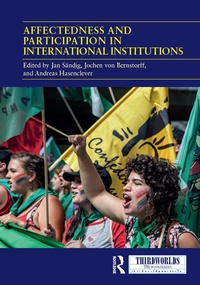
Affectedness And Participation In International Institutions
1st Edition
Published on 9. June 2020
244 pages
978-1-000-76216-7 (ISBN)
Description

Affectedness and Participation in International Institutions looks at the growing involvement of affected persons in global politics, such as young climate activists, indigenous movements, and persons affected by HIV/AIDS.
Since the early 2000s, international organisations within various policy areas have increasingly recognised and involved affected persons' organisations. This has promised to address long-standing legitimacy and democracy deficits of international policy making and norm setting. Yet, the powerful do not easily cede the terrain: Some major states, classic NGOs, and intergovernmental organisations seek to curtail the influence of the newcomers. The authors within this collection study these contestations from an interdisciplinary political science and international law perspective. Based on evidence from a broad range of policy areas, we address some of the crucial questions: What does it mean to be affected? How can affected groups meaningfully participate in international negotiations? Whose voices do still remain excluded? Ultimately, the authors chart whether the rising involvement of the 'most affected' will re-shape global politics and social struggles on the ground.
Taking a dual political science and international law perspective, Affectedness and Participation in International Institutions will be of great interest to scholars of civil society in global governance, international law, and international institutions. This book was originally published as a special issue of Third World Thematics.
Since the early 2000s, international organisations within various policy areas have increasingly recognised and involved affected persons' organisations. This has promised to address long-standing legitimacy and democracy deficits of international policy making and norm setting. Yet, the powerful do not easily cede the terrain: Some major states, classic NGOs, and intergovernmental organisations seek to curtail the influence of the newcomers. The authors within this collection study these contestations from an interdisciplinary political science and international law perspective. Based on evidence from a broad range of policy areas, we address some of the crucial questions: What does it mean to be affected? How can affected groups meaningfully participate in international negotiations? Whose voices do still remain excluded? Ultimately, the authors chart whether the rising involvement of the 'most affected' will re-shape global politics and social struggles on the ground.
Taking a dual political science and international law perspective, Affectedness and Participation in International Institutions will be of great interest to scholars of civil society in global governance, international law, and international institutions. This book was originally published as a special issue of Third World Thematics.
More details
Series
Edition
1. Auflage
Language
English
Place of publication
London
United Kingdom
Publishing group
Taylor & Francis Ltd
Target group
College/higher education
ISBN-13
978-1-000-76216-7 (9781000762167)
Copyright in bibliographic data and cover images is held by Nielsen Book Services Limited or by the publishers or by their respective licensors: all rights reserved.
Schweitzer Classification
Other editions
Additional editions
Jan Saendig | Jochen von Bernstorff | Andreas hasenclever
Affectedness And Participation In International Institutions
Book
06/2021
1st Edition
Routledge
€65.30
Shipment within 10-20 days
Jan Saendig | Jochen von Bernstorff | Andreas hasenclever
Affectedness And Participation In International Institutions
Book
12/2019
1st Edition
Routledge
€179.81
Shipment within 15-20 days
Persons
Jan Saendig is a Research Fellow in Peace and Conflict Studies at the University of Tuebingen, Germany. His research focuses on armed and non-violent contention in Sub-Saharan Africa and the role of civil society in global governance.
Jochen von Bernstorff is Professor of International Law at the University of Tuebingen, Germany. His research focuses on the history and theory of international law and international institutions.
Andreas Hasenclever is Professor of International Relations and Peace Studies at the University of Tuebingen, Germany. His major research interests are in the field of Peace and Conflict Studies with particular reference to regime analysis, international trust dynamics, and the impact of religious traditions on political conflict.
Jochen von Bernstorff is Professor of International Law at the University of Tuebingen, Germany. His research focuses on the history and theory of international law and international institutions.
Andreas Hasenclever is Professor of International Relations and Peace Studies at the University of Tuebingen, Germany. His major research interests are in the field of Peace and Conflict Studies with particular reference to regime analysis, international trust dynamics, and the impact of religious traditions on political conflict.
Content
1. Affectedness in international institutions: promises and pitfalls of involving the most affected Jan Saendig, Jochen Von Bernstorff & Andreas Hasenclever 2. Legitimating global governance: publicisation, affectedness, and the Committee on World Food Security Josh Brem-Wilson 3. Shifting the paradigm: a typology of affected persons' participation in international institutions Markus Hasl 4. Affectedness, empowerment and norm contestation - children and young people as social agents in international politics Anna Holzscheiter 5. Affectedness alliances: affected people at the centre of transnational advocacy Annette Schramm & Jan Saendig 6. The dark side of the affectedness-paradigm: lessons from the Indigenous peoples' movement at the United Nations Andreas Hasenclever & Henrike Narr 7. Tied affectedness? Grassroots resistance and the World Bank Giedre Jokubauskaite 8. Between threat and infantilisation: how frames impede the meaningful participation of the disaster affected in Haiti Tanja Granzow 9. BRICS civil society initiatives: towards the inclusion of affected communities in collective development? Lisa Thompson & Pamela Tsolekile De Wet 10. Voices unheard - affected communities and the climate negotiations on loss and damage Patrick Toussaint 11. Practicing human rights across scale: indigenous peoples' affectedness and recognition in REDD+ governance Linda Wallbott & Eugenia Recio 12. The limits of the all affected principle: attending to deep structures B. S. Chimni
