

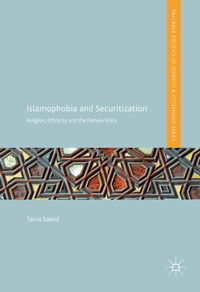
Islamophobia and Securitization
Description

This book explores everyday realities of young Muslim women in Britain, who are portrayed as antithetical to the British way of life in media and political discourse. The book captures how geo-political events, and national tragedies continue to implicate individuals and communities at the domestic and local level, communities that have no connection to such tragedies and events, other than being associated with a religio-ethnic identity. The author shows how Muslim women are caught within the spectrum of the vulnerable-fanatic, always perceived to be 'at risk' of being 'radicalized'. Focusing on educated Muslim females, the book explores experiences of Islamophobia and securitization inside and outside educational institutions, and highlights individual and group acts of resistance through dialogue, with Muslim women challenging the metanarrative of insecurity and suspicion that plagues their everyday existence in Britain. Islamophobia and Securitization will be of inte
rest to scholars and students researching Muslims in the West, in particular sociologists, anthropologists, and political scientists. It will also appeal to analysts and academics researching security and terrorism, race and racialization, as well as gender, immigration, and diaspora.Reviews / Votes
"This book is a highly critical academic insight into unexplored and explored themes around radicalisation, race, colonialism, immigration, multiculturalism, gender, security and terrorism. Saeed compiles, in an informed and accessible writing style, the voices of resistance in young Muslim women in the UK from within the educational system and beyond . ." (Fernán Osorno Hernández, Network, 2018)"In this book, Saeed explores the securitisation of British Muslims, specifically Muslim women of Pakistani origin. . Saeed's work provides an important contribution to the discourse about Islam in Britain. . It is a must-read for anyone working on or interested in understanding the British Muslim experience and countering extremism in Britain." (Amani El Sehrawey, LSE Review of Books, blogs.lse.ac.uk, July, 2017)
More details
Other editions
Additional editions
Person
Tania Saeed is Assistant Professor at Lahore University of Management Sciences, Pakistan. Her area of specialization is democratization and social exclusion with a focus on religious minorities, gender, and security in the context of the United Kingdom and Pakistan.
Content
Gender, Islamophobia and the Security Discourse: An Introduction .- 1. Muslims, South Asians and the Pakistani community in Britain: Intersecting Security, Identity and Belonging 2.- Securitizing the Muslim Female: Islamophobia and the Hidden Terrorist.- 3. Securitizing the Educated Muslim: Islamophobia, Radicalization and the ISoc Sisters.- 4. Securitizing the Ethno-Religious Identity(s): Exploring Islamophobia as Pakophobia.- 5. Challenging Islamophobia and the Security Discourse: Dialogue and the Muslim Activist.- Conclusion: Gender, Islamophobia and the Security Discourse: Future Challenges
