

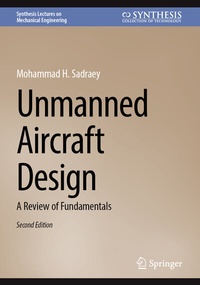
Unmanned Aircraft Design
Description

This book provides fundamental principles, design procedures, and design tools for unmanned aerial vehicles (UAVs) with three sections focusing on vehicle design, autopilot design, and ground system design. The design of manned aircraft and the design of UAVs have some similarities and some differences. They include the design process, constraints (e.g., g-load, pressurization), and UAV main components (autopilot, ground station, communications system, sensors, and payload). A UAV designer must be aware of the latest UAV developments; current technologies; know lessons learned from past failures; and they should appreciate the breadth of UAV design options.
The contribution of unmanned aircraft continues to expand every day and over 67 countries are developing and employing UAVs for both military and civil/scientific purposes. A UAV system is much more than a reusable air vehicle or vehicles. UAVs are air vehicles, they fly like airplanes and operate in an airplane environment. They are designed like air vehicles; they have to meet critical air vehicle requirements. A designer needs to know how to integrate complex, multi-disciplinary systems, and to understand the environment, the requirements and the design challenges and this book is an excellent overview of the fundamentals from an engineering perspective.
This book is meant to meet the needs of newcomers into the world of UAVs. The materials are intended to provide enough information in each area and illustrate how they all play together to support the design of a complete UAV. Therefore, this book can be used both as a reference for engineers entering the field or as a supplementary text for a UAV design course to provide system-level context for each specialized topic.
The second edition is extensively revised. Some of the new terminologies, concepts, and specific unmanned aircraft systems are introduced. The revisions make the book clearer and easier to understand, and will add number of new subjects in areas that have become more prominent in the unmanned aviation world.
More details
Other editions
Additional editions
Previous edition
Person
Dr. Mohammad H. Sadraey is a professor in the School of Engineering at Southern New Hampshire University (SNHU), Manchester, New Hampshire. Dr. Sadraey's main research interests are in aircraft design techniques, aircraft performance, flight dynamics, and design and automatic control of unmanned aircraft. He earned his M.Sc. in aerospace engineering in 1995 from RMIT, Melbourne, Australia, and his Ph.D. in aerospace engineering from the University of Kansas, Kansas, in 2006. Dr. Sadraey is a senior member of the American Institute of Aeronautics and Astronautics (AIAA), and a member of Sigma Gamma Tau Honor Society, and the American Society for Engineering Education (ASEE). He is also listed in Who's Who in America. He has more than 26 years of professional experience in academia and industry. Dr. Sadraey is the author of seven other books, including Aircraft Design: A Systems Engineering Approach published by Wiley publications in 2012, and Aircraft Performance by CRC in 2016.
