

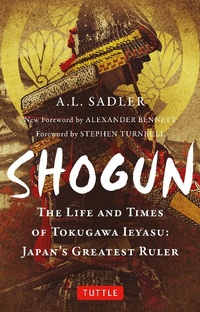
Shogun
The Life of Tokugawa Ieyasu
Published on 10. July 2009
384 pages
978-1-4629-1654-2 (ISBN)
Description

This book tells the fascinating history of the life of Shogun Tokugawa Ieyasu — Japan's most famous Shogun.
Since its initial appearance, A.L.Sadler's imposing biography of the Japanese Shogun Tokugawa Ieyasu has been recognized as an outstanding contribution to the knowledge of Japanese history. It is also considered the standard reference work on the period that saw the entrenchment of feudalism in Japan and the opening of some two and a half centuries of rigid isolation from the rest of the world.
In the course of Japanese history, there have been five great military leaders who by common consent stand out above the others of their type. Of these, two lived in the twelfth century, while the other three, Oda Nobunaga, Toyotomi Hideyoshi, and Tokugawa Ieyasu, were contemporary in the latter half of the sixteenth century. The last of these three, with whose life Mr. Sadler deals, may well be described as having perfected the shogunate system. Not only did Ieyasu found a dynasty of rulers and organize a powerful system of government, but also he rounded off his achievements by contriving before his death to arrange for his deification afterward.
As Mr. Sadler notes, "Tokugawa Ieyasu is unquestionably one of the greatest men the world has yet seen," and this fascinating account of Ieyasu's life and times is presented in a thoroughly absorbing narrative in which dramatic highlights abound.
Japan's feudal age came to a close in 1868 with the downfall of the Tokugawa Shogunate and the restoration of the Emperor to political power. The event marked the end of the powerful regime that Ieyasu established at the beginning of the seventeenth century. That it did not at the same time mark the eclipse of Ieyasu's greatness is sufficient testimony to the major role he played in his country's history. It is to A. L. Sadler's lasting credit that he has brought this eminent but often ruthless military leader so vividly to life.
Since its initial appearance, A.L.Sadler's imposing biography of the Japanese Shogun Tokugawa Ieyasu has been recognized as an outstanding contribution to the knowledge of Japanese history. It is also considered the standard reference work on the period that saw the entrenchment of feudalism in Japan and the opening of some two and a half centuries of rigid isolation from the rest of the world.
In the course of Japanese history, there have been five great military leaders who by common consent stand out above the others of their type. Of these, two lived in the twelfth century, while the other three, Oda Nobunaga, Toyotomi Hideyoshi, and Tokugawa Ieyasu, were contemporary in the latter half of the sixteenth century. The last of these three, with whose life Mr. Sadler deals, may well be described as having perfected the shogunate system. Not only did Ieyasu found a dynasty of rulers and organize a powerful system of government, but also he rounded off his achievements by contriving before his death to arrange for his deification afterward.
As Mr. Sadler notes, "Tokugawa Ieyasu is unquestionably one of the greatest men the world has yet seen," and this fascinating account of Ieyasu's life and times is presented in a thoroughly absorbing narrative in which dramatic highlights abound.
Japan's feudal age came to a close in 1868 with the downfall of the Tokugawa Shogunate and the restoration of the Emperor to political power. The event marked the end of the powerful regime that Ieyasu established at the beginning of the seventeenth century. That it did not at the same time mark the eclipse of Ieyasu's greatness is sufficient testimony to the major role he played in his country's history. It is to A. L. Sadler's lasting credit that he has brought this eminent but often ruthless military leader so vividly to life.
More details
Other editions
Additional editions
Book
07/2009
Tuttle Publishing
€44.75
Article exhausted; check for reprint
Content
- Frontcover
- Title Page
- Copyright
- CONTENTS
- LIST OF ILLUSTRATIONS
- FOREWORD
- PREFACE
- INTRODUCTION
- 1 The Pedigree of The Tokugawas
- 2 Takechiyo
- 3 Matsudaira Motonobu. Motoyasu. The Battle of Oke-hazama
- 4 Ieyasu Quells The Monto Sect
- 5 Tokugawa Ieyasu. Lord Of Mikawa and Totomi
- 6 The Retreat from Echizen and The Battle of the Anegawa
- 7 Mikata-ga-hara
- 8 Kuroda JOsui, Or Simon Kondera
- 9 Ieyasu's Family Tragedy
- 10 Nagashino and The Fall of the Hose of Takeda
- 11 Death of Nobunaga. Ieyasu's flight through Iga
- 12 Ieyasu Gets Kai and Shinano
- 13 Lord of five Provinces. Ieyasu Opposes Hideyoshi
- 14 The Komaki Campaign
- 15 After Komaki
- 16 Isolation of Ieyasu
- 17 Ieyasu's Second Marriage and Alliance with HOjO
- 18 His Submission to Hideyoshi. He visits the Capital
- 19 The Kwanto Campaign
- 20 Ieyasu Enters Edo
- 21 The Korean Campaign and Death of Hideyoshi
- 22 The Sekigahara Campaign
- 23 Hosokawa Tadaoki, his wife, and his Father
- 24 Kuroda JOsui and Kyushu
- 25 The Building of Edo
- 26 The coming of the Dutch
- 27 Ieyasu and New Spain
- 28 Luchu and Formosa
- 29 The "Madre De Dios" Affair
- 30 The Fall of Okubo Tadachika
- 31 The English Company
- 32 Date Masamune's Mission to Europe
- 33 Ieyasu and Hideyori
- 34 Osaka. The Winter Campaign
- 35 The Summer Campaign
- 36 Honami KO-etsu
- 37 The Three Jinnai of Edo
- 38 Literary Taste of the Mikado and Shogun
- 39 The Hondas
- 40 Death of Ieyasu
- 41 Ieyasu's Family
- 42 Ieyasu's Personal Habits and Views
- 43 Tokugawa Legislation
- 44 The Legacy of Ieyasu
- Appendices
- Bibliography
- INdex
- Backcover
