

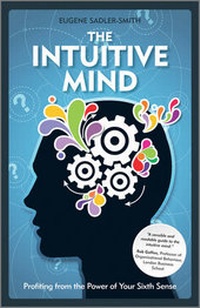
The Intuitive Mind
Profiting from the Power of Your Sixth Sense
Published on 2. November 2010
336 pages
978-0-470-68538-9 (ISBN)
Description

This new agenda for the managerial mind will change the way youthink and do business.
Eugene Sadler-Smith, a leading intuition researcher and educatorin business and management, argues that human beings have one brainbut two minds - analytical and intuitive. Management hasoverlooked the importance of intuition, and under-exploited thepotential that the intuitive mind has to contribute in areas asdiverse as decision making, creativity, team working,entrepreneurship, business ethics and leadership.
"The Intuitive Mind is a fascinating andpractical book that will maximize your intuition and help you makebetter decisions today and predictions about tomorrow! SigmundFreud and Carl Jung would most assuredly approve."
Steve W. Martin, www.heavyhitterwisdom.com
Heavy Hitter Sales Psychology: How to Penetrate the C-LevelExecutive Suite and Convince Company Leaders to Buy
"Eugene Sadler-Smith gives needed attention to theintuitive way of thinking and reminds us that leadership is an artas well as a science."
Cindi Fukami, Professor of Management, University of Denver,USA
"From one of our prominent 'thinkers' inthe management education arena, we learn in The Intuitive Mindhow to use our intuitive judgment to improve our managerialdecision making."
Joe Raelin, The Knowles Chair for Practice-OrientedEducation, Northeastern University, USA
"This timely, well researched and accessible book takesintuition out of the shadows and provides practical guidance tosolve thorny problems."
Sebastian Bailey, Global Product Director, The MindGym
More details
Other editions
Additional editions
Book
10/2009
Wiley
€36.00
Shipment within 10-20 days
Person
Dr Eugene Sadler-Smith, Professor of Management Developmentand Organization Behaviour, School of Management, University ofSurrey, UK. Before becoming an academic he worked in human resourcedevelopment in the gas industry. His research interests arecurrently centred upon the role of intuitive judgement in decisionmaking and management. His research has been published widely injournals such as the Academy of Management Executive, Academy ofManagement Learning and Education, British Journal of Psychology,Journal of Occupational & Organizational Psychology, Journal ofOrganizational Behaviour, Management Learning, Long RangePlanning, and Organization Studies. Eugene Sadler-Smithis joint Editor-in-Chief of Management Learning. He has researchedand published widely in the field of learning and development andis author of several books including Learning and Developmentfor Managers: Perspectives from Research and Practice(Blackwell/Wiley, 2006) and Inside Intuition (Routledge,2008). His intuition research has featured in The Times andon BBC Radio 4.
Content
Acknowledgements.
Introduction - Your Most Valuable Asset
Chapter 1: Intuitive Mindware
Chapter 2: The Ambidextrous Mind
Chapter 3: Insights, Intuitions and the Moral Instinct
Chapter 4: Intuitive Mind Reading
Chapter 5: Intuitive Shortcuts
Chapter 6: Intuitive ESP
Chapter 7: The Intuitive Brain
Chapter 8: The Intuitive Entrepreneur
Chapter 9: Intuitive Leadership
Chapter 10: Intuitive Intelligence
Index
INTRODUCTION - YOUR MOST VALUABLE ASSET In a world of uncertainty and unparalleled change people in general, and leaders and managers in particular, are forced to ask themselves fresh and searching questions about what it is that they can truly rely upon when times get tough - what are their most important and valuable assets? In the face of the 2008 credit crunch and subsequent recession of 2009 millions of ordinary people were forced to ask this very question. Was their most valuable asset the house they owned, their stocks and shares, or even their job? Regrettably events that surfaced in 2008-2009 brought home to millions across the world the fact that taken-for-granted supposed high-value assets such as property and financial wealth can nose dive out of the control of individual citizens, employees and company bosses, and leave governments standing by, virtually helpless. Shares can end up worth little more than the paper they’re written on, a home can be worth less than the mortgage taken to buy it and businesses can downsize at the drop of a hat. The wider knock-on effects of company lay-offs, closures, bankruptcy, unemployment, threats of deflation and the spectre of civil unrest can be traumatic.
But the gloom of economic recession has brought about for many people the startling realisation that the most valuable asset that an employee, leader or manager can own actually is something that can’t be taken away from them or owned by someone else; its multiplier effect can be extraordinary; it can be used to create other assets such as a new job or a business venture; it’s perfectly natural and eminently sustainable; under the right conditions and with the right care and attention it can show real and permanent growth in value; moreover it’s a guaranteed lifelong asset. It can empower and emancipate citizens and employees and loosen the grip of inept and immoral leaders. As a leader, manager, employee or citizen your most valuable asset isn’t held in a bank vault, or in bricks and mortar or on a company balance sheet, it’s held inside a much more secure but quite fragile place - your head - and is the twin portfolio of assets comprised of your analytical mind and your intuitive mind.
But why ‘minds’ rather than ‘mind’? Recent scientific advances in psychology and cognitive neuroscience show that the human species has evolved two distinct systems of thinking (‘two minds’) which are the foundations not only of our reasoning processes, 1 but of our feelings and behaviours as well. Each of the two minds we all possess is a unique and valuable asset both in personal and professional life.
The analytical mind is the asset that our education and training sets out to nurture, condition and discipline from the time we start kindergarten to the time we leave college, and beyond; for example, many MBA courses are heavily - perhaps overly - analytical and hard-data driven. The analytical mind gives us the power to compute, reason and problem solve. However it’s only 50 % of the design spec that nature built into our species’ capacities for thinking, problem solving, creating, judging and deciding. Alongside the analytical mind, there’s the mental asset that goes largely unnoticed and, certainly in most businesses, largely untapped - the intuitive mind. But if we take a closer look at the commercial world we find that there are some very significant figures who have seen its potential and realised the value of this asset.
Sony Walkman, Starbucks Coffee and Virgin, as well as being highly successful, global brands, have at least one other thing in common: the senior executives in each of these firms have claimed that spontaneous intuition and business instinct - the products of the intuitive mind - have been crucial in the management and decision-making processes of their companies. For these executives their own and the intuitive minds of their employees are vital items in the human resource base of their businesses. Indeed it’s not just these three, many other successful business leaders are singled out by the fact that they deploy their own intuition and that of their employees skilfully in the right place and at the right time in the management of their enterprises in the pursuit of profit and the creation of wealth.
The examples of Akio Morita of Sony, Howard Schultz of Starbucks and Sir Richard Branson of Virgin testify to the importance of the intuitive mind in creating new products and innovating new business ventures that have not only created wealth for individuals, companies and nations, but also impacted on the lives of millions of people worldwide by producing products and services that have shaped vital aspects of modern life. For these companies, and many others, the intuitive mind has been one of their most powerful assets. Akio Morita (Sony) described intuition as essential for the creativity that is the touchstone of technological innovation and new product development: Machines and computers cannot be creative in themselves, because creativity requires something more than the processing of existing information. It requires human thought, spontaneous intuition and a lot of courage.2 Howard Schultz’s (Starbucks) experience testifies to the emotional charge that comes with creative intuitions that if interpreted and followed through in the right way may signal a unique business opportunity: It happened in the spring of 1983. I had been at Starbucks for a year, and the company had sent me to Milan to attend an international housewares show. The morning after I arrived, I decided to walk to the show. During my stroll through the centre of the city, I noticed espresso bars on almost every street corner. What struck me emotionally was the ritual and romance of each coffeehouse. The bartenders, called baristas, had a strong bond with customers. All kinds of people gathered and chatted at the bars, which served as extensions of the front porch in each neighbourhood. Right then it struck me like a lightning rod: Why not bring the concept to America? Starbucks could be re-created to do just that. The vision was so overwhelming, I began shaking.3 Sir Richard Branson (Virgin) in his autobiography acknowledges that for him gut feeling is a vital ingredient in his entrepreneurial judgement and business venturing decisions: I make up my mind about someone within thirty seconds of meeting that person. In the same way that I tend to make up my mind about people within thirty seconds of meeting them, I also make up my mind about a business proposal within thirty seconds and whether it excites me. I rely far more on gut instinct than researching huge amounts of statistics.4 It isn’t just highly successful business executives who have ‘gut instincts’ about people, events and situations and who use intuition to make important decisions. Nature, through the processes of evolution, has equipped Homo sapiens with a highly-sophisticated perceptual, processing and decision-making system that operates without effort and beyond our conscious awareness. We all have intuition, we’ve all experienced its effects, and we’ve all lived with the consequences of listening to it or of ignoring it. It works in parallel with the analytical mind, and both minds are needed if we’re to perform, profit and grow in our professional and personal lives.
The intuitive mind probably evolved as a neurobiological alarm bell that acted as an early warning radar, offering help in deciding what or what not to do next, who or who not to trust and if, when and how to take important decisions. As a result it’s a guidance system which often errs on the side of caution because our well-being and survival are its number one priorities. Like a complex computer-based simulator the intuitive mind provides a window on the future, enabling users to hypothesise future problems and possibilities. But as well as signalling danger ahead, the intuitive mind also flags up opportunity and the signals it posts within conscious awareness can predict what might or might not happen, the rewards that may be reaped and the hazards that might be encountered on the road ahead.
Unfortunately the intuitive mind can’t communicate directly with us in the normal language of our conscious awareness - words. To get its message across it speaks a different language - that of ‘gut feeling’ or ‘hunch’. It’s a biologically ancient body-mind system, but as is the case with even the most advanced digital technology, one of its drawbacks is that it isn’t 100 % reliable. The intuitive blip that we sense on the screen of our consciousness can be misunderstood and misinterpreted, overlooked or ignored. Sometimes its predictions can take us to the wrong place and we may, at our peril, confuse its voice with other more feeble but potentially dangerous voices such as logical errors, bias, prejudice and wishful thinking.
How can we steer clear of these pitfalls? The answer, as with any sophisticated system, is that we need a users’ manual to help us understand both how the system works and how to use it as effectively as possible. Some mystics take the view that the intuitive mind is the home of a sacrosanct ‘sixth sense’ which is inhibited and limited in its power by any attempts to understand it. This is one view, but the position adopted in this book is that the workings of the intuitive mind: 1. are neither magical nor paranormal; 2. can be explained...
But the gloom of economic recession has brought about for many people the startling realisation that the most valuable asset that an employee, leader or manager can own actually is something that can’t be taken away from them or owned by someone else; its multiplier effect can be extraordinary; it can be used to create other assets such as a new job or a business venture; it’s perfectly natural and eminently sustainable; under the right conditions and with the right care and attention it can show real and permanent growth in value; moreover it’s a guaranteed lifelong asset. It can empower and emancipate citizens and employees and loosen the grip of inept and immoral leaders. As a leader, manager, employee or citizen your most valuable asset isn’t held in a bank vault, or in bricks and mortar or on a company balance sheet, it’s held inside a much more secure but quite fragile place - your head - and is the twin portfolio of assets comprised of your analytical mind and your intuitive mind.
But why ‘minds’ rather than ‘mind’? Recent scientific advances in psychology and cognitive neuroscience show that the human species has evolved two distinct systems of thinking (‘two minds’) which are the foundations not only of our reasoning processes, 1 but of our feelings and behaviours as well. Each of the two minds we all possess is a unique and valuable asset both in personal and professional life.
The analytical mind is the asset that our education and training sets out to nurture, condition and discipline from the time we start kindergarten to the time we leave college, and beyond; for example, many MBA courses are heavily - perhaps overly - analytical and hard-data driven. The analytical mind gives us the power to compute, reason and problem solve. However it’s only 50 % of the design spec that nature built into our species’ capacities for thinking, problem solving, creating, judging and deciding. Alongside the analytical mind, there’s the mental asset that goes largely unnoticed and, certainly in most businesses, largely untapped - the intuitive mind. But if we take a closer look at the commercial world we find that there are some very significant figures who have seen its potential and realised the value of this asset.
Sony Walkman, Starbucks Coffee and Virgin, as well as being highly successful, global brands, have at least one other thing in common: the senior executives in each of these firms have claimed that spontaneous intuition and business instinct - the products of the intuitive mind - have been crucial in the management and decision-making processes of their companies. For these executives their own and the intuitive minds of their employees are vital items in the human resource base of their businesses. Indeed it’s not just these three, many other successful business leaders are singled out by the fact that they deploy their own intuition and that of their employees skilfully in the right place and at the right time in the management of their enterprises in the pursuit of profit and the creation of wealth.
The examples of Akio Morita of Sony, Howard Schultz of Starbucks and Sir Richard Branson of Virgin testify to the importance of the intuitive mind in creating new products and innovating new business ventures that have not only created wealth for individuals, companies and nations, but also impacted on the lives of millions of people worldwide by producing products and services that have shaped vital aspects of modern life. For these companies, and many others, the intuitive mind has been one of their most powerful assets. Akio Morita (Sony) described intuition as essential for the creativity that is the touchstone of technological innovation and new product development: Machines and computers cannot be creative in themselves, because creativity requires something more than the processing of existing information. It requires human thought, spontaneous intuition and a lot of courage.2 Howard Schultz’s (Starbucks) experience testifies to the emotional charge that comes with creative intuitions that if interpreted and followed through in the right way may signal a unique business opportunity: It happened in the spring of 1983. I had been at Starbucks for a year, and the company had sent me to Milan to attend an international housewares show. The morning after I arrived, I decided to walk to the show. During my stroll through the centre of the city, I noticed espresso bars on almost every street corner. What struck me emotionally was the ritual and romance of each coffeehouse. The bartenders, called baristas, had a strong bond with customers. All kinds of people gathered and chatted at the bars, which served as extensions of the front porch in each neighbourhood. Right then it struck me like a lightning rod: Why not bring the concept to America? Starbucks could be re-created to do just that. The vision was so overwhelming, I began shaking.3 Sir Richard Branson (Virgin) in his autobiography acknowledges that for him gut feeling is a vital ingredient in his entrepreneurial judgement and business venturing decisions: I make up my mind about someone within thirty seconds of meeting that person. In the same way that I tend to make up my mind about people within thirty seconds of meeting them, I also make up my mind about a business proposal within thirty seconds and whether it excites me. I rely far more on gut instinct than researching huge amounts of statistics.4 It isn’t just highly successful business executives who have ‘gut instincts’ about people, events and situations and who use intuition to make important decisions. Nature, through the processes of evolution, has equipped Homo sapiens with a highly-sophisticated perceptual, processing and decision-making system that operates without effort and beyond our conscious awareness. We all have intuition, we’ve all experienced its effects, and we’ve all lived with the consequences of listening to it or of ignoring it. It works in parallel with the analytical mind, and both minds are needed if we’re to perform, profit and grow in our professional and personal lives.
The intuitive mind probably evolved as a neurobiological alarm bell that acted as an early warning radar, offering help in deciding what or what not to do next, who or who not to trust and if, when and how to take important decisions. As a result it’s a guidance system which often errs on the side of caution because our well-being and survival are its number one priorities. Like a complex computer-based simulator the intuitive mind provides a window on the future, enabling users to hypothesise future problems and possibilities. But as well as signalling danger ahead, the intuitive mind also flags up opportunity and the signals it posts within conscious awareness can predict what might or might not happen, the rewards that may be reaped and the hazards that might be encountered on the road ahead.
Unfortunately the intuitive mind can’t communicate directly with us in the normal language of our conscious awareness - words. To get its message across it speaks a different language - that of ‘gut feeling’ or ‘hunch’. It’s a biologically ancient body-mind system, but as is the case with even the most advanced digital technology, one of its drawbacks is that it isn’t 100 % reliable. The intuitive blip that we sense on the screen of our consciousness can be misunderstood and misinterpreted, overlooked or ignored. Sometimes its predictions can take us to the wrong place and we may, at our peril, confuse its voice with other more feeble but potentially dangerous voices such as logical errors, bias, prejudice and wishful thinking.
How can we steer clear of these pitfalls? The answer, as with any sophisticated system, is that we need a users’ manual to help us understand both how the system works and how to use it as effectively as possible. Some mystics take the view that the intuitive mind is the home of a sacrosanct ‘sixth sense’ which is inhibited and limited in its power by any attempts to understand it. This is one view, but the position adopted in this book is that the workings of the intuitive mind: 1. are neither magical nor paranormal; 2. can be explained...
