
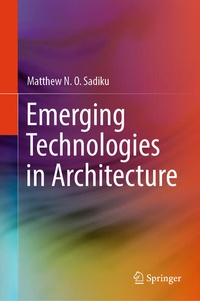
Emerging Technologies in Architecture
Description
Alles über E-Books | Antworten auf Fragen rund um E-Books, Kopierschutz und Dateiformate finden Sie in unserem Info- & Hilfebereich.
This is a comprehensive introductory text on the issues, ideas, theories, and applications of emerging technologies in the architecture industry. It provides an overview of each technology in simple terms so that beginners can understand it. It is a must-read book for anyone who wants to learn about modern architecture, which has become vital in many areas of life.
More details
Other editions
Additional editions
Person
Matthew N. O. Sadiku is presently a Regents professor emeritus of electrical and computer engineering at Prairie View A&M University, Prairie View, TX. He is the author of over 1,390 professional papers and over 150 books. He is a Life Fellow of IEEE. His current research interests are in the areas of computational electromagnetic, computer science/networks, engineering education, and marriage counseling.
Content
Introduction.- Building Information Modeling.- Artificial Intelligence in Architecture.- Generative Design in Architecture.- Robotics in Architecture.- Drones in Architecture.- Internet of Things in Architecture.- Big Data in Architecture.- Cloud Computing in Architecture,- Blockchain in Architecture.- 3D Printing in Architecture.- Immersive Technologies in Architecture.

System requirements
File format: PDF
Copy protection: Watermark-DRM (Digital Rights Management)
System requirements:
- Computer (Windows; MacOS X; Linux): Use the free software Adobe Reader, Adobe Digital Editions, or any other PDF viewer of your choice (see eBook Help).
- Tablet/Smartphone (Android; iOS): Install the free app Adobe Digital Editions or another reading app for eBooks, e.g., PocketBook (see eBook Help).
- E-reader: Bookeen, Kobo, Pocketbook, Sony, Tolino and many more (only limited: Kindle).
The file format PDF always displays a book page identically on any hardware. This makes PDF suitable for complex layouts such as those used in textbooks and reference books (images, tables, columns, footnotes). Unfortunately, on the small screens of e-readers or smartphones, PDFs are rather annoying, requiring too much scrolling.
This eBook uses Watermark-DRM, a „soft” copy protection. This means that there are no technical restrictions to prevent illegal distribution. However, there is a personalised watermark embedded in the eBook that can be used to identify the purchaser of the eBook in the event of misuse and to provide evidence for legal purposes.
For more information, see our eBook Help page.