

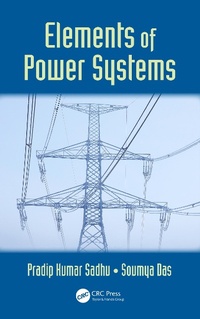
Elements of Power Systems
1st Edition
Published on 18. September 2015
562 pages
978-1-4987-3447-9 (ISBN)
Description

Elements of Power Systems prepares students for engineering degrees, diplomas, Associate Member of the Institution of Engineers (AMIE) examinations, or corresponding examinations in electrical power systems. Complete with case studies, worked examples, and circuit schematic diagrams, this comprehensive text:Provides a solid understanding of the the
Reviews / Votes
"... a very good contribution that covers many aspects of power systems and components. ... I strongly believe that this book will be interesting for students and professionals in electrical power engineering."-Dr. Dipl.-Ing. M. Popov, Delft University of Technology (TU Delft), Netherlands
"... provides an important resource for engineers, instructors, applied researchers, and students in the field of power engineering. ... This well-written book offers broad coverage of important issues, operating concepts, and control techniques commonly addressed in most textbooks regarding power systems."
-Dr. Chao-Tsung Ma, Department of Electrical Engineering, CEECS, National United University, Miaoli City, Taiwan
"... a very good choice as a complete reference for power systems. Readers will find it worthwhile for their collections and self-reading material."
-Prof. R. P. Maheshwari, Department of Electrical Engineering, Indian Institute of Technology, Roorkee
"This book offers a simplified and summarized presentation of the majority of topics related to electric power systems. Sadhu (Indian School of Mines) and Das (Burdwan Univ., India) review and briefly discuss the foundations of a particular area in each of the book's 20 chapters. The first four chapters are an overview of basic concepts and terminologies employed in power systems engineering. The next six chapters focus on power overhead transmission lines and underground cables. They also cover issues related to transmission lines, such as corona and electrical insulation. Electric power distribution systems, earthing, and substations are presented in separate chapters. The book goes on to discuss elements of power system protection, including relays, circuit breakers, and fault analysis. Concluding chapters deal with power system stability and load flow. The authors have reduced the mathematical and physical complexities that one may encounter in each of these topics as much as possible, allowing the general reader with some background in power systems to benefit from the book. The worked examples and end-of-chapter questions are very helpful for understanding the material."
-CHOICE, July 2016 Issue "... a very good contribution that covers many aspects of power systems and components. ... I strongly believe that this book will be interesting for students and professionals in electrical power engineering."
-Dr. Dipl.-Ing. M. Popov, Delft University of Technology (TU Delft), Netherlands
"... provides an important resource for engineers, instructors, applied researchers, and students in the field of power engineering. ... This well-written book offers broad coverage of important issues, operating concepts, and control techniques commonly addressed in most textbooks regarding power systems."
-Dr. Chao-Tsung Ma, Department of Electrical Engineering, CEECS, National United University, Miaoli City, Taiwan
"... a very good choice as a complete reference for power systems. Readers will find it worthwhile for their collections and self-reading material."
-Prof. R. P. Maheshwari, Department of Electrical Engineering, Indian Institute of Technology, Roorkee
"This book offers a simplified and summarized presentation of the majority of topics related to electric power systems. Sadhu (Indian School of Mines) and Das (Burdwan Univ., India) review and briefly discuss the foundations of a particular area in each of the book's 20 chapters. The first four chapters are an overview of basic concepts and terminologies employed in power systems engineering. The next six chapters focus on power overhead transmission lines and underground cables. They also cover issues related to transmission lines, such as corona and electrical insulation. Electric power distribution systems, earthing, and substations are presented in separate chapters. The book goes on to discuss elements of power system protection, including relays, circuit breakers, and fault analysis. Concluding chapters deal with power system stability and load flow. The authors have reduced the mathematical and physical complexities that one may encounter in each of these topics as much as possible, allowing the general reader with some background in power systems to benefit from the book. The worked examples and end-of-chapter questions are very helpful for understanding the material."
-CHOICE, July 2016 Issue
More details
Edition
1. Auflage
Language
English
Place of publication
London
United Kingdom
Publishing group
Taylor & Francis Ltd
Target group
College/higher education
Illustrations
260 s/w Abbildungen, 4 s/w Tabellen
260 b/w images and 4 tables
File size
7,00 MB
ISBN-13
978-1-4987-3447-9 (9781498734479)
Copyright in bibliographic data and cover images is held by Nielsen Book Services Limited or by the publishers or by their respective licensors: all rights reserved.
Schweitzer Classification
Other editions
Additional editions
Pradip Kumar Sadhu | Soumya Das
Elements of Power Systems
Book
07/2017
1st Edition
CRC Press
€110.36
Shipment within 10-20 days
Pradip Kumar Sadhu | Soumya Das
Elements of Power Systems
Book
09/2015
1st Edition
CRC Press
€263.30
Shipment within 15-20 days
Persons
Pradip Kumar Sadhu holds bachelor, post-graduate, and Ph.D degrees in electrical engineering from Jadavpur University, West Bengal, India. Dr. Sadhu has 18 years of experience in teaching and industry. Currently, he is a professor and head of the Electrical Engineering Department of the Indian School of Mines, Dhanbad, where he has guided a large number of doctoral candidates and M.Tech students. He holds four patents, has been published in several national and international journals and conference proceedings, and is principal investigator of a number of government-funded projects.
Soumya Das holds a B.Tech from the West Bengal University of Technology and an ME from Jadavpur University, West Bengal, India. He is currently pursuing his Ph.D with the Department of Electrical Engineering at the Indian School of Mines, Dhanbad. He is also an assistant professor in the Electrical Engineering Department of the University Institute of Technology, Burdwan University, West Bengal, India, where he has guided a large number of B.Tech and M.Tech students. Previously, he was an assistant professor in the Electrical Engineering Department at the Bengal Institute of Technology and Management, Santiniketan, India.
Soumya Das holds a B.Tech from the West Bengal University of Technology and an ME from Jadavpur University, West Bengal, India. He is currently pursuing his Ph.D with the Department of Electrical Engineering at the Indian School of Mines, Dhanbad. He is also an assistant professor in the Electrical Engineering Department of the University Institute of Technology, Burdwan University, West Bengal, India, where he has guided a large number of B.Tech and M.Tech students. Previously, he was an assistant professor in the Electrical Engineering Department at the Bengal Institute of Technology and Management, Santiniketan, India.
Content
Introductory. Per-Unit Systems. Load Characteristics. Tariffs. Mechanical Design of Overhead Line. Overhead Line Insulators. Corona. Transmission Line Parameters. Performance of Transmission Lines. Underground Cables. Distribution System. Fault Analysis. Circuit Breakers. Different Types of Relays. Protection of Alternator and Transformers. Travelling Wave. Earthing. Substation. Power System Stability. Load Flows.
