

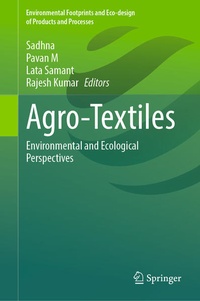
Agro-Textiles
Description

More details
Other editions
Additional editions
Persons
Dr. Lata Samant is an Assistant Professor in the Indus Design School at Indus University, India. Her teaching portfolio includes courses on fashion, surface embellishment, and sustainable textile. She holds a Ph.D. from G.B. Pant University of Agriculture and Technology, Uttarakhand, where her research focused on developing bio-composites using natural fibers like ramie and flax with rubber and polyester resin. She also earned her master's degree from CCS Haryana Agricultural University, Hisar, where her research was centered on enhancing dye uptake in cotton fabrics through enzyme treatment. Dr. Lata Samant has been recognized with prestigious fellowships, including the ICAR-SRF (2019) for Ph.D. and ICAR-JRF (2016) for Masters. She has several publications in the fields of textiles, natural fibers, natural dyes, functional finishers, and the utilization of agro-biomass in textiles, reflecting her significant contributions in the area of textiles.
Rajesh Kumar is a graduate specializing in Knitwear from NIFT, Mumbai, and holds a degree in Masters of Fashion Management from Manipal Academy of Higher Education, Manipal, Karnataka. He is a distinguished academician with expertise in apparel production, garment construction, and sustainable fashion practices. With extensive experience in product development and pattern-making for knitwear and woven fabrics, he has contributed significantly to both academia and industry. Rajesh's research interests include natural fiber composites, functional clothing, and sustainable design, with published works in SCI-Scopus journals and edited volumes by Springer Nature. Currently serving as Associate Professor and IQAC & NAAC Head at the School of Arts and Design, Rajesh has held key academic and managerial roles, including Program Director at Woxsen University. Recognized for his innovative pedagogy and curriculum development, he has led numerous workshops and conferences on sustainable textiles and design. His impactful contributions to research, teaching, and management have earned him multiple accolades, including Best Researcher and Best Performer awards.
Content
Chapter 1: Introduction To Agro-Textiles - Scope, Applications, And Sustainability Challenges.- Chapter 2: Environmental and Ecological Perspectives On Agro-Textile Development.- Chapter 3: Raw Materials For Sustainable Agro-Textiles: Natural Vs Synthetic Fibers.- Chapter 4: Impact of Agro-Textiles On Crop Growth and Productivity Under Protected Cultivation.- Chapter 5: Life Cycle Assessment of Agro-Textiles.- Chapter 6: Carbon Footprint and Energy Analysis of Agro-Textile Production.- Chapter 7: Water Footprints of Agro-Textiles: Challenges In Sustainable Resource Management.- Chapter 8: Ecological Impact Assessment of Agro-Textile Applications In Agriculture.- Chapter 9: Eco-Design Approaches For Agro-Textiles: Strategies and Tools.- Chapter 10: Innovative Technologies In Sustainable Agro-Textile Manufacturing.
