

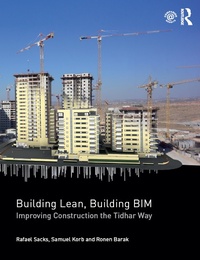
Building Lean, Building BIM
Improving Construction the Tidhar Way
Published on 6. December 2017
420 pages
978-1-315-30050-4 (ISBN)
Description

Building Lean, Building BIM is the essential guide for any construction company that wants to implement Lean Construction and Building Information Modelling (BIM) to gain a strategic edge over their competition.
The first of its kind, the book outlines the principles of Lean, the functionality of BIM, and the interactions between the two, illustrating them through the story of how Tidhar Construction has implemented Lean Construction and BIM in a concerted effort over four years. Tidhar is a small-to-medium-sized construction company that pioneered a way of working that gave it a profit margin unheard of in its market. The company's story serves as a case study for explanation of the various facets of Lean Construction and BIM. Each chapter defines a principle of Lean and/or BIM, describes the achievements and failures in Tidhar's implementation based on the experiences of the key people involved, and reviews the relevant background and theory.
The implementation at Tidhar has not been a pure success, but by examining their motives alongside their achievements and failures, readers will learn about what pitfalls and pinnacles to expect. A number of chapters also compare the experience of Tidhar with those of other companies who are leaders in their fields, such as Skanska and DPR.
This book is highly relevant and useful to a wide range of readers from the construction industry, especially those who are frustrated with the inefficiencies in their companies and construction projects. It is also essential reading for Lean and BIM enthusiasts, researchers and students from a variety of industries and backgrounds.
The first of its kind, the book outlines the principles of Lean, the functionality of BIM, and the interactions between the two, illustrating them through the story of how Tidhar Construction has implemented Lean Construction and BIM in a concerted effort over four years. Tidhar is a small-to-medium-sized construction company that pioneered a way of working that gave it a profit margin unheard of in its market. The company's story serves as a case study for explanation of the various facets of Lean Construction and BIM. Each chapter defines a principle of Lean and/or BIM, describes the achievements and failures in Tidhar's implementation based on the experiences of the key people involved, and reviews the relevant background and theory.
The implementation at Tidhar has not been a pure success, but by examining their motives alongside their achievements and failures, readers will learn about what pitfalls and pinnacles to expect. A number of chapters also compare the experience of Tidhar with those of other companies who are leaders in their fields, such as Skanska and DPR.
This book is highly relevant and useful to a wide range of readers from the construction industry, especially those who are frustrated with the inefficiencies in their companies and construction projects. It is also essential reading for Lean and BIM enthusiasts, researchers and students from a variety of industries and backgrounds.
More details
Language
English
Place of publication
London
United Kingdom
Publishing group
Taylor & Francis Ltd
Target group
Professional and scholarly
Illustrations
29 s/w Tabellen, 65 Farbfotos bzw. farbige Rasterbilder, 82 farbige Zeichnungen
29 Tables, black and white; 82 Line drawings, color; 65 Halftones, color
File size
150,48 MB
ISBN-13
978-1-315-30050-4 (9781315300504)
Copyright in bibliographic data and cover images is held by Nielsen Book Services Limited or by the publishers or by their respective licensors: all rights reserved.
Schweitzer Classification
Other editions
Additional editions
Rafael Sacks | Samuel Korb | Ronen Barak
Building Lean, Building BIM
Improving Construction the Tidhar Way
Book
12/2017
1st Edition
Routledge
€282.26
Shipment within 10-20 days
Rafael Sacks | Samuel Korb | Ronen Barak
Building Lean, Building BIM
Improving Construction the Tidhar Way
Book
12/2017
1st Edition
Routledge
€137.80
Shipment within 10-20 days
Persons
Rafael Sacks is Professor in the Faculty of Civil and Environmental Engineering, Technion - Israel Institute of Technology.
Samuel Korb is a graduate student in the department of Civil Engineering, Technion - Israel Institute of Technology.
Ronen Barak is a Civil Engineer and researcher of BIM and computer applications for construction. He is responsible for and directly involved with the entire Lean and BIM journey at Tidhar Construction.
Samuel Korb is a graduate student in the department of Civil Engineering, Technion - Israel Institute of Technology.
Ronen Barak is a Civil Engineer and researcher of BIM and computer applications for construction. He is responsible for and directly involved with the entire Lean and BIM journey at Tidhar Construction.
Content
1. Preface
2. Introduction: Growing the Margin
3. Early failures
4. Learning to See
5. Visualizing in 3D, Planning in 4D, Costing in 5D, Building in Reality
6. Non-Value Adding Work
7. Value-streams
8. Education, Motivating People, Gemba
9. BIM in the Big Room - Co-located Design
10. Problem Solving (Continuous Improvement)
11. Work in Progress (WIP)
12. Reduce Planning Resolution
13. What Flows in Construction?
14. Value for Customers
15. Designing the Product for Production System Design
16. Driving Production Off-site
17. Production Planning and Control in Construction
18. Respect for People
19. Leadership
20. Conclusion
2. Introduction: Growing the Margin
3. Early failures
4. Learning to See
5. Visualizing in 3D, Planning in 4D, Costing in 5D, Building in Reality
6. Non-Value Adding Work
7. Value-streams
8. Education, Motivating People, Gemba
9. BIM in the Big Room - Co-located Design
10. Problem Solving (Continuous Improvement)
11. Work in Progress (WIP)
12. Reduce Planning Resolution
13. What Flows in Construction?
14. Value for Customers
15. Designing the Product for Production System Design
16. Driving Production Off-site
17. Production Planning and Control in Construction
18. Respect for People
19. Leadership
20. Conclusion
